Giant Trevally
Caranx ignobilis
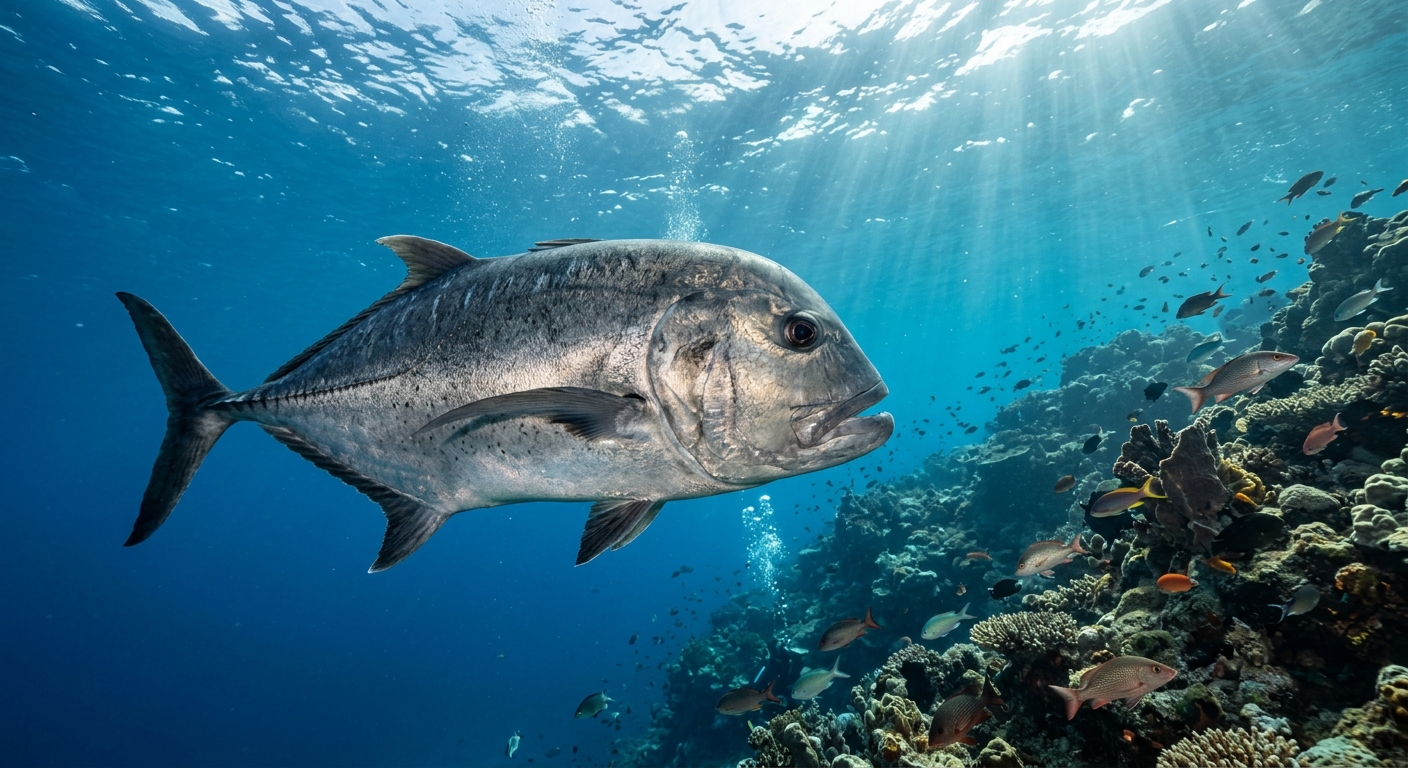
About Giant Trevally
The Giant Trevally, commonly known as the GT, is the largest member of the jack family and one of the most impressive apex predators on tropical reefs. With a massive, deep body, steep forehead, and powerful tail, GTs are built for explosive speed and raw power. They patrol reef edges, channels, and atolls, often hunting cooperatively. Famous for their aggressive feeding behavior, GTs have been documented hunting birds mid-flight. For divers, encountering a school of large GTs cruising a reef wall is one of the most exhilarating underwater experiences.
Quick Facts
- Habitat: The Giant Trevally, *Caranx ignobilis*, is a **powerful pelagic predator** found predominantly in the **Indo-Pacific region**. Its vast range extends from the coasts of **East Africa** and the Red Sea, across the Indian Ocean to the Central Pacific, encompassing diverse habitats. You'll encounter them in a variety of marine environments, from shallow coastal waters to offshore reefs and even open ocean. Juveniles commonly inhabit estuaries, lagoons, and shallow protected bays, offering them refuge from larger predators and ample food sources. As they mature, they move into deeper waters, often congregating around **drop-offs, pinnacles, and exposed reef walls** where currents are strong. They are frequently observed in the waters surrounding **remote atolls** like those in the Maldives, Fiji, and French Polynesia, and are a common sight in the coral-rich waters of Australia’s Great Barrier Reef and Indonesia’s Raja Ampat. While primarily marine, they can tolerate fluctuating salinities and are occasionally found in brackish waters or even the lower reaches of rivers. Their presence is generally tied to areas with abundant prey and strong currents, making them a fixture of **nutrient-rich reef ecosystems**. Divers often spot them patrolling the edges of reefs, ambushing prey from concealment or actively hunting in open water.
- Diet: Giant Trevally are **opportunistic and voracious apex predators**, primarily feeding on a diverse range of smaller fish, cephalopods, and crustaceans. Their diet is highly adaptable and depends significantly on the local availability of prey. Common prey items include fusiliers, snappers, mullets, juvenile groupers, and small reef fish such as damselfish. They are also known to consume squid, cuttlefish, and shrimp. Giant Trevally employ a variety of **sophisticated hunting strategies**. They are often seen hunting individually, relying on their incredible speed and power to **ambush unsuspecting prey**. However, they are also known to hunt in **coordinated packs**, especially when targeting larger schools of baitfish. These group hunts can be spectacular to witness, with trevally corralling and attacking the baitfish in a frenzied feedingবর্তন। One remarkable hunting technique they utilize, particularly in shallow waters, is using the **surface ripple effect** to conceal their approach before launching a surprise attack on fish near the surface or even unsuspecting birds, a behavior famously documented in places like the Seychelles. Their powerful, streamlined bodies and large, crescent-shaped caudal fins enable them to accelerate rapidly, making them incredibly effective hunters in both open water and around complex reef structures.
- Best season: Encounters with Giant Trevally are possible year-round in many parts of their extensive range, but specific seasons offer **peak activity and larger aggregations**. In the **Maldives**, the best visibility and conditions for witnessing large schools of trevally are typically from **December to May**, when the northeast monsoon brings clearer waters and rich plankton blooms attract their prey. For divers in **Indonesia’s Raja Ampat**, the prime season runs from **October to April**, coinciding with calmer seas and optimal visibility, increasing chances of seeing large hunting parties. In **Fiji**, while present year-round, the **drier season from May to October** generally offers the best diving conditions, with clearer waters making it easier to spot these fast-moving fish. Along **Australia's Great Barrier Reef**, opportunities are good throughout the warmer months, roughly **November to April**, when water temperatures are higher and reef activity is at its peak. Generally, periods of **stronger currents** and **higher prey abundance**, often following specific lunar cycles or monsoonal shifts, lead to more frequent and impressive sightings of Giant Trevally in their hunting grounds. Divers looking specifically for large, actively hunting individuals should research local aggregation patterns at their chosen destination.
Fun Facts
Giant Trevally have been filmed leaping from water to catch terns in flight — documented in BBC Blue Planet II,They hunt cooperatively with sharks, picking off fleeing fish,Large mature males develop a dark, almost black coloration — nicknamed Black GT,They can accelerate from stationary to full speed in a fraction of a second,In Hawaiian culture, catching an ulua (GT) is considered a rite of passage
Diving Tips
When diving with Giant Trevally, observe them from a **respectful distance** to witness their natural behaviors without disturbing them. They are generally not aggressive towards divers, but their **large size and powerful movements** can be startling. Avoid blocking their escape routes or cornering them. To spot them, pay close attention to **reef edges, channel entrances, and areas with strong currents**; these are their preferred hunting grounds. Look for schools of baitfish exhibiting evasive maneuvers, as trevally are often nearby. Listen for subtle changes in the reef soundscape, as their presence can sometimes be indicated by the sudden scattering of smaller fish. Observe their **distinctive torpedo-shaped body** and the **silvery sheen** that allows them to blend into the sparkling water. When observing feeding frenzies, **maintain buoyancy control** and exercise extreme caution; their intense hunting can create a chaotic environment. Never attempt to feed or touch Giant Trevally; artificial feeding disrupts their natural predatory instincts and can make them associate divers with food, potentially leading to **dangerous encounters**. Photography is generally welcomed but avoid flash photography directly at their eyes. Always dive with a **responsible operator** who adheres to local conservation guidelines. Remember that these are **apex predators** vital to marine ecosystem health, and ethical interaction ensures their continued presence for future generations of divers.