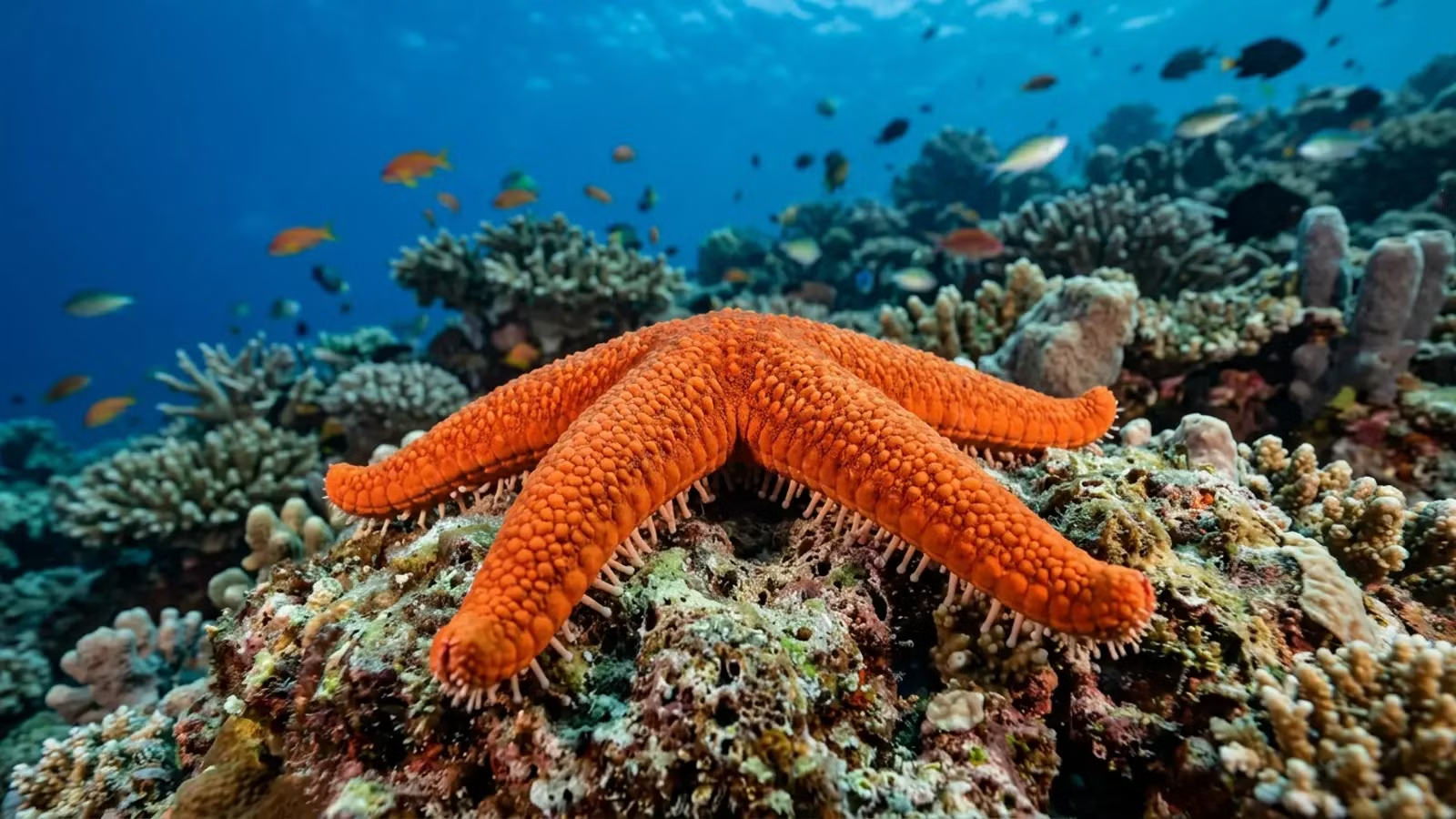
Sea stars, belonging to the class Asteroidea within the phylum Echinodermata, are non-vertebrate marine organisms found throughout the world's oceans. Often referred to historically as starfish, marine scientists prefer the term sea star because these animals are echinoderms closely related to sea urchins and sand dollars rather than fish. The class encompasses approximately 1,900 to 2,000 living species, exhibiting body forms ranging from five-armed varieties to species with ten, twenty, or even over fifty arms, such as the Antarctic Labidiaster annulatus.
Morphologically, sea stars typically feature a central disc from which arms radiate in pentaradial symmetry. Their bodies are covered by an endoskeleton comprised of calcified structures known as ossicles, situated beneath an epidermal layer. The aboral (upper) surface displays texture ranging from smooth to spiny, with colouration including vibrant shades of red, orange, blue, grey, and brown. Specialized dermal structures include pedicellariae—pincer-like ossicles that remove settling organisms or capture prey—and papulae, which serve a respiratory function.
Behaviour & reproduction
- Size
- Unknown
- Weight
- Up to 5 kg
- Lifespan
- Up to 35 years
- Status
- Not Evaluated
Sea stars perform essential ecological roles in benthic marine communities. Certain species, including the ochre sea star (Pisaster ochraceus), act as keystone predators. By consuming competitive bivalves like California mussels, they prevent single-species monopolies and maintain local biodiversity in intertidal and subtidal zones. Other species exhibit predatory behaviours that shape benthic environments, such as the tropical crown-of-thorns starfish (Acanthaster planci), which preys on live stony corals across the Indo-Pacific region.


