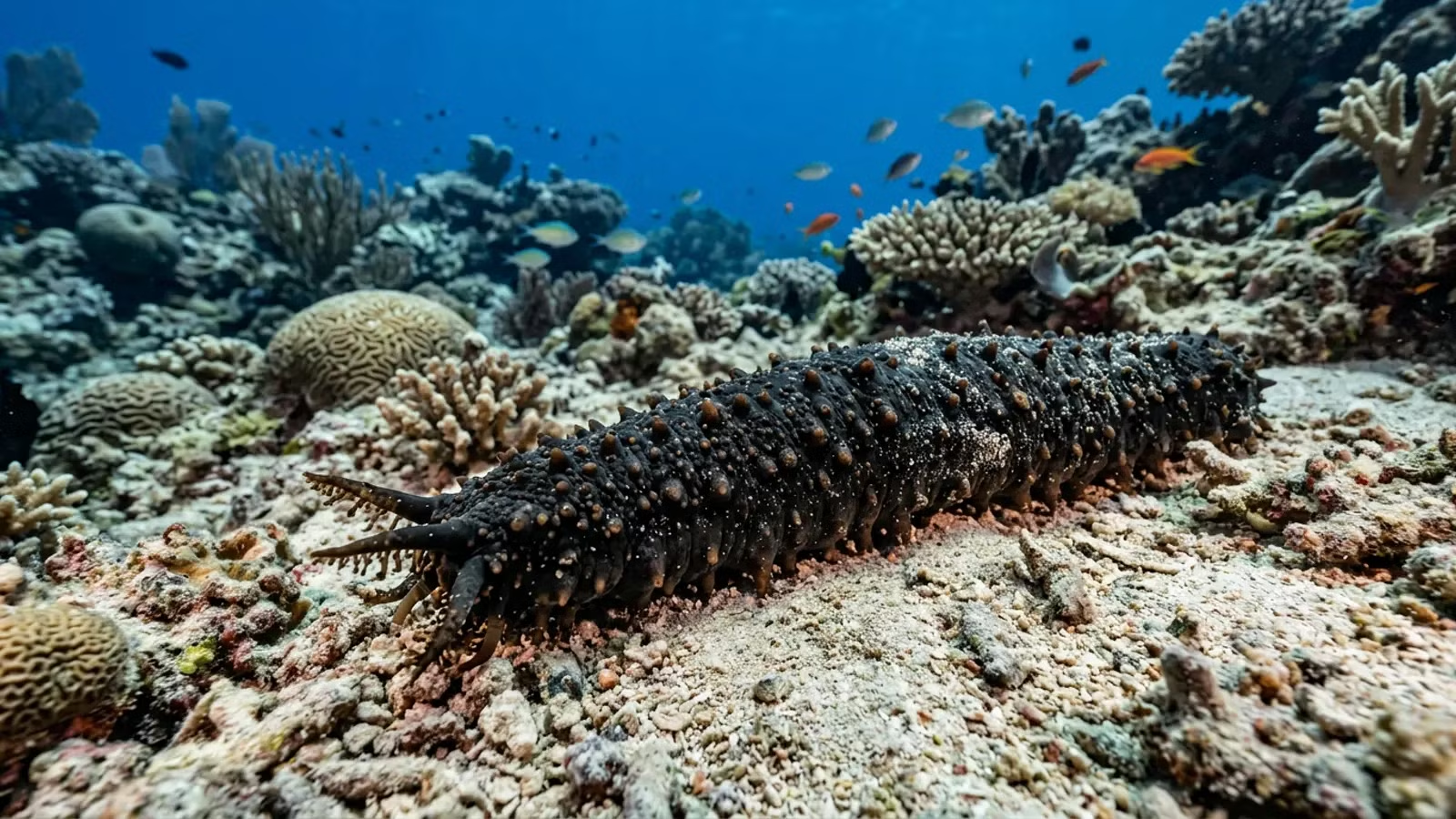
Sea Cucumber in its natural habitat, diving encounters and best destinations

Sea CucumberWhere and when to see them

5 to 10 years

Want to dive with this animal?

Only destinations where this animal occurs.

The Sea Cucumber at a glance

Sea cucumbers are benthic marine invertebrates belonging to the class Holothuroidea within the phylum Echinodermata, making them distant relatives of starfish, sea urchins, sand dollars, and feather stars. Found throughout all the world's oceans, these slow-moving creatures derive their common name from their structural resemblance to the cucumber fruit. Though lacking arms, they retain an underlying fivefold radial symmetry overlaid by a secondary bilateral appearance. Their elongated, tubular bodies feature a mouth surrounded by specialized feeding tentacles at one end and an anus at the other.

Behaviour & reproduction

Size
Unknown
Weight
Less than 1 g to over 5 kg
Lifespan
5 to 10 years
Status
Not Evaluated

Across tropical and temperate reefs, sea cucumbers exhibit distinct physiological adaptations. Aspidochirotida species feature shield-like oral tentacles used for shovelling sediment, whereas suspension-feeding Dendrochirotida possess highly branched, feathery tentacles that sweep the water column for plankton. While over 1,786 species exist globally, with the greatest concentration found in the Asia-Pacific region, many wild populations face intense fishing pressure to satisfy commercial demand for dried seafood known as bêche-de-mer.

Top Locations

Diving Tips

Scuba divers encountering sea cucumbers should observe them with strict hands-off etiquette. Although these slow-crawling invertebrates appear passive, physical handling causes severe stress and can trigger extreme defensive reactions. When threatened, several species discharge Cuvierian tubules—sticky, white, glue-like threads ejected from the anus that entangle potential predators. Under extreme distress, some holothuroids undergo evisceration, violently contracting their body muscles to expel their internal organs out through their anus. While they can regenerate these lost organs over several weeks, forcing this reaction expends vital energy.

Divers should maintain neutral buoyancy above the seafloor to avoid kicking up sediment or disturbing buried specimens. Look closely at the head end to observe their modified tube feet or feathery oral tentacles actively feeding—some species insert individual tentacles into their mouth one by one to lick off collected plankton. Photographers should use ambient light or gentle strobe settings, taking care not to disturb night-feeding species like sea apples (*Pseudocolochirus*), which may retract their delicate tentacles into their body if startled.

Fun facts about the Sea Cucumber

  • Sea cucumbers can loosen their catch-collagen body wall to virtually liquefy their body into tight gaps, then firm it up to lock themselves in place.
  • When threatened, some species expel sticky, white glue-like threads called Cuvierian tubules or eject their internal organs through their anus.
  • The snake sea cucumber (Synapta maculata) can reach lengths of up to 3 metres, making it the longest known species of sea cucumber.
  • By ingesting sediment and excreting clean sand, sea cucumbers perform a role similar to earthworms on land while helping to reduce local ocean acidification.

Best time to see the Sea Cucumber

Sea cucumbers are non-migratory, year-round residents of benthic marine habitats across all climate zones, meaning diving encounters are consistent throughout the entire year. Because their geographic range spans from tropical coral reefs to temperate intertidal zones and deep polar waters, local diving conditions and water visibility dictate the best times for encounters rather than seasonal sea cucumber migrations.

In tropical Indo-Pacific destinations where holothuroid diversity is highest, diving conditions are generally best during local dry seasons when underwater visibility is optimal. Divers interested in observing group behaviors like broadcast spawning should seek out dense populations, as successful sexual reproduction requires high numbers of individuals simultaneously releasing eggs and sperm into the water column. In temperate zones, shallow-water species such as *Cucumaria miniata* remain visible year-round, wedged tightly into current-swept crevices. Night diving across all regions offers excellent opportunities to spot nocturnal feeders that extend their feeding tentacles exclusively after dark.

Where the Sea Cucumber lives

Sea cucumbers inhabit marine environments in every ocean on Earth, spanning a vast bathymetric range from shallow, nearshore intertidal zones down to deep abyssal trenches nearly 5,000 metres below the surface. Benthic by nature, they live on or within the sea floor, frequently found partially buried in sand or mud, resting on coral reef rubble, or wedged inside rocky cracks and crevices.

The highest species diversity occurs in the tropical Asia-Pacific region, where different species occupy distinct microhabitats. For instance, tiny *Synaptula lamperti* live directly on outer sponge surfaces in places like Indonesia, whereas larger sausage-shaped stichopodids crawl over open sand flats in shallow lagoons. Deep-sea ocean beds host specialized soft-bodied forms such as sea pigs (*Scotoplanes globosa*), which can account for over 95 percent of the total benthic animal mass at extreme depths. Whether tucked beneath sheltered reef overhangs or attached to current-swept boulders, sea cucumbers adapt to almost any seabed where organic detritus accumulates.

What the Sea Cucumber eats

Sea cucumbers are detritivores and omnivores that feed on organic waste, algae, plankton, decaying animal matter, and fine organic particles. Surrounding their mouth is a ring of 8 to 30 modified tube feet that act as specialized oral tentacles used to gather food from the surrounding water or sediment. Their feeding techniques generally fall into two primary modes: deposit feeding and suspension feeding.

Deposit-feeding species traverse the seafloor using shield-like oral tentacles to shovel large quantities of sand and organic debris into their mouth. As the sediment passes through their long, coiled digestive tract, they extract organic nutrients and excrete clean, log-shaped sand castings. In contrast, suspension feeders such as *Cucumaria miniata* and *Pseudocolochirus* anchor themselves in areas with steady currents, extending feathery, tree-like tentacles into the water to catch floating plankton. Each food-laden tentacle is then brought to the mouth individually to strip off trapped morsels. Feeding activity varies by species, with some feeding continuously and others extending their apparatus primarily at night.

Sea Cucumber: frequently asked questions

When is the best time to see Sea Cucumber?
Sea cucumbers are non-migratory, year-round residents of benthic marine habitats across all climate zones, meaning diving encounters are consistent throughout the entire year. Because their geographic range spans from tropical coral reefs to temperate intertidal zones and deep polar waters, local diving conditions and water visibility dictate the best times for encounters rather than seasonal sea cucumber migrations. In tropical Indo-Pacific destinations where holothuroid diversity is highest, diving conditions are generally best during local dry seasons when underwater visibility is optimal. Divers interested in observing group behaviors like broadcast spawning should seek out dense populations, as successful sexual reproduction requires high numbers of individuals simultaneously releasing eggs and sperm into the water column. In temperate zones, shallow-water species such as *Cucumaria miniata* remain visible year-round, wedged tightly into current-swept crevices. Night diving across all regions offers excellent opportunities to spot nocturnal feeders that extend their feeding tentacles exclusively after dark.
How big does Sea Cucumber get?
Sea Cucumber: Unknown
Is Sea Cucumber dangerous for divers?
Scuba divers encountering sea cucumbers should observe them with strict hands-off etiquette. Although these slow-crawling invertebrates appear passive, physical handling causes severe stress and can trigger extreme defensive reactions. When threatened, several species discharge Cuvierian tubules—sticky, white, glue-like threads ejected from the anus that entangle potential predators. Under extreme distress, some holothuroids undergo evisceration, violently contracting their body muscles to expel their internal organs out through their anus. While they can regenerate these lost organs over several weeks, forcing this reaction expends vital energy. Divers should maintain neutral buoyancy above the seafloor to avoid kicking up sediment or disturbing buried specimens. Look closely at the head end to observe their modified tube feet or feathery oral tentacles actively feeding—some species insert individual tentacles into their mouth one by one to lick off collected plankton. Photographers should use ambient light or gentle strobe settings, taking care not to disturb night-feeding species like sea apples (*Pseudocolochirus*), which may retract their delicate tentacles into their body if startled.
What is the conservation status of Sea Cucumber?
Sea Cucumber: Not Evaluated
Plan your trip

Ready to dive with these animals?

Choose a destination or search every available vessel to find the liveaboard that matches the marine life you want to see.