Orca
Orcinus orca
About Orca
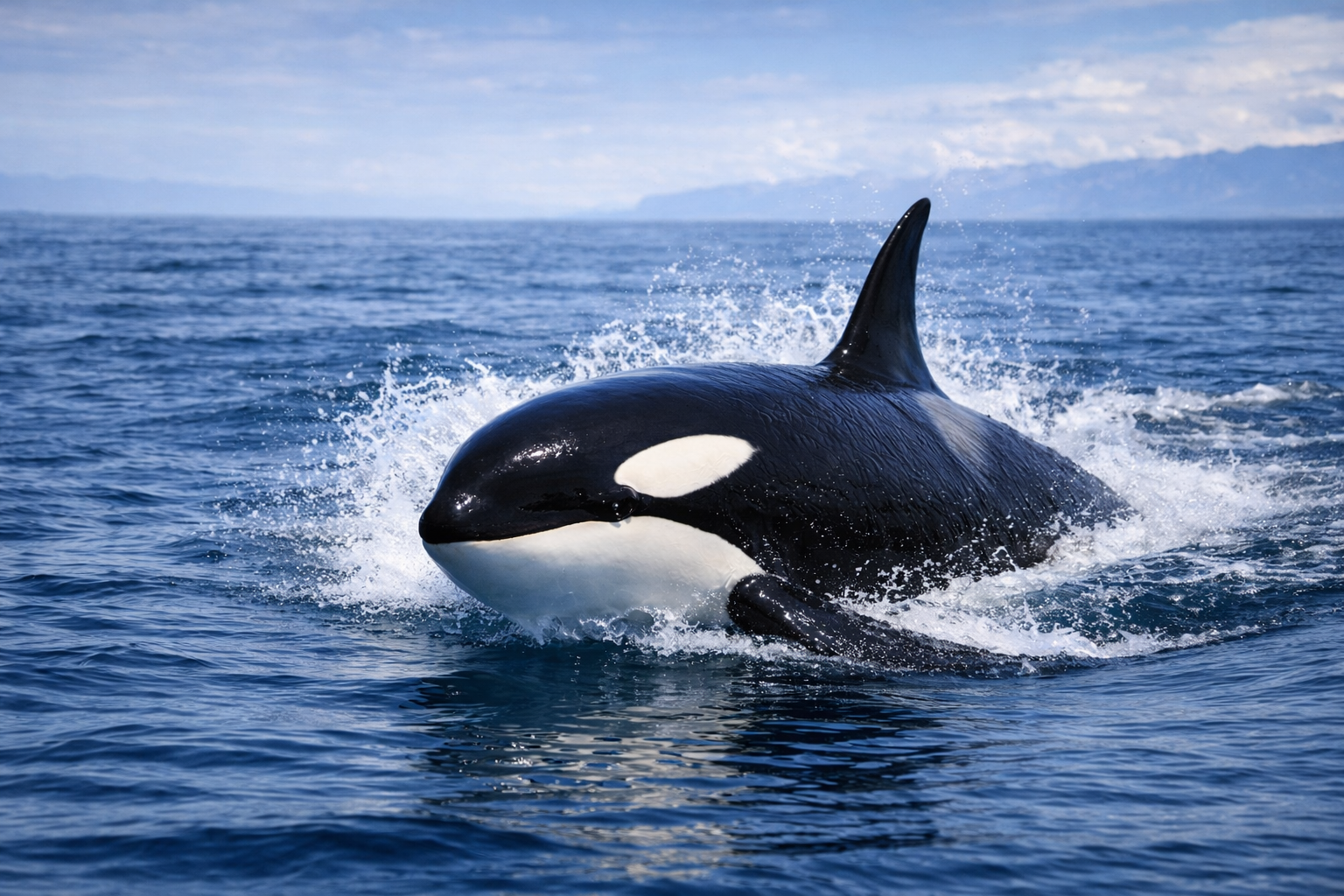
Orcas (Orcinus orca), also called killer whales, are the largest members of the dolphin family and the ocean's true apex predator. Highly intelligent, deeply social and acoustically sophisticated, they live in tight matriarchal pods that pass hunting techniques, dialects and cultural traditions from one generation to the next. Scientists no longer treat orcas as a single, uniform species. Distinct populations — called ecotypes — specialise in completely different prey and habitats: fish-eating "Residents" in the North Pacific, mammal-hunting "Transients" (Bigg's) along the same coast, deep-water "Offshores" that target sharks, plus multiple Antarctic and North Atlantic ecotypes. Different ecotypes rarely interbreed and speak different acoustic "languages", even when they share the same waters. Encountering orcas underwater is one of the rarest and most tightly regulated wildlife experiences on Earth. In most countries they are protected by strict distance rules; a small number of destinations — notably Norway during the winter herring run and Baja California in the Sea of Cortez — offer regulated, permit-based snorkelling under professional guidance.
Quick Facts
- Habitat: Orcas are the most widely distributed marine mammal on Earth, found in every ocean from the tropics to the polar ice edges. They are most reliably encountered in cold, productive waters where large concentrations of prey gather. In Norway, the fjords around Skjervøy and Tromsø host winter aggregations from late October to mid-January that follow the migrating herring shoals. Iceland's Snæfellsnes Peninsula sees resident pods hunting herring between February and April, while northern Vancouver Island (Johnstone Strait, Blackfish Sound) is home to fish-eating "Resident" pods from July to September. In the eastern North Pacific, mammal-hunting "Bigg's" (Transient) orcas patrol the Salish Sea year-round, and the Aleutians and Kamchatka support offshore populations. Southern Hemisphere hotspots include Peninsula Valdés in Argentina (February–April) where orcas beach themselves to catch sea lion pups, the Antarctic Peninsula and Ross Sea (December–March) where Types A, B and C hunt seals and minke whales, New Zealand's coasts where orcas specialise in stingrays, and the Sea of Cortez off Baja California (October–May) where they herd mobula rays. Tropical sightings do occur — particularly around the Galápagos, Sri Lanka and the Strait of Gibraltar — but they are far less predictable than the high-latitude hotspots.
- Diet: Diet is entirely dependent on the orca's ecotype, and different populations never interbreed or share prey. Resident orcas of the North Pacific are strict fish-eaters, with Southern and Northern Residents specialising almost exclusively on Chinook salmon. Bigg's (Transient) orcas of the same region hunt marine mammals: harbour seals, sea lions, porpoises, and occasionally minke and grey whale calves. Offshore orcas of the outer North Pacific specialise in sharks, including sleeper sharks, and their teeth are worn flat from shark skin. Type A Antarctic orcas hunt minke whales in open water, Type B1 "Pack Ice" orcas cooperatively create waves to wash Weddell seals off ice floes, and Type C "Ross Sea" orcas feed on Antarctic toothfish. New Zealand orcas dig stingrays out of the sand, Norwegian and Icelandic orcas use "carousel feeding" to corral herring into tight balls and stun them with tail slaps, and Peninsula Valdés orcas famously strand themselves onto beaches to snatch sea lion pups. In the Strait of Gibraltar a small population targets bluefin tuna, and Sea of Cortez orcas herd and feed on massive schools of mobula rays. Wherever they live, orcas rely on cooperative hunting, culturally transmitted techniques and prey-specific dialects passed down through generations.
- Best season: There is no single global orca season — the best time to see them depends entirely on where you are. In **Norway** (Skjervøy and Andenes), the peak runs from **mid-November to late January**, when herring gather and licensed operators offer in-water snorkelling. **Iceland** offers winter sightings around Snæfellsnes from November to February and summer opportunities near the Westman Islands. In **Mexico's Sea of Cortez**, the window is **October to May**, with the highest chances from December through April. **Western Australia's Bremer Bay** hosts the famous Bremer Canyon aggregation from **mid-January to mid-April**. **Argentina's Península Valdés** is best in **February to April** for the unique beach-stranding hunt. **Antarctica** delivers encounters during the **Austral summer from November to March**. In the **Pacific Northwest** — including the San Juan Islands, Johnstone Strait and Vancouver Island — visit between **May and September** for Resident and Bigg's orcas. **New Zealand** offers year-round sightings, especially around Auckland, the Bay of Islands and Kaikoura. Because orcas are wild, free-ranging apex predators, **no destination can guarantee an encounter**. Plan a **5–7 day window** in the peak weeks and be prepared for weather cancellations.
Fun Facts
Orcas have the second-largest brain of any animal on Earth — around 6.8 kg — with a highly developed neocortex linked to emotion, language and self-awareness.,Different ecotypes speak entirely different dialects and never interbreed, even when their ranges overlap.,Female orcas are one of only five species (including humans) known to undergo menopause; post-reproductive matriarchs lead the pod for decades.,Norwegian and Icelandic orcas invented "carousel feeding" — a coordinated technique where the pod herds herring into a tight ball and stuns them with tail slaps.,Antarctic Type B orcas hunt seals resting on ice floes by swimming in formation and creating a wave that washes the seal into the water.,Orcas can dive to more than 1,000 m and hold their breath for over 15 minutes, though most hunting happens in the top 60 m.,They can sustain 45 km/h (28 mph) and burst to 56 km/h — faster than any other marine mammal.,A resident orca family stays together for life; sons never leave their mother's pod.,There are no verified fatal attacks by wild orcas on humans in recorded history.,In the Sea of Cortez, one Baja pod ("Moctezuma" and family) specialises in flipping mobula rays and hunting dolphin superpods — a behaviour found nowhere else in the world.
Diving Tips
Orca encounters are **heavily regulated** in nearly every country, so always understand the local law before you book and dive only with **permit-holding operators**. All legal in-water encounters are **surface snorkelling only** — **never scuba dive with orcas**, because bubbles disturb them. Enter the water **quietly from the side of the boat**, avoid jumping or splashing, and stay **horizontal at the surface** with calm breathing and still fins. **Do not swim toward the orcas**; let them choose whether to approach. Keep groups small — **no more than 4–6 swimmers** — and stay close together without spreading across the pod's path. **Never separate a calf from an adult**, never place yourself between pod members, and never touch, feed or block their travel line. If a pod is actively hunting — carousel feeding, a mammal chase or wave-washing — **stay out of the water** and observe from the boat. Approach distances vary by country: the **United States** requires **91 metres** nationwide under the Marine Mammal Protection Act and **300–400 yards** for endangered Southern Resident orcas in Washington waters; **Canada** mandates **200 metres** for all cetaceans and **400 metres** for Southern Residents; **Norway** sets a **20-metre** boat distance and caps group sizes for licensed in-water encounters; **Iceland's IceWhale code** requires **50 metres** and limits vessels to three per pod; **New Zealand** prohibits swimming with orcas entirely with a **50-metre** minimum approach; **Australia** recommends **100 metres** for boats and **300 metres** for jet-skis and also prohibits swimming; the **EU and Antarctica (IAATO)** require **100 metres**, increasing to **200 metres** when calves are present; and **Mexico (SEMARNAT)** requires a permit, limits boats to one per pod within **240 metres**, and allows snorkelling only through authorised operators.