Hawksbill Turtle in its natural habitat — diving encounters and best destinations

Eretmochelys imbricata

Hawksbill Turtle: Where and when to dive with them

Up to 1.0 metres
30-50 years
Critically Endangered

Want to dive with this animal?

Only destinations where this animal occurs.

The Hawksbill Turtle at a glance

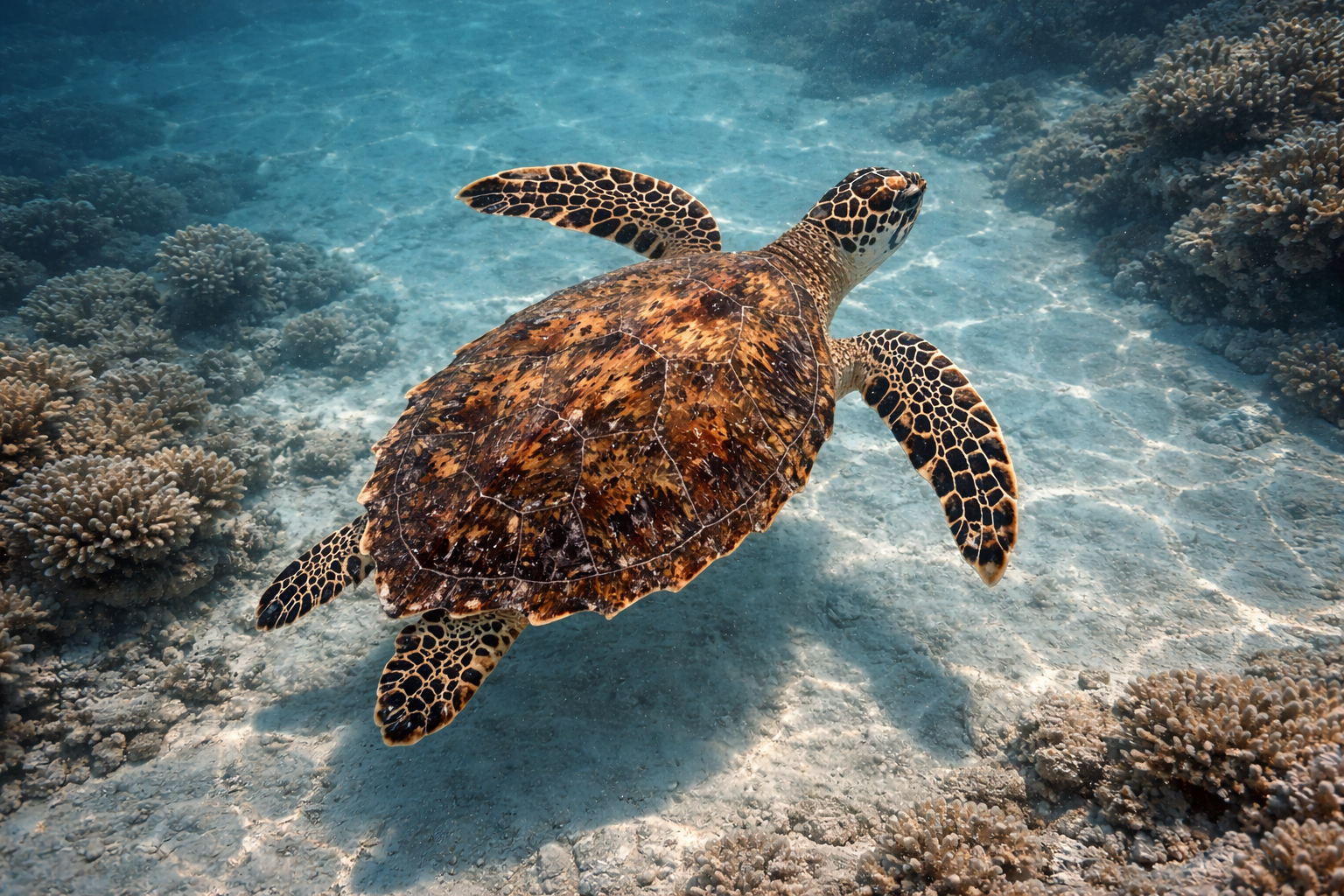
The ocean’s intricate tapestry of life holds many wonders, and among the most enchanting for any diver is the graceful presence of a turtle. Specifically, the Hawksbill turtle, Eretmochelys imbricata, offers a uniquely captivating encounter. These medium-sized sea turtles, rarely exceeding a metre in carapace length, are true jewels of the reef, distinguished by their stunning carapaces and distinctive, elongated heads. Their shells are a mosaic of overlapping scutes, often exhibiting a beautiful amber, brown, and black streaked pattern that camouflages them amongst the corals. The aptly named "hawk-like" beak is perhaps their most defining feature – a slender, pointed snout perfectly adapted for their specialised diet. Unlike other sea turtles with broader, blunter jaws, this delicate rostrum allows them to reach into small crevices and cracks, extracting their preferred food source. Juveniles typically display more pronounced, sharper scutes along the edges of their shells, which tend to smooth with age.

Behaviour & reproduction

Size
Up to 1.0 metres (shell length)
Weight
45-75 kg
Lifespan
30-50 years
Status
Critically Endangered

Socially, these turtles are generally solitary creatures, though divers may occasionally observe multiple individuals foraging in areas with abundant food. Their behaviours are driven largely by foraging, nesting, and migration. When observed underwater, they often exhibit a calm, unhurried demeanour, gliding effortlessly through the water column or resting peacefully on ledges. They are known to be site-faithful, meaning they often return to the same foraging grounds repeatedly, sometimes even to the same cleaning stations, where small fish help remove parasites from their shells. Reproduction involves females returning to their natal beaches to lay clutches of eggs, a process that typically occurs at night. After approximately two months, the hatchlings emerge, instinctively making their perilous journey to the sea. The precise timing and location of these events are crucial for their survival, underscoring the importance of protecting nesting habitats.

Diving Tips

When encountering Hawksbill turtles, divers should always maintain a respectful distance, ideally several meters, to avoid causing any stress or altering their natural behavior. Never chase, touch, or attempt to feed a turtle; interaction is strictly prohibited and can be harmful to the animal. Adopt a calm and slow approach, minimizing sudden movements or loud noises that could startle them. Look for turtles foraging on coral bommies or rocky outcrops, as their distinctive beak helps them pull sponges from crevices. Their camouflage can make them difficult to spot, so pay close attention to irregularly shaped shadows or movements near the reef. Observe their feeding behavior; they often spend extended periods in one area, allowing for good observational opportunities. Be mindful of your buoyancy control to avoid accidentally touching the reef or stirring up sediment, which can obscure views and damage the delicate ecosystem. Remember that Hawksbill turtles are critically endangered, and their protection is paramount, so report any signs of injury or entanglement to local authorities. Photography is permissible but should be done without flash or intrusive movements. Adhere to all local regulations regarding marine life encounters.

Fun facts about the Hawksbill Turtle

  • Hawksbills are one of the few animals that can eat toxic sponges without ill effect
  • Their overlapping shell scutes are unique among sea turtles
  • They help maintain reef health by eating sponges
  • A single hawksbill can consume over 500 kg of sponge per year

Best time to see the Hawksbill Turtle

Encounters with Hawksbill turtles are possible year-round in many tropical locations, but certain seasons offer more consistent sightings, often correlating with foraging and nesting patterns. In the Caribbean, such as in the Cayman Islands or Bonaire, the drier months from December to May often provide excellent visibility alongside frequent turtle sightings as they actively forage. For places like the Philippines (e.g., Apo Island, Malapascua) or Indonesia (e.g., Komodo, Raja Ampat), the dry season from April to October is generally considered prime time for diving and turtle encounters due to calm seas and clear waters. During nesting season, typically from late spring to early fall in many regions (e.g., June to November in the Caribbean), females may be seen more frequently in shallow coastal waters near nesting beaches, though direct interaction with nesting turtles is discouraged and often regulated. Seasonal plankton blooms can sometimes reduce visibility but do not typically deter these turtles, which are mainly benthic feeders.

Hawksbill Turtle — Season matrix by country

Turtles are resident animals — the question is not whether they are there, but when the water is calm and clear enough to spend a whole dive with one.

Peak seasonSightings possibleUnlikely
Nov–Apr
Reef walls and thilas across all atolls

Hawksbills work the sponge-covered walls year-round; the clear northeast monsoon is the best window for close-up wide-angle work.

Best months

JFMAMJJASOND
LiveaboardsMaldives
Sep–Nov · Apr–Jun
Fury ShoalsSt. John'sRas Mohammed

Hawksbills feed on soft corals along the southern Red Sea reefs; spring and autumn avoid both the summer heat and winter wind.

Best months

JFMAMJJASOND
LiveaboardsEgypt
Oct–Apr
Raja AmpatWakatobiKomodo

The Raja Ampat liveaboard season from October to April is the most reliable time to shoot hawksbills over soft-coral gardens.

Best months

JFMAMJJASOND
LiveaboardsIndonesia
Oct–Nov · Apr–May
Inner and outer island reefs

The Seychelles hold globally important hawksbill nesting; the inter-monsoon months in April and October give the calmest, clearest water.

Best months

JFMAMJJASOND
LiveaboardsSeychelles

Where the Hawksbill Turtle lives

Hawksbill turtles (Eretmochelys imbricata) are globally distributed but predominantly found in tropical and subtropical waters of the Atlantic, Pacific, and Indian Oceans. They favor shallow coastal habitats, particularly coral reefs, rocky areas, and estuaries, due to their specialized diet and foraging behavior. Juveniles often inhabit mangrove estuaries and shallow lagoons, seeking protection and abundant food sources. As they mature, they move to deeper reef environments. Notable dive locations for encounters include the Great Barrier Reef in Australia, the Mesoamerican Barrier Reef in the Caribbean (e.g., Belize, Mexico's Yucatán Peninsula), and various sites across Southeast Asia, such as Indonesia's Raja Ampat and the Philippines. These turtles are rarely seen in open ocean pelagic zones, preferring the structural complexity of reef systems which provide both food and shelter. They are site-faithful, often returning to the same foraging and nesting areas.

What the Hawksbill Turtle eats

Hawksbill turtles are uniquely adapted omnivores, with a highly specialized diet centered around sponges. Their narrow, pointed beak, resembling a bird's, is perfectly suited for extracting sponges from crevices on coral reefs and rocky substrates. While sponges form the bulk of their diet, they are not exclusively spongeo-vores; they also consume other benthic invertebrates, including sea anemones, jellyfish, and mollusks, and occasionally algae. This selective feeding on sponges, many of which are toxic to other animals, makes them crucial for coral reef health, as they help prevent sponges from outcompeting corals. Their diet varies regionally based on the availability of preferred sponge species. They typically forage during the day, systematically exploring reef structures for their next meal, often displaying repeated feeding patterns in specific reef sections.

Hawksbill Turtle: frequently asked questions

When is the best time to see Hawksbill Turtle?
Encounters with Hawksbill turtles are possible year-round in many tropical locations, but certain seasons offer more consistent sightings, often correlating with foraging and nesting patterns. In the Caribbean, such as in the Cayman Islands or Bonaire, the drier months from December to May often provide excellent visibility alongside frequent turtle sightings as they actively forage. For places like the Philippines (e.g., Apo Island, Malapascua) or Indonesia (e.g., Komodo, Raja Ampat), the dry season from April to October is generally considered prime time for diving and turtle encounters due to calm seas and clear waters. During nesting season, typically from late spring to early fall in many regions (e.g., June to November in the Caribbean), females may be seen more frequently in shallow coastal waters near nesting beaches, though direct interaction with nesting turtles is discouraged and often regulated. Seasonal plankton blooms can sometimes reduce visibility but do not typically deter these turtles, which are mainly benthic feeders.
How big does Hawksbill Turtle get?
Hawksbill Turtle: Up to 1.0 metres (shell length)
Is Hawksbill Turtle dangerous for divers?
When encountering Hawksbill turtles, divers should always maintain a respectful distance, ideally several meters, to avoid causing any stress or altering their natural behavior. Never chase, touch, or attempt to feed a turtle; interaction is strictly prohibited and can be harmful to the animal. Adopt a calm and slow approach, minimizing sudden movements or loud noises that could startle them. Look for turtles foraging on coral bommies or rocky outcrops, as their distinctive beak helps them pull sponges from crevices. Their camouflage can make them difficult to spot, so pay close attention to irregularly shaped shadows or movements near the reef. Observe their feeding behavior; they often spend extended periods in one area, allowing for good observational opportunities. Be mindful of your buoyancy control to avoid accidentally touching the reef or stirring up sediment, which can obscure views and damage the delicate ecosystem. Remember that Hawksbill turtles are critically endangered, and their protection is paramount, so report any signs of injury or entanglement to local authorities. Photography is permissible but should be done without flash or intrusive movements. Adhere to all local regulations regarding marine life encounters.
What is the conservation status of Hawksbill Turtle?
Hawksbill Turtle: Critically Endangered

Hawksbill, green, loggerhead or leatherback?

The pointed beak and the overlapping scutes are the giveaway. Here is the full side-by-side with the other three sea turtles you meet on a reef.

Green turtle

Chelonia mydas

Shell length
80–120 cm
How to identify it
Rounded head, blunt beak, smooth shell edge
Where you meet it
Seagrass meadows and shallow reef tops
Diet
Seagrass and algae (adults are vegetarian)
IUCN status
Endangered

Hawksbill turtle

Eretmochelys imbricata

Shell length
60–90 cm
How to identify it
Narrow pointed beak, serrated overlapping scutes
Where you meet it
Coral reefs and sponge-covered walls
Diet
Sponges and soft corals
IUCN status
Critically Endangered

Loggerhead turtle

Caretta caretta

Shell length
80–110 cm
How to identify it
Massive blocky head, reddish-brown shell
Where you meet it
Rubble slopes and rocky reefs with shellfish
Diet
Crabs, conch and hard-shelled prey
IUCN status
Vulnerable

Leatherback turtle

Dermochelys coriacea

Shell length
130–180 cm
How to identify it
No hard shell — leathery ridged back, huge front flippers
Where you meet it
Open ocean — a rare, lucky blue-water sighting
Diet
Jellyfish and salps only
IUCN status
Vulnerable
Plan your trip

Ready to dive with these animals?

Choose a destination or search every available vessel to find the liveaboard that matches the marine life you want to see.