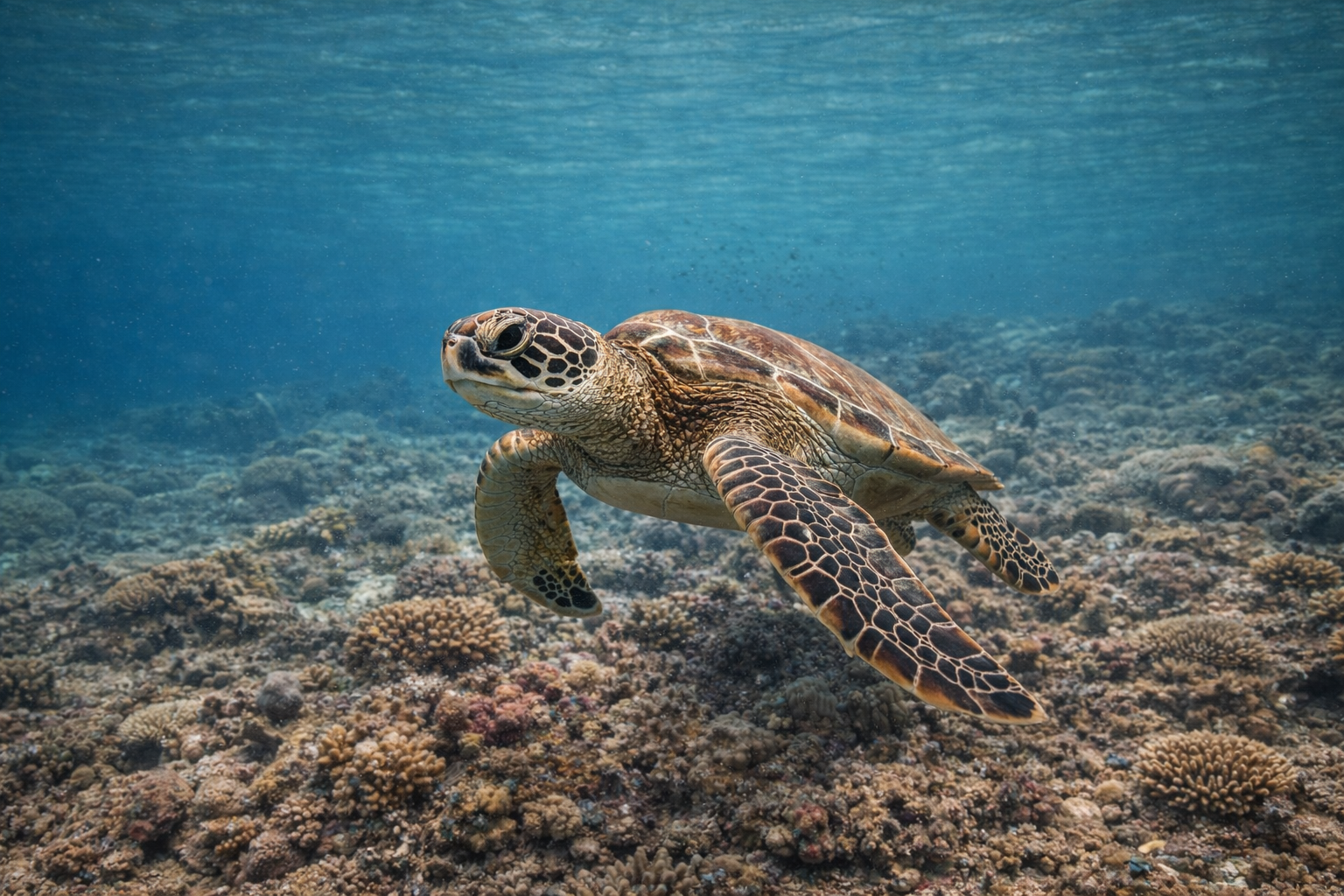
Green Turtle
Chelonia mydas
About Green Turtle
The most common sea turtle on tropical coral reefs, named for the green color of its body fat. A herbivore that grazes on seagrass beds, often seen resting under coral ledges. Can grow up to 1.5 meters and live over 80 years.
Quick Facts
- Habitat: The Green Sea Turtle, *Chelonia mydas*, inhabits **tropical and subtropical ocean waters** worldwide. As juveniles, they are often found in **pelagic environments**, drifting with ocean currents. However, as they mature, they transition to more **coastal waters**, particularly in areas rich with seagrass beds and algal reefs, which are their primary food sources. Significant populations can be found in the **Caribbean Sea**, around locations such as the **Florida Keys**, **Grand Cayman**, and **Belize**, where they frequent lush seagrass meadows. In the **Pacific Ocean**, they are commonly observed around **Hawaii's 'Big Island'**, particularly at dive sites like **Kona**, where they often rest in healthy coral formations. Other important habitats include the **Great Barrier Reef** in Australia, Indonesian waters around **Raja Ampat**, and various islands in the **Indian Ocean** such as the Maldives and Seychelles. They utilize different habitats throughout their life cycle, from open ocean to shallow foraging grounds and specific nesting beaches (though divers encounter them primarily in foraging and resting areas). They are often seen resting under **coral bommies** or in crevices within reefs, especially during the day, before moving to shallower feeding grounds.
- Diet: Green Sea Turtles are primarily **herbivores** as adults, with a diet consisting almost exclusively of **seagrasses and marine algae**. Their serrated jaws are perfectly adapted for grazing on these tough plant materials. They play a crucial role in maintaining the health of seagrass beds by 'mowing' them, which prevents overgrowth and promotes new, nutrient-rich growth. While juveniles may eat a more **omnivorous diet**, including small invertebrates, **adults are almost strictly vegetarian**. They are often observed slowly grazing across **shallow, sandy bottoms** where seagrass thrives, such as the vast meadows off **Akumal, Mexico**, or in the **Turks and Caicos Islands**. They have a **slow digestive process** and spend significant time foraging to meet their nutritional needs. This specialized diet is what gives their fat its greenish hue, hence their common name.
- Best season: Encounters with Green Sea Turtles can be excellent year-round in many stable tropical locations, but certain seasons offer **peak viewing opportunities** based on local conditions and behaviors. In the **Caribbean**, particularly in places like the **Cayman Islands** and **Belize**, the **drier months from December to May** often provide the best visibility and calmest seas, making turtle spotting more reliable. During the **summer months (June to September)**, these turtles are often more active near nesting beaches, though divers will typically observe them in foraging areas rather than directly on nesting sites. For **Hawaii**, particularly around **Kona**, turtles are present year-round, but the **calmer summer and fall months (May to October)** generally offer the most comfortable diving conditions and higher chances of encounters as they bask or feed along the extensive reef systems. In the **Indo-Pacific**, such as **Indonesia (e.g., Raja Ampat)** or parts of the **Great Barrier Reef**, diving for turtles is generally **excellent during the dry season (May to October)** when cooler currents bring richer nutrients, supporting vibrant seagrass beds they feed upon. Seasonal variations can also influence their presence in certain areas due to **migration patterns** between nesting and feeding grounds, though these migrations are often lengthy and less predictable for divers. Always check **local dive shop reports** for specific seasonal abundance.
Fun Facts
Green turtles navigate thousands of kilometres using Earth's magnetic field,A single female can lay over 100 eggs per nest,The sex of hatchlings is determined by sand temperature,They can hold their breath for up to 5 hours while sleeping underwater
Diving Tips
When encountering a Green Sea Turtle, maintaining a **respectful distance** is paramount. Keep at least **three to five meters (10-15 feet) away** to avoid disturbing their natural behavior. Never chase, touch, or attempt to feed a turtle; touching them can remove their protective mucus layer, making them vulnerable to disease and stress. Observe them calmly from a distance, allowing them to continue grazing or resting undisturbed. Look for turtles resting under **large coral overhangs** or within **sandy patches near seagrass beds**. Their camouflaged shells can make them surprisingly difficult to spot against the reef until they move. Pay attention to divers who have paused, as they may have already sighted a turtle. When a turtle surfaces for air, it's an excellent opportunity for a clear view, but remember to stay below them and **avoid blocking their path** to the surface. Strong currents can be a factor in some turtle habitats, so ensure you are proficient in **drift diving techniques** if applicable. Always carry your **certification card** and adhere to all **marine park regulations**, which often include strict rules against touching or disturbing marine life. In many regions, Green Sea Turtles are a **protected species**, and disturbing them can result in significant penalties. Be a **responsible diver** and help protect these magnificent marine reptiles by leading by example.