What diving with a whale shark is actually like
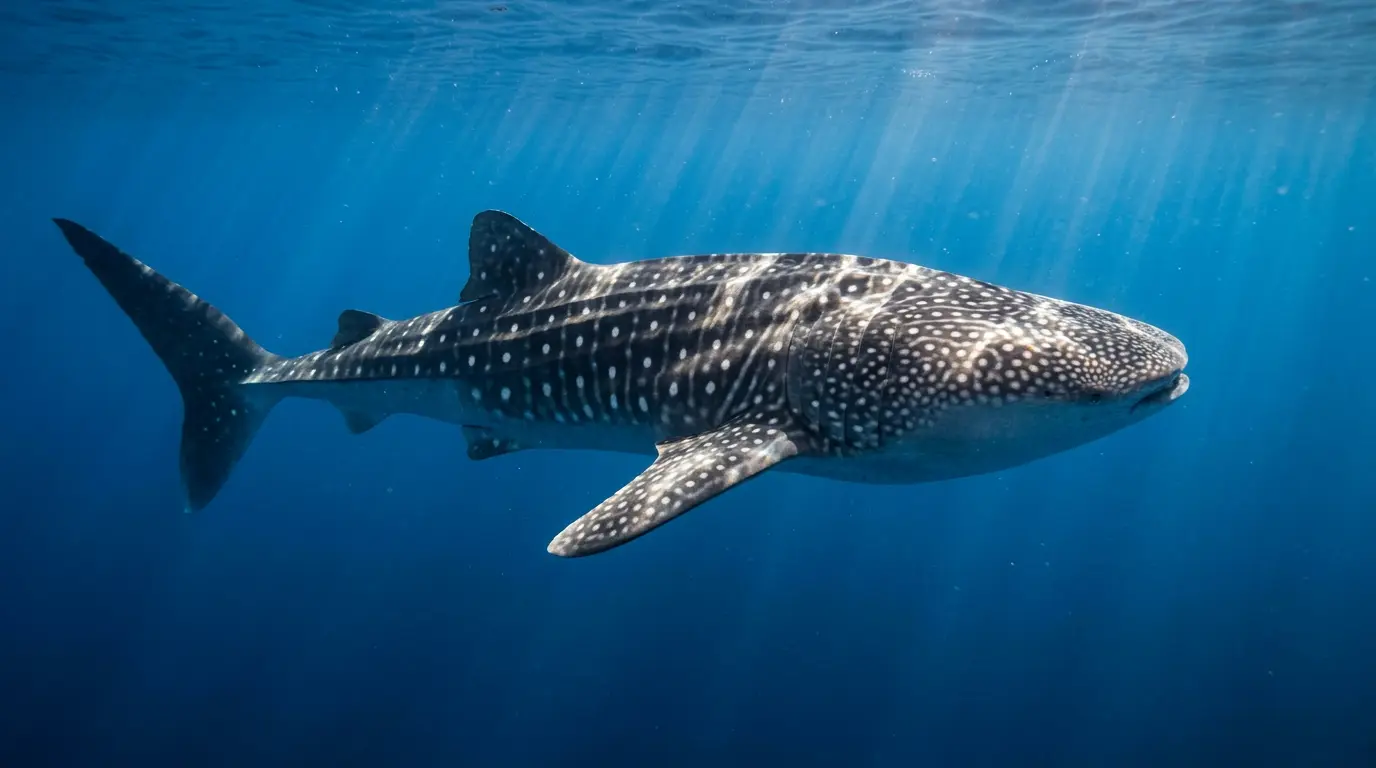
The first thing that surprises people is the speed. A whale shark looks slow — the tail beats maybe once every four or five seconds — but that single sweep moves an animal the size of a bus, and a fit snorkeller in fins has roughly 60 to 90 seconds to keep pace before it simply leaves. You do not swim with a whale shark for an hour. You get a series of passes, each one lasting a minute or two, and you spend the rest of the time back on the boat catching your breath.
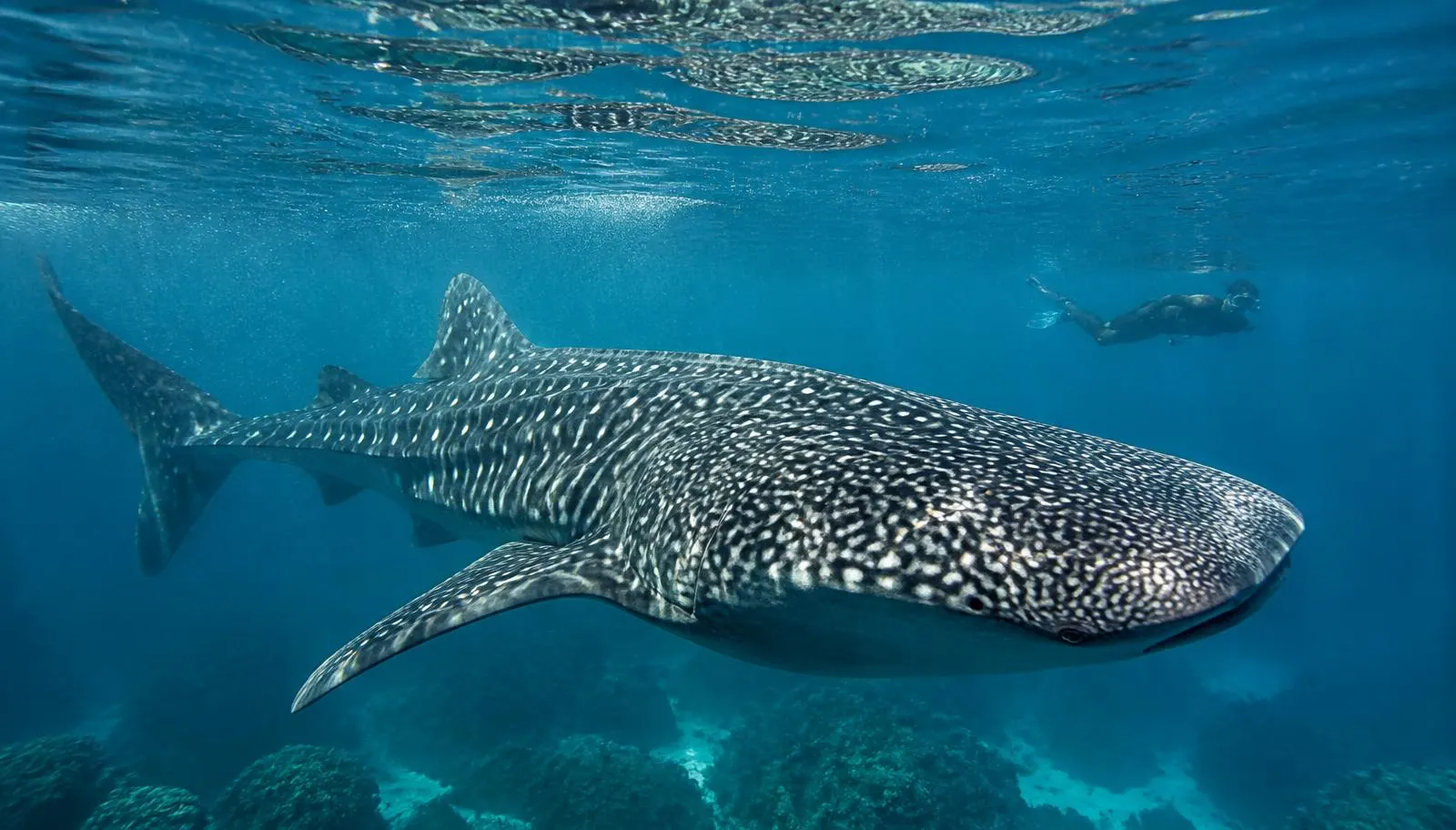
The second surprise is how little they care. There is no fear response, no evasion, no aggression. A whale shark is a plankton filter with a mouth 1.5 metres wide and teeth the size of a match head. It registers you as an obstacle to route around, nothing more. That indifference is exactly what makes the encounter safe — and what makes bad behaviour so damaging, because the animal will not defend itself or move away when a dozen people crowd it.
The third thing is scale. Photos never convey it. A seven-metre juvenile — the average size at most aggregations — fills your entire mask at three metres distance. Adult females at Galapagos run 12 to 15 metres and pass at depth like a submarine. Most people surface laughing or in tears.
Where to dive with whale sharks: the best places compared
Whale sharks are pan-tropical, but reliable aggregations happen in only a dozen places where plankton, fish spawn or coral spawn concentrates seasonally. Everything below is a genuine seasonal aggregation, not a chance sighting.
Two rules cut through the list: if you want certainty, go to Ningaloo or Isla Mujeres in peak season. If you want whale sharks as part of a full diving trip rather than a single boat day, book a Maldives, Djibouti or Galapagos liveaboard.
| Destination | Season | Encounter | Odds | Typical cost |
|---|---|---|---|---|
| Ningaloo, Australia | Mar–Aug | Snorkel, spotter plane | Very high | $300–450 / day |
| Isla Mujeres, Mexico | Jun–Sep | Snorkel, huge aggregation | Very high | $150–250 / day |
| La Paz, Mexico | Oct–Apr | Snorkel, juveniles in bay | High | $90–150 / day |
| Djibouti | Nov–Feb | Snorkel, liveaboard | Very high | Liveaboard week |
| Maldives (South Ari) | All year | Snorkel + scuba | Moderate–high | Liveaboard week |
| Philippines (Donsol) | Dec–May | Snorkel, wild, no feeding | High | $40–80 / day |
| Galapagos (Darwin/Wolf) | Jun–Nov | Scuba, pregnant adults | High | Liveaboard week |
| Thailand (Richelieu Rock) | Feb–May | Scuba, chance encounter | Low–moderate | Liveaboard week |
| Utila, Honduras | Mar–Apr, Aug–Sep | Snorkel on feeding boils | Moderate | $60–100 / day |
| Saudi Arabia (Al Lith) | Mar–May | Snorkel, uncrowded | Moderate | Liveaboard week |
Ningaloo, Australia
Season: Mar–Aug
Encounter: Snorkel, spotter plane
Odds: Very high
Typical cost: $300–450 / day
Isla Mujeres, Mexico
Season: Jun–Sep
Encounter: Snorkel, huge aggregation
Odds: Very high
Typical cost: $150–250 / day
La Paz, Mexico
Season: Oct–Apr
Encounter: Snorkel, juveniles in bay
Odds: High
Typical cost: $90–150 / day
Djibouti
Season: Nov–Feb
Encounter: Snorkel, liveaboard
Odds: Very high
Typical cost: Liveaboard week
Maldives (South Ari)
Season: All year
Encounter: Snorkel + scuba
Odds: Moderate–high
Typical cost: Liveaboard week
Philippines (Donsol)
Season: Dec–May
Encounter: Snorkel, wild, no feeding
Odds: High
Typical cost: $40–80 / day
Galapagos (Darwin/Wolf)
Season: Jun–Nov
Encounter: Scuba, pregnant adults
Odds: High
Typical cost: Liveaboard week
Thailand (Richelieu Rock)
Season: Feb–May
Encounter: Scuba, chance encounter
Odds: Low–moderate
Typical cost: Liveaboard week
Utila, Honduras
Season: Mar–Apr, Aug–Sep
Encounter: Snorkel on feeding boils
Odds: Moderate
Typical cost: $60–100 / day
Saudi Arabia (Al Lith)
Season: Mar–May
Encounter: Snorkel, uncrowded
Odds: Moderate
Typical cost: Liveaboard week
Australia — Ningaloo Reef, the most reliable whale sharks on Earth
Ningaloo is the benchmark. From March to August, whale sharks patrol the outer edge of a 260 km fringing reef, drawn in by the mass coral spawning that follows the March full moon. Operators fly a spotter plane, radio the boat onto the animal, and drop swimmers in a line ahead of its track. Success rates over the season run well above 90 percent, and most operators offer a free return trip if you do not swim with one.
The rules are the strictest in the world and they work: maximum ten swimmers in the water, three metres from the body, four metres from the tail, no flash, no touching, no free-diving down onto the animal. Contact ends the encounter for the whole boat and can cost the operator its licence.
Exmouth and Coral Bay are the two bases. April to July is the sweet spot — the animals are dense, the wind is manageable, and humpback whales start passing from July, so a day trip can deliver both. Water is 24–27 °C; a 3 mm shorty is plenty.
Mexico — Isla Mujeres and the biggest aggregation in the world
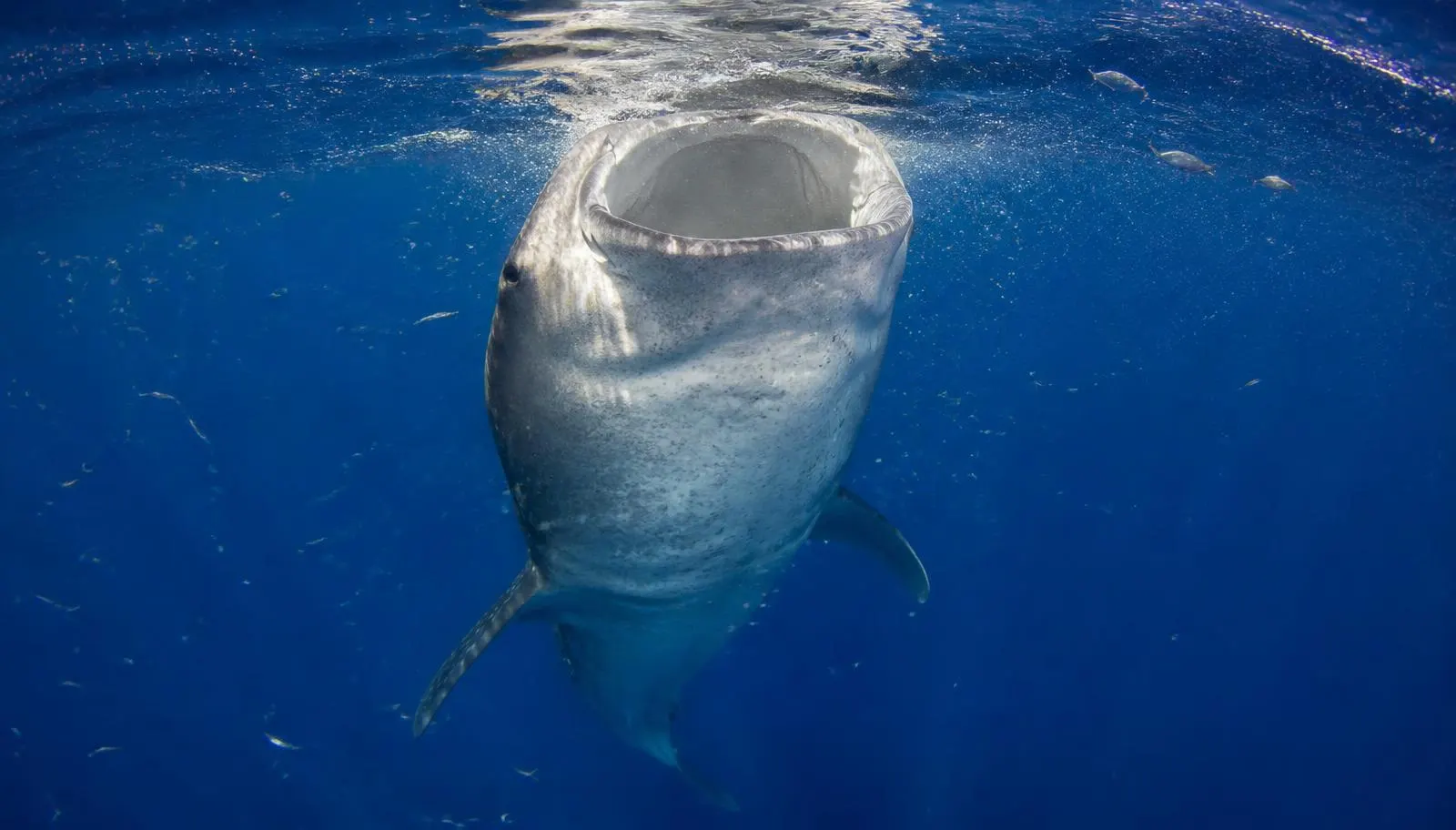
Every summer, tuna spawn in the open water north-east of the Yucatán and hundreds of whale sharks arrive to hoover up the eggs. Researchers have counted more than 400 animals in a single afternoon — the largest known gathering of the species anywhere. The behaviour is what makes it special: instead of cruising, the sharks hang vertically at the surface, mouths wide, sucking egg-rich water. This is called botella feeding, and it means the animals stay put and you get long, calm encounters.
Season is June to mid-September, peaking in late July and August. Boats leave Isla Mujeres, Cancún or Isla Holbox for a 1.5 to 2 hour run offshore. Regulations allow two swimmers plus a guide in the water at a time, life jacket compulsory, no scuba, no touching. Sea sickness is the real hazard — take a tablet before you board.
The Baja alternative runs the opposite half of the year: from October to April juvenile whale sharks feed inside the sheltered bay at La Paz, in flat water a few minutes from shore. Smaller animals, far cheaper, and it pairs with sea lions at Los Islotes.
Maldives — the only year-round whale shark population
The South Ari Marine Protected Area holds a resident population of juvenile male whale sharks that does not migrate away. That makes the Maldives the one destination where the answer to "when should I go" is "whenever you can". Sightings are not guaranteed on any single day, but over a seven-night liveaboard the odds are strong, and the season simply shifts sides of the atoll with the monsoon.
Encounters here are usually snorkel-based over shallow reef flats at Maamigili and Dhigurah, often with the animal cruising at 5 to 10 metres so you see the whole silhouette. Scuba encounters happen too, but the boat traffic in the MPA can be heavy in high season — pick an operator that drops you ahead of the animal rather than racing others to it.
Combine it properly: the same liveaboard week gives you manta cleaning stations, reef sharks at Fotteyo and night dives with nurse sharks at Alimatha.
Djibouti — winter whale sharks in the Gulf of Tadjoura
From November to February, juvenile whale sharks pack into the shallow, plankton-thick bays of the Gulf of Tadjoura. It is arguably the highest-density snorkelling encounter after Isla Mujeres, and the animals are small — three to six metres — which makes them easy to keep pace with. Almost all trips are liveaboard-based, run out of Djibouti City on 7-night itineraries that combine whale shark snorkelling with volcanic reef diving in the Seven Brothers islands.
Visibility is often mediocre — that plankton soup is the whole point — so manage photographic expectations. Water is 25–27 °C, topside is dry desert heat, and the boats are simple. It is a wildlife trip, not a luxury trip.
Philippines — Donsol yes, Oslob no
Donsol in Sorsogon is a genuine wild aggregation. From December to May, plankton blooms in the bay bring whale sharks in; spotters find them from the boat, swimmers slip in ahead of the animal, and nothing is fed. It is community-run, cheap, and one of the best examples of wildlife tourism funding conservation.
Oslob on Cebu is the opposite and we do not recommend it. Whale sharks there are hand-fed krill from outrigger boats every morning, which keeps the animals resident, alters their natural migration and feeding behaviour, and produces documented boat-strike scarring. Swimmers are packed in metres from the animals. It photographs well and it is bad for the sharks. Choose Donsol.
Southern Leyte (Sogod Bay, Nov–May) is a third, quieter wild option, usually as a side trip from reef diving.
Galapagos — the pregnant giants at Darwin and Wolf
Galapagos is the outlier: not a snorkelling aggregation but a scuba encounter with the largest whale sharks on the planet. From June to November, huge females — 10 to 15 metres, almost all of them apparently pregnant — pass the northern islands of Darwin and Wolf, riding the cold Cromwell upwelling. They do not linger. You hook in on the reef in strong current, and the animal materialises out of the blue and is gone in ninety seconds.
This is advanced diving: surge, current, cold thermoclines down to 18 °C, and Nitrox and 50+ logged dives are typically required. Only liveaboards may visit Darwin and Wolf, on fixed 7- or 10-night itineraries. In the same week you get hammerhead schools in the hundreds, Galapagos sharks, mola mola and marine iguanas.
Snorkel or scuba: which gets you closer?
Snorkelling wins for whale sharks, and it is not close. Most aggregations feed at or just under the surface, and a snorkeller can reposition and keep pace far better than a diver dragging a tank. Several destinations — Ningaloo, Isla Mujeres, Donsol, Djibouti — legally forbid scuba for whale shark encounters precisely because bubbles push the animals down and away.
Scuba only makes sense where the animals are deep and cruising: Galapagos, Richelieu Rock, occasional Maldives and Red Sea encounters. There, hang mid-water, stay still and let the shark choose the distance. Never swim down onto one, and never position yourself directly in front of the mouth or over the tail.
Free-diving straight down at a whale shark is the single most common cause of an aborted encounter, and in Australia it is an offence.
Whale shark etiquette: the rules that keep encounters good
Photograph the spot pattern behind the left gill and upload it to Wildbook for Whale Sharks — it is the fingerprint researchers use, and your holiday snap becomes a data point.
- Never touch. The mucus layer on the skin is an immune barrier; touching strips it and opens the animal to infection.
- Keep 3 m from the body and 4 m from the tail. A tail sweep at close range genuinely hurts.
- Swim parallel, never in front. Blocking the path makes the animal dive and ends the encounter.
- No flash photography. Banned nearly everywhere and pointless — daylight at the surface is plenty.
- Maximum group size matters. Book operators who cap swimmers per drop, even if it costs more.
- Never book feeding operations. If krill is being handed over the side, walk away.
- Reef-safe sunscreen only, or better, wear a rash guard.
What it costs
Day trips range from about $40 in Donsol to $450 at Ningaloo with a spotter plane, food and photos included. Mexico sits in the middle at $150–250 for Isla Mujeres and under $150 for La Paz. Most day-trip prices include the marine park fee; check, because Ningaloo and the Maldives MPA both charge separately.
Liveaboard weeks — Djibouti, Maldives, Galapagos, Red Sea, Saudi Arabia — run from roughly $1,600 for a simple Djibouti boat to $6,500+ for Galapagos, and that price buys 3 to 4 dives a day for a week rather than one encounter. If whale sharks are your main goal but you also want a full diving holiday, the liveaboard maths wins easily.
Budget extras: marine park fees ($10–60), Nitrox ($100–150 a week), reef-safe sunscreen, and travel insurance that actually covers diving.
What to pack
- Long fins — the single biggest upgrade to your encounter time.
- Rash guard or 3 mm shorty — sun protection first, warmth second.
- Your own mask and snorkel. Rental masks leak and you will be in and out of the water ten times a day.
- Sea sickness tablets for Mexico, Djibouti and Ningaloo — all involve offshore running.
- Wide-angle camera setup. A 16–35 mm or a dome-port action cam; nothing narrower will fit the animal in frame.
- Reef-safe sunscreen and a hat.
Month-by-month whale shark calendar
The Maldives is the only destination that works every month of the year, which makes it the safe choice when your travel dates are fixed.

NingalooAustralia
Coral spawning draws whale sharks to the outer reef; spotter planes push success rates above 90 percent.

Isla MujeresMexico
Hundreds of animals feeding vertically on tuna eggs — the largest aggregation on Earth.
La PazMexico
Juveniles feeding in a sheltered bay minutes from shore; flat water and low cost.

South Ari AtollMaldives
A resident juvenile population that never migrates away — combine with mantas on a liveaboard week.

Gulf of TadjouraDjibouti
Dense winter aggregation of small juveniles in plankton-rich bays; liveaboard only.

DonsolPhilippines
Genuine wild, community-run encounters with no feeding — the ethical Philippines choice.

Darwin & Wolf IslandsGalapagos
Huge pregnant females on scuba, alongside hammerhead schools; advanced divers only.

Richelieu RockThailand
A chance encounter rather than an aggregation, on Similan and Surin liveaboards.

UtilaHonduras
Whale sharks surface on tuna boils; short searches from a very cheap dive base.

Al LithSaudi Arabia
A young, uncrowded Red Sea aggregation reached on southern liveaboard itineraries.
Are whale sharks dangerous?
No. Whale sharks are filter feeders with roughly 3,000 vestigial teeth a few millimetres long, used for nothing. There is no record of a whale shark deliberately harming a person. The mouth cannot bite you and the animal has no interest in you.
The real risks are mundane: a tail sweep at close range if you crowd the animal, propeller injuries from boats manoeuvring around swimmers, exhaustion in swell, and sunburn. Stay to the side, listen to the guide, wear the life jacket where it is required, and none of it applies.
The danger runs the other way. Whale sharks are Endangered on the IUCN Red List, killed by finning, boat strikes and bycatch, and slow to mature — a female may be 25 to 30 years old before she breeds. Every rule about distance and touching exists because the population cannot absorb the damage.
Choosing an ethical whale shark operator
Ask three questions before you book. Do you feed the animals? If the answer is anything but a flat no, book elsewhere. How many swimmers go in per drop? Ten is the legal maximum in Australia; two to six is common in Mexico; "as many as fit" is a red flag. What happens if the animal dives? A good operator pulls everyone out and finds another shark; a bad one lets swimmers chase.
Good signs: written codes of conduct, a briefing before you leave the dock, guides who count people in and out of the water, participation in photo-ID research, and a no-sighting return policy. Bad signs: guaranteed sightings, touching in the marketing photos, no group limits, and boats that motor directly at animals.
Every liveaboard we sell that includes whale shark encounters runs on wild, unfed animals. If you want the whole trip built around them, tell us your dates and we will match them to the right aggregation.