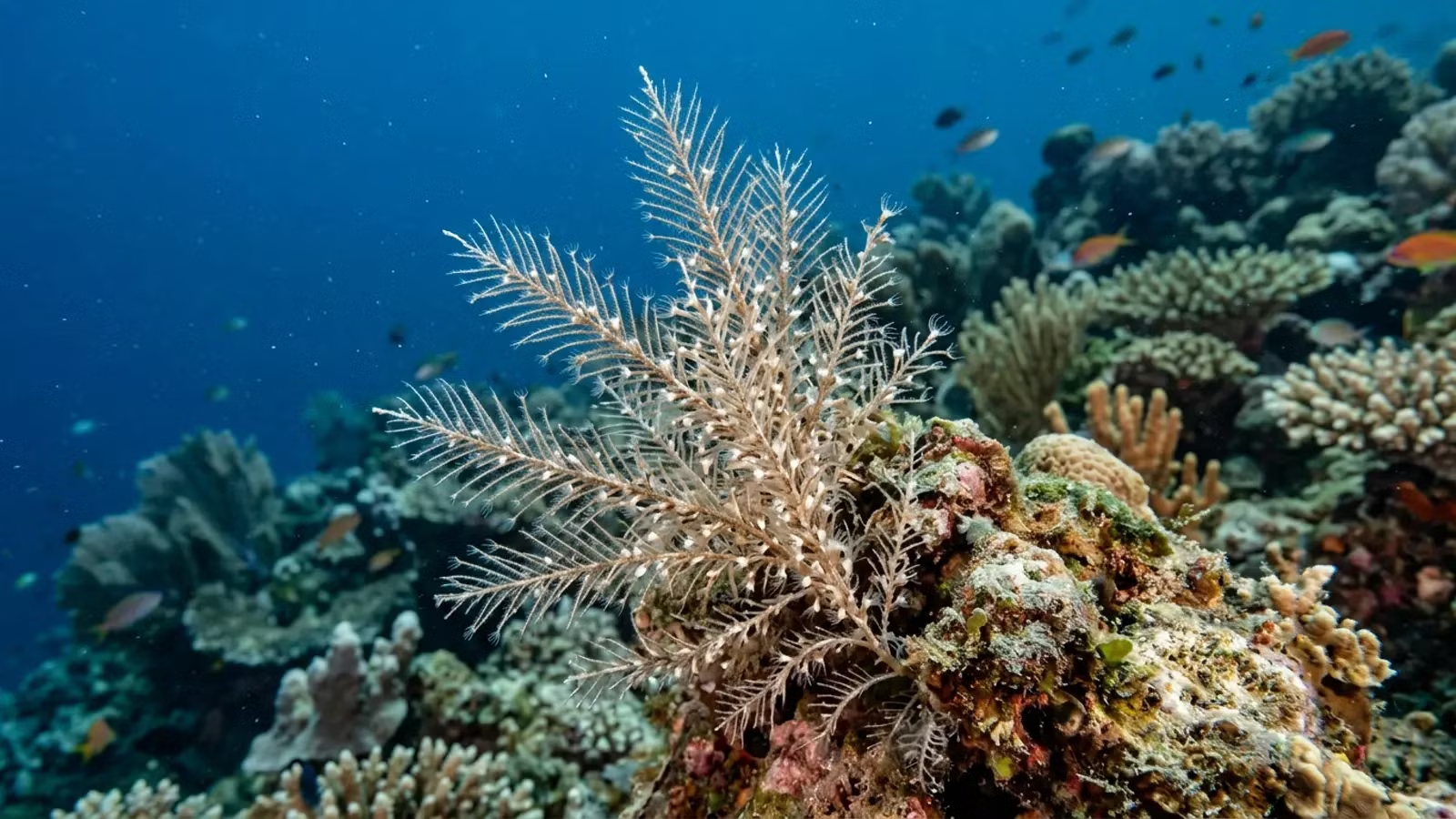
Hydroids belong to the diverse invertebrate class Hydrozoa (predominantly the subclass Hydroidolina), a group containing approximately 3,700 known species within the phylum Cnidaria. Related closely to true jellyfish and corals, these predatory organisms are overwhelmingly marine, though a tiny fraction has adapted to freshwater habitats. Hydroids range from solitary polyps to intricate, multi-individual colonies that anchor themselves to hard benthic substrates or drift through open ocean waters.
Behaviour & reproduction
- Size
- Unknown
- Weight
- Less than 1 g to 1 kg
- Lifespan
- Months to several years; some species are biologically immortal
- Status
- Not Evaluated
The typical hydroid life cycle is biphasic, alternating between asexual benthic polyps and sexual pelagic stages. It begins with a microscopic, ciliated planula larva roughly one millimetre long. Upon finding a suitable surface, the larva metamorphoses into a sessile polyp. In colonial species, budding creates interconnected networks anchored by horizontal, root-like stolons and vertical tubelike hydrocauli. These polyps eventually liberate gamete-producing medusae—tiny bell-shaped jellies ranging from 0.5 to 6 centimetres—or retain them as attached reproductive structures called gonophores.
For scuba divers, hydroids represent a fascinating element of reef architecture. Their growth forms vary dramatically, appearing as delicate tree-like fronds, feathery fans, or dense "furry mats" encrusting shells and rock faces. Though individual polyps are usually only a few millimetres tall, whole colonies create micro-habitats that enhance structural complexity, harbouring diverse micro-fauna and offering outstanding opportunities for close-up macro photography.


