Scad in its natural habitat — diving encounters and best destinations

Scad

Unknown
3 to 6 years
Not Evaluated

Want to dive with this animal?

Only destinations where this animal occurs.

The Scad at a glance

The common name scad refers to several schooling, pelagic marine fish within the jack family, Carangidae, predominantly comprising species in the genera Decapterus (such as the round scad and mackerel scad) and Selar (such as the bigeye scad). These streamlined, torpedo-shaped fish are built for rapid propulsion in the open sea. Characterised by elongated, cylindrical to moderately compressed bodies, they exhibit classic pelagic countershading: a metallic blue-green or olive dorsal surface transitioning to silvery-white flanks and a clean belly. Key diagnostic features include a deeply forked caudal fin, two distinct dorsal fins, prominent lateral-line scutes near the tail, and often a single, tiny, detached finlet behind the soft dorsal and anal fins. Species like the bigeye scad (Selar crumenophthalmus) feature exceptionally large eyes equipped with a well-developed adipose eyelid, an adaptation tailored for nocturnal feeding and tracking micro-prey in low-light environments.

Behaviour & reproduction

Size
Unknown
Weight
Up to 0.7 kg
Lifespan
3 to 6 years
Status
Not Evaluated

Scad species, encompassing genera such as Decapterus and Selar, typically exhibit highly schooling behaviour, forming large, dense aggregations often near coastal areas, reefs, or oceanic banks. These active, pelagic fish are primarily diurnal feeders, preying on zooplankton, small crustaceans, and larval fish. Their reproduction is characterised by broadcast spawning, where eggs and sperm are released into the water column for external fertilisation. Spawning seasons can vary regionally but are often extended, occurring over several months during warmer periods. Females can produce a substantial number of pelagic eggs, with fecundity varying greatly depending on species and size, ranging from tens of thousands to over a hundred thousand eggs per spawning event. Larvae develop planktonically, drifting with currents, before settling into juvenile habitats. Individuals typically reach sexual maturity within one to two years, demonstrating a relatively fast life history.


Where to dive with the Scad: 31 top spots

Diving Tips

To fully enjoy a scad encounter, divers should focus on pristine, neutral buoyancy and gentle movements. Avoid finning directly into the heart of a baitball; penetrating the core splits the formation and scatters the school into the blue. Instead, position yourself along the outer periphery or hover motionless underneath the mass, looking upward toward the surface. This ambient backlighting creates dramatic silhouettes and preserves the school's natural, swirling geometry. Photographers should equip a wide-angle or fisheye lens to capture the immense scale of the aggregation. Use ambient light with a fast shutter speed (1/250s or higher) to freeze rapid motion, or set twin strobes at low power with wide diffusers to illuminate the silver scales without producing harsh specular blowouts. Always remain acutely aware of your surroundings, as high-speed hunting by pelagic predators like trevallies, sharks, or marlin can create sudden, chaotic surges in the water column.

Fun facts about the Scad

  • Scad form dense, synchronised baitballs that confuse predators by making the entire school appear as a single, colossal organism.
  • Many scad species, such as the bigeye scad, possess a specialised transparent adipose eyelid that covers and protects their large eyes while hunting at night.
  • To deter predators in low light, some scad species utilise light-scattering silver guanine crystals in their scales to produce disorienting flashes.
  • Behind their main dorsal and anal fins, round scad have a single, tiny detached finlet that helps reduce drag and micro-turbulence during high-speed swimming.

Best time to see the Scad

Scad can be observed year-round in tropical waters, but specific peak aggregations offer the most theatrical diving. In the Red Sea around Ras Mohammed and Sharm El Sheikh, magnificent baitballs form from June to August, attracting large apex predators. Across Southeast Asia, premier dive havens such as Raja Ampat and the Komodo National Park in Indonesia host massive schools throughout their primary dive seasons—October to April for Raja Ampat and May to October for Komodo. In the Philippines, coastal dive sites around Moalboal and Coron offer reliable encounters from November to May when calmer sea conditions and exceptional water clarity prevail. Caribbean destinations like Bonaire and the Cayman Islands see vast schools clustering around jetties and shallow fringing reefs between April and September, delivering consistently bright, clear, and action-packed underwater spectacles.

Where the Scad lives

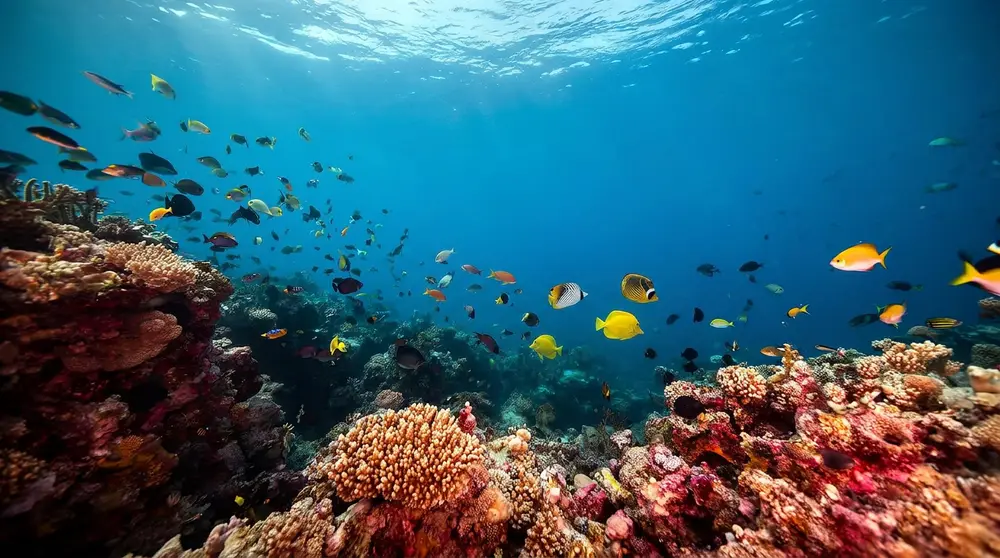
Scad occupy coastal, neritic, and epipelagic marine habitats across a depth range spanning from the surface down to approximately 170 metres, though they are most frequently encountered between 3 and 40 metres. They inhabit tropical and subtropical regions across the Indo-Pacific, the Western Atlantic, the Eastern Atlantic, the Caribbean Sea, and the Red Sea. Divers commonly encounter large schools hovering in the calm, sunlit blue water directly adjacent to outer coral reef walls, deep drop-offs, sandy lagoon passages, and artificial structures like shipwrecks, offshore oil platforms, and long commercial jetties. While they rely on structural topography such as reef margins and wrecks for shelter against strong currents and daytime predators, they are equally at home across open pelagic shelves where nutrient upwellings concentrate high densities of marine plankton.

What the Scad eats

Scad are specialised planktivorous and micronektonic feeders that play a pivotal role in converting planktonic production into harvestable biomass. Their primary diet consists of zooplankton, including calanoid copepods, larval decapods, hyperiid amphipods, mysids, and pelagic tunicates such as salps and appendicularians. As they mature, larger individuals routinely supplement this diet with larval and juvenile fish, pteropods, and tiny cephalopods. Feeding activity intensifies significantly during crepuscular windows—dawn and dusk—as well as throughout the night, coinciding with the diel vertical migration of deep-water zooplankton toward the surface. Scad employ ram-feeding and particulate picking, swimming with slightly agape jaws to ingest suspended plankton or executing targeted snaps at individual, larger micro-prey. Their finely serrated gill rakers efficiently strain organisms from seawater while maintaining efficient swimming speed.

Scad: frequently asked questions

When is the best time to see Scad?
Scad can be observed year-round in tropical waters, but specific peak aggregations offer the most theatrical diving. In the Red Sea around Ras Mohammed and Sharm El Sheikh, magnificent baitballs form from June to August, attracting large apex predators. Across Southeast Asia, premier dive havens such as Raja Ampat and the Komodo National Park in Indonesia host massive schools throughout their primary dive seasons—October to April for Raja Ampat and May to October for Komodo. In the Philippines, coastal dive sites around Moalboal and Coron offer reliable encounters from November to May when calmer sea conditions and exceptional water clarity prevail. Caribbean destinations like Bonaire and the Cayman Islands see vast schools clustering around jetties and shallow fringing reefs between April and September, delivering consistently bright, clear, and action-packed underwater spectacles.
How big does Scad get?
Scad: Unknown
Is Scad dangerous for divers?
To fully enjoy a scad encounter, divers should focus on pristine, neutral buoyancy and gentle movements. Avoid finning directly into the heart of a baitball; penetrating the core splits the formation and scatters the school into the blue. Instead, position yourself along the outer periphery or hover motionless underneath the mass, looking upward toward the surface. This ambient backlighting creates dramatic silhouettes and preserves the school's natural, swirling geometry. Photographers should equip a wide-angle or fisheye lens to capture the immense scale of the aggregation. Use ambient light with a fast shutter speed (1/250s or higher) to freeze rapid motion, or set twin strobes at low power with wide diffusers to illuminate the silver scales without producing harsh specular blowouts. Always remain acutely aware of your surroundings, as high-speed hunting by pelagic predators like trevallies, sharks, or marlin can create sudden, chaotic surges in the water column.
What is the conservation status of Scad?
Scad: Not Evaluated
Plan your trip

Ready to dive with these animals?

Choose a destination or search every available vessel to find the liveaboard that matches the marine life you want to see.