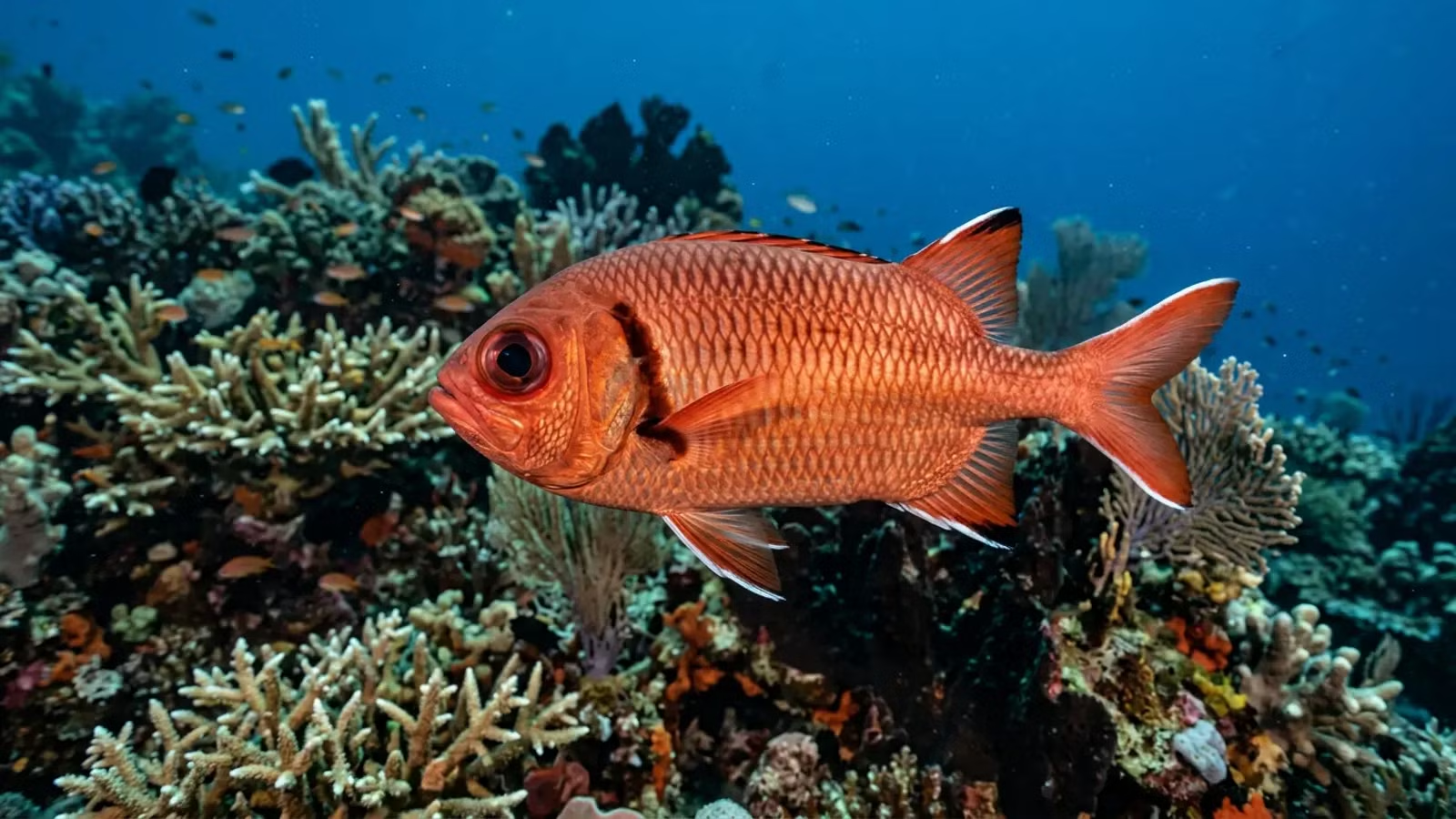
Soldierfishes belong to the subfamily Myripristinae within the ray-finned fish family Holocentridae. Distributed across tropical and subtropical waters in the Atlantic, Indian, and Pacific Oceans, these fish are closely related to squirrelfishes (subfamily Holocentrinae) but feature distinct structural traits. Soldierfishes typically possess a robust, laterally compressed body with a blunter, shorter snout and a crescentic preopercle that generally lacks the single long, sharp preopercular spine found on squirrelfishes. Their common name stems from their vivid reddish coloration, reminiscent of traditional military uniforms.
Under water, soldierfishes present striking shades of red, pink, or silver-red, frequently patterned with lighter scale centres, dark opercular markings, or white and yellow fin trims. Because red light attenuates quickly in seawater, these bright shades appear dark or greyish at depth, blending seamlessly with shadows and reef crevices. Their most prominent feature is a pair of oversized eyes engineered for twilight and night vision. Their bodies are covered in large, rough ctenoid scales and spiny-edged head bones. They feature a deeply forked caudal fin, an anal fin with four distinct spines, and a long dorsal fin with stout spines that lay flat when relaxed but flare erect when defensive.
Behaviour & reproduction
- Size
- Unknown
- Weight
- Up to 1.4 kg
- Lifespan
- Up to 13 years
- Status
- Not Evaluated
Soldierfish, primarily species within the genus Myripristis, are generally nocturnal, seeking shelter in crevices, caves, and beneath ledges during daylight hours, often forming dense aggregations for protection. As dusk approaches, these aggregations disperse as individual fish or small groups forage for zooplankton in the water column. Their reproduction is typically characterised by broadcast spawning, a common mode among many marine teleosts. During spawning, which often occurs around twilight or dawn, females release eggs and males release sperm directly into the water column, where fertilisation takes place externally. The eggs are pelagic, drifting with currents as they develop. Specific details regarding precise clutch sizes, incubation periods, and the duration of larval development for most Myripristis species are not extensively documented in the broader scientific literature. Juveniles usually inhabit shallower reef areas before moving to deeper habitats as they mature.


