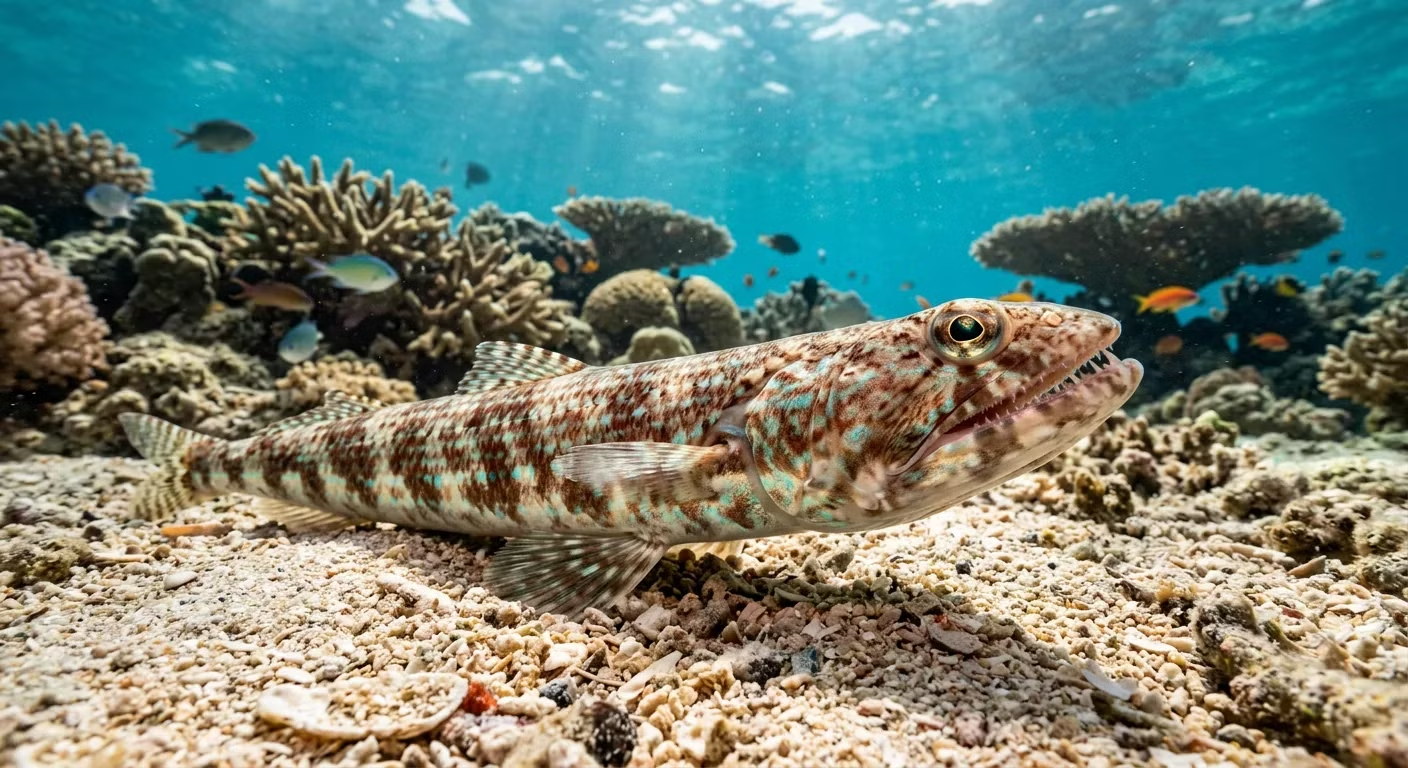
Lizardfishes (family Synodontidae) are slender, cylindrical bottom-dwellers renowned for their reptilian appearance and exceptional camouflage. Their elongated, torpedo-shaped bodies are adorned with intricate, mottled patterns of brown, grey, rufous, and sandy hues, interspersed with subtle iridescent speckling that mirrors their chosen substrate. The head is distinctly flattened and lizard-like, crowned with large, bulbous eyes positioned high on the skull to provide an expansive stereoscopic field of view. Their mouths are capacious and deeply cleft, lined with needle-sharp, recurved teeth that extend across the jaws, palate, and tongue, ensuring that seized prey has virtually no chance of escape. Pectoral and pelvic fins are robust and muscular, often splayed outwards to prop the fish up on the seabed like a tripod, while a single dorsal fin and small adipose fin complete their hydrodynamic profile.
Behaviour & reproduction
- Size
- Unknown
- Weight
- Up to 1.2 kg
- Lifespan
- 5-9 years
- Status
- Not Evaluated
Lizardfish, belonging to the family Synodontidae and exemplified by Synodus spp., are predominantly solitary, demersal predators, typically observed resting motionless on the seafloor, often partially buried in sand or rubble, awaiting prey. They are generally active during daylight hours, employing ambush tactics to capture small fishes and crustaceans. Regarding reproduction, lizardfish are oviparous, releasing their eggs into the water column. While specific spawning seasons can vary regionally, many species are known to reproduce multiple times throughout the year in tropical and subtropical waters, with peaks often correlating with warmer months. Fertilisation is external, and the eggs are typically pelagic, drifting as part of the plankton before hatching into larval stages. These larvae are slender, transparent, and undergo a pelagic phase, eventually settling to the seabed as they mature. The precise incubation period and clutch sizes are highly variable across species, but large numbers of small, planktonic eggs are characteristic. Sexual maturity is typically reached within the first few years of life, depending on the species and environmental conditions.


