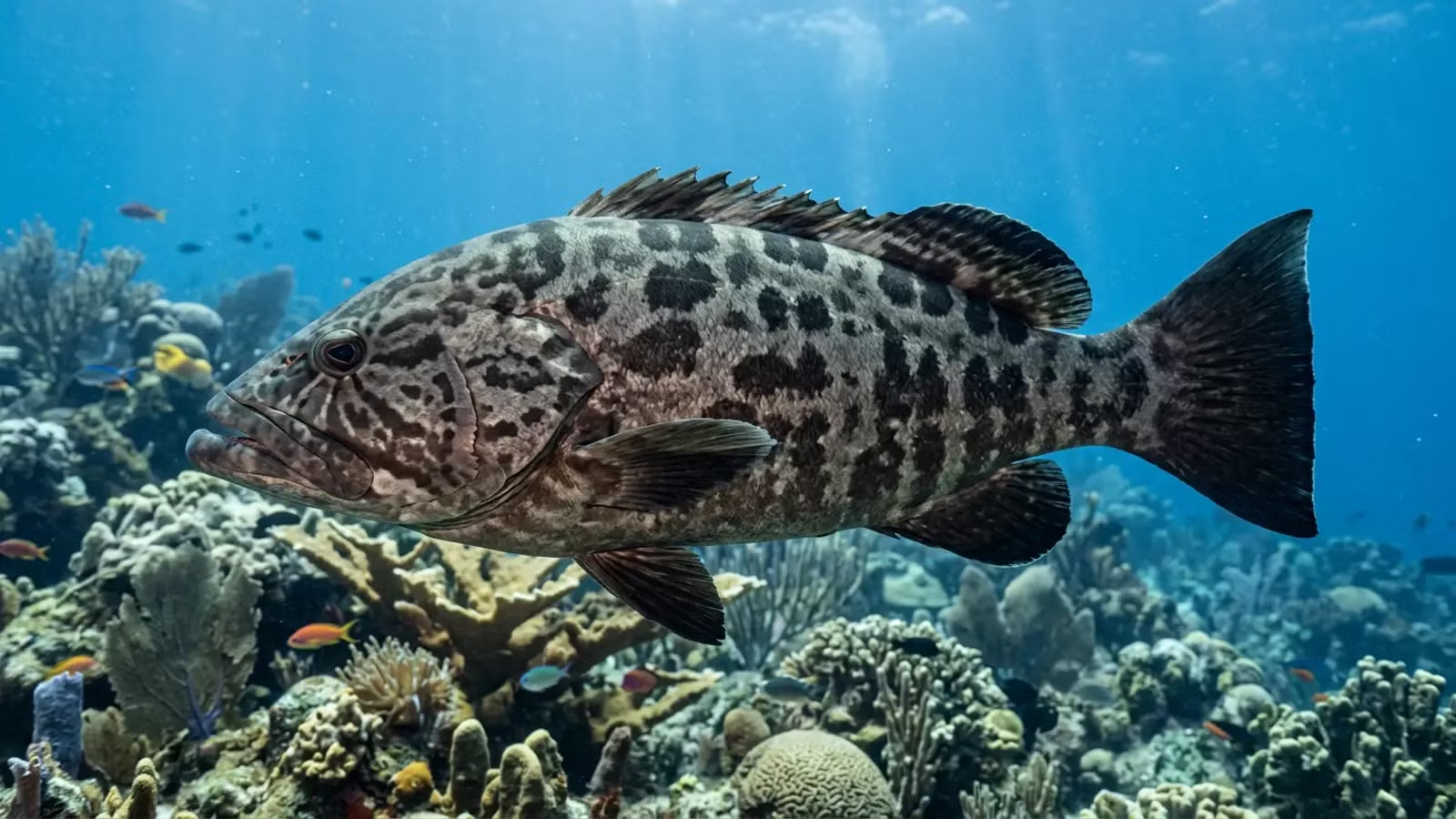
Black Grouper in its natural habitat, diving encounters and best destinations

Black GrouperWhere and when to see them

Up to 30 years

Want to dive with this animal?

Only destinations where this animal occurs.

The Black Grouper at a glance

The black grouper (Mycteroperca bonaci), also known as the marbled rockfish, is a robust reef fish belonging to the sea bass family Serranidae. It is characterised by an oblong, laterally compressed body, a protruding lower jaw, and an evenly rounded preopercle lacking the distinct notch seen in the similar gag grouper. Its body colouration ranges from olive to grey, marked with dark rectangular blotches and small bronze or brassy hexagonal spots across the head and flanks. The soft-rayed portions of its dorsal and anal fins display dark bluish-black margins, while the pectoral fins are sooty brown, often fading to orange near the edges.

Behaviour & reproduction

Size
Unknown
Weight
Up to 100 kg
Lifespan
Up to 30 years
Status
Not Evaluated

This large marine predator commonly reaches around 70 centimetres in length, though fully grown adults can attain lengths of up to 1.5 metres and weigh as much as 100 kilograms. As monandric protogynous hermaphrodites, all black groupers begin life as females. Females reach sexual maturity around five years of age at roughly 82.6 centimetres in length. Between the ages of 11 and 15 years, some individuals undergo a sex reversal to become functional males, resulting in a natural population ratio of approximately one male for every four females.

Diving Tips

To observe black groupers effectively underwater, scuba divers should look around structural reef features such as overhangs, cave entrances, and deep rocky ledges where these bottom-dwelling fish seek shelter. Because adults are generally solitary and cautious, divers should approach with smooth, neutral buoyancy and avoid rapid movements. When startled, a black grouper will quickly retreat into a crevice or beneath a ledge, keeping its eyes fixed on the observer. Maintaining a respectful distance allows divers to watch their natural behaviour, including their deliberate, hovering movements and rasper-toothed jaw displays. Divers should also remain aware of local regulations and marine protected areas, such as closed zones designed to protect spawning stocks. In areas where larger predators like hammerheads or sandbar sharks are present, watching how black groupers react near cover offers a clear view of predator-prey dynamics in reef ecosystems.

Fun facts about the Black Grouper

  • All black groupers are born female, with some changing sex to male between 11 and 15 years of age.
  • They possess rasper-like teeth plates inside their throats that prevent captured prey from escaping after being swallowed.
  • Adult black groupers will opportunistically hunt around the spawning aggregations of other reef fish species.
  • Juvenile black groupers often inhabit shallow seagrass beds before migrating to deeper offshore coral reefs.

Best time to see the Black Grouper

Observations of black groupers occur year-round across their tropical and subtropical western Atlantic range, but seasonal variations affect their visibility and behaviour. In the Gulf of Mexico and the Caribbean Sea, peak viewing opportunities coincide with their seasonal spawning aggregations, during which solitary individuals gather in significant numbers along outer reef drops and deep shelves. In waters off the southeastern United States and South Atlantic management areas, fishing closures run from January through April to protect these critical spawning aggregations, creating favorable conditions for divers to observe natural social interactions without fishing pressure. During the warmer summer months, juvenile black groupers are more frequently encountered in shallow coastal habitats such as Florida seagrass beds. Dive conditions, water clarity, and sea state across the Bahamas and Caribbean are often best from late spring through autumn, providing optimal underwater visibility for spotting these cryptically patterned predators along deep reef walls.

Where the Black Grouper lives

The black grouper inhabits warm coastal and offshore marine environments across the western Atlantic Ocean. Its primary range extends from Florida and Bermuda southwards into the Gulf of Mexico, throughout the Caribbean Sea, and down to Santa Catarina in Brazil, including offshore island groups such as Trindade and Fernando de Noronha. There is a notable gap in their distribution along the northern coast of South America between Paramaribo in Suriname and Maranhão in Brazil, while occurrences north to Massachusetts are considered vagrant juveniles. Adults are typically found at depths ranging from 6 to 33 metres over rocky bottoms, coral reefs, and seaward ledges, although in the eastern Gulf of Mexico they normally reside in deeper waters exceeding 30 metres. Juvenile black groupers occupy much shallower habitats, frequently utilising coastal seagrass beds in places like Florida before migrating to deeper offshore reef zones as they mature.

What the Black Grouper eats

Black groupers are carnivorous predators whose dietary habits change significantly as they develop. Young juveniles feed almost exclusively on small crustaceans, particularly shrimp, within shallow inshore nursery habitats. As they grow into adults, their diet shifts primarily to reef-dwelling fishes, including grunts, snappers, and herrings, as well as squid and larger crustaceans. Equipped with large, powerful jaws and expandable gill cavities, black groupers capture prey by rapidly opening their mouths to create a strong suction, drawing food directly into their mouth cavity. Within their throat, specialised rasper-like tooth plates prevent struggling prey from escaping once swallowed. Adult black groupers are opportunistic hunters; they regularly exploit the seasonal spawning aggregations of other fish species, feeding on the dense concentrations of prey fish gathered along continental shelf edges and outer reef slopes.

Black Grouper: frequently asked questions

When is the best time to see Black Grouper?
Observations of black groupers occur year-round across their tropical and subtropical western Atlantic range, but seasonal variations affect their visibility and behaviour. In the Gulf of Mexico and the Caribbean Sea, peak viewing opportunities coincide with their seasonal spawning aggregations, during which solitary individuals gather in significant numbers along outer reef drops and deep shelves. In waters off the southeastern United States and South Atlantic management areas, fishing closures run from January through April to protect these critical spawning aggregations, creating favorable conditions for divers to observe natural social interactions without fishing pressure. During the warmer summer months, juvenile black groupers are more frequently encountered in shallow coastal habitats such as Florida seagrass beds. Dive conditions, water clarity, and sea state across the Bahamas and Caribbean are often best from late spring through autumn, providing optimal underwater visibility for spotting these cryptically patterned predators along deep reef walls.
How big does Black Grouper get?
Black Grouper: Unknown
Is Black Grouper dangerous for divers?
To observe black groupers effectively underwater, scuba divers should look around structural reef features such as overhangs, cave entrances, and deep rocky ledges where these bottom-dwelling fish seek shelter. Because adults are generally solitary and cautious, divers should approach with smooth, neutral buoyancy and avoid rapid movements. When startled, a black grouper will quickly retreat into a crevice or beneath a ledge, keeping its eyes fixed on the observer. Maintaining a respectful distance allows divers to watch their natural behaviour, including their deliberate, hovering movements and rasper-toothed jaw displays. Divers should also remain aware of local regulations and marine protected areas, such as closed zones designed to protect spawning stocks. In areas where larger predators like hammerheads or sandbar sharks are present, watching how black groupers react near cover offers a clear view of predator-prey dynamics in reef ecosystems.
What is the conservation status of Black Grouper?
Black Grouper: Not Evaluated
Plan your trip

Ready to dive with these animals?

Choose a destination or search every available vessel to find the liveaboard that matches the marine life you want to see.