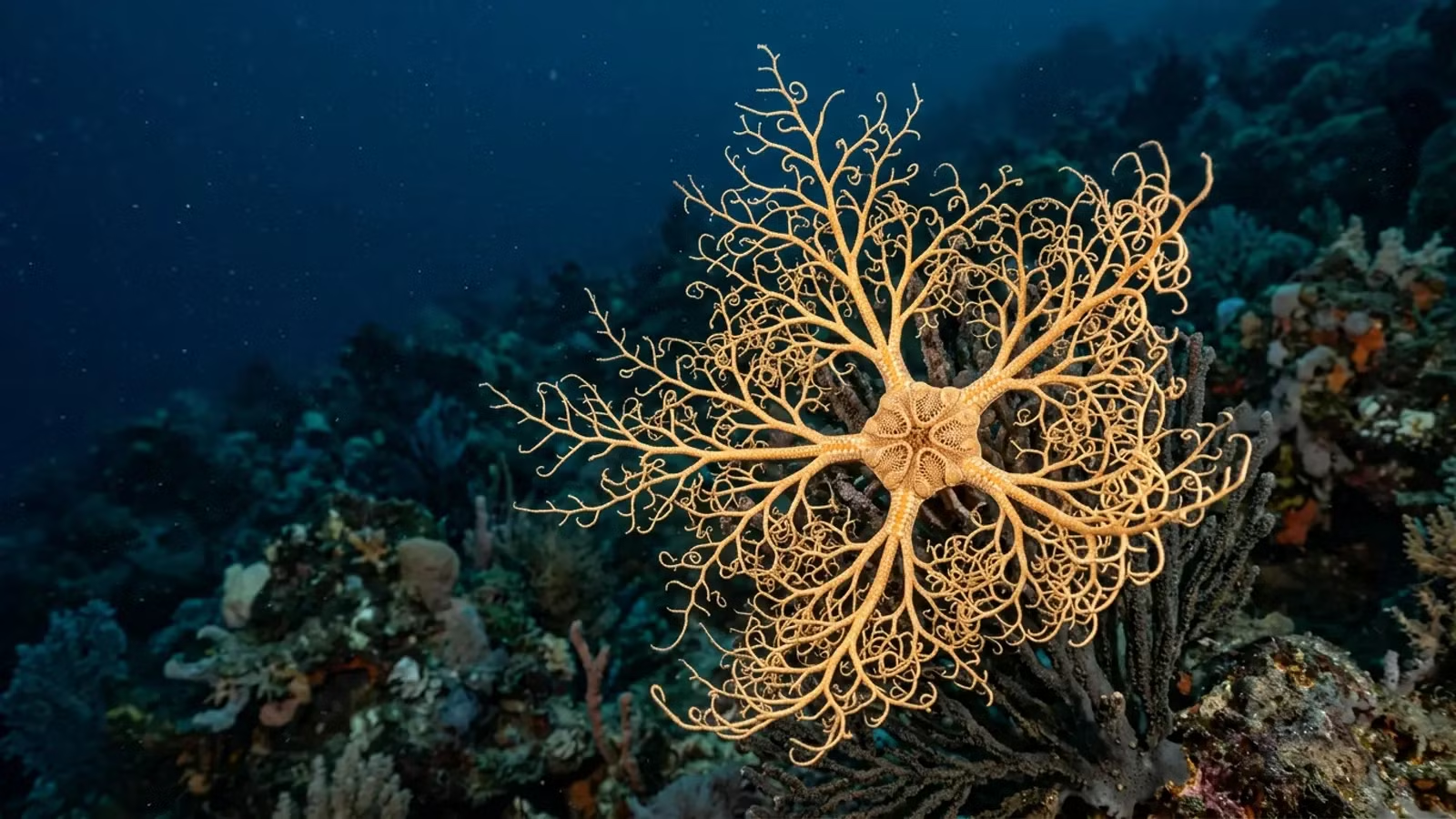
Basket Star in its natural habitat, diving encounters and best destinations

Basket StarWhere and when to see them

Up to 35 years

Want to dive with this animal?

Only destinations where this animal occurs.

The Basket Star at a glance

Basket stars belong to the suborder Euryalina, a unique group of oversized brittle stars renowned for their sprawling, repeatedly branching arms. Unlike standard echinoderms with simple limbs, basket stars possess five primary arms that split into secondary, tertiary, and quaternary branches. This fractal structure expands into an extraordinary feeding net when fully extended, making them one of the most visually stunning invertebrates encountered on reef walls and deep seamounts.

Behaviour & reproduction

Size
Unknown
Weight
Up to 5 kg
Lifespan
Up to 35 years
Status
Not Evaluated

Internally, these invertebrates possess a fascinating physiology. Like other echinoderms, basket stars lack true blood, instead using a water vascular system to transport nutrients and achieve gas exchange throughout their complex arm network. They are surprisingly long-lived creatures, capable of surviving for up to 35 years in the wild and reaching weights of up to 5 kilograms.

Top Locations

Dive sites with confirmed sightings

Diving Tips

Observing a basket star requires a night diving certification and refined buoyancy control. Because these animals are highly sensitive to artificial light, direct exposure from powerful dive torches will trigger a slow defensive response, causing the tendrils to curl inward and end the encounter. Divers should approach with torches angled away, using side-lighting or low-intensity beams to view the structure without disturbing the animal.

Maintain a respectful distance of at least 30 centimetres from the host structure. Basket stars are almost always perched on delicate sea fans, soft corals, or sponges; accidental physical contact can damage both the host and the basket star's fragile tendrils.

Photographers will find a mid-range macro or wide-angle lens (35–60 mm) ideal for capturing the entire branching disc. Position continuous lights or strobes off to the side to highlight the sticky mucus coating and fine detail of the tendrils, or use backlighting to create a dramatic silhouette against open water. Avoid prolonged torchlight exposure on a single individual.

Fun facts about the Basket Star

  • Basket stars lack blood, performing gas exchange entirely through their water vascular system.
  • A single basket star can live up to 35 years in the wild and weigh up to 5 kg.
  • Their thousands of fine arm tendrils are equipped with microscopic hooks and sticky mucus to trap zooplankton.
  • During the day, basket stars curl into a compact, fist-sized knot, unfurling only after dark.

Best time to see the Basket Star

Because basket stars are nocturnal residents tied to permanent reef features or deep seamounts, seasonality is primarily dictated by local diving conditions rather than animal migrations. In tropical destinations such as Komodo, Raja Ampat, the Red Sea, Bonaire, and the Caribbean, basket stars can be observed year-round on night dives, with peak conditions corresponding to calm seas and clear underwater visibility.

In temperate and cold-water regions, seasonality plays a more significant role for divers. In northern subpolar destinations like Norway's Lofoten Islands, the prime diving window runs from May through September, when sea conditions are manageable and dive operations are fully active. Similarly, in temperate zones like South Africa or the Mediterranean, encounters occur throughout the year, but the calmest seas typically fall during local summer months, making access to deep rocky walls and wreck sites far easier.

Where the Basket Star lives

Basket stars boast an immense depth distribution, ranging from shallow tropical reefs at 5 metres down to abyssal habitats and deep seamounts exceeding 1,800 to 2,000 metres. While deep-water species colonise rocky ridges and cold-water coral mounds, shallow-water species reside on rocky walls, steep drop-offs, wrecks, and high-current reef passages.

To maximise their exposure to plankton-rich currents, basket stars actively seek elevated perches. They use flexible cirri on their underside to anchor onto gorgonian sea fans, noble corals, large sponges, and soft coral colonies. Juveniles of certain species often settle directly onto soft corals or deep sea fans for protection. Geographically, they occur worldwide, including the North Pacific, North Atlantic, Arctic Ocean, Mediterranean Sea, Caribbean, Red Sea, Indo-Pacific, and off coastal South Africa.

What the Basket Star eats

The basket star is a specialised nocturnal passive suspension feeder. As night falls, it unfolds its massive array of branching arms into the water column, orienting the living net perpendicular to prevailing currents to intercept drifting plankton, zooplankton, and fine organic particles.

The capture mechanism relies on thousands of microscopic hooks lining the tendrils, combined with a sticky layer of mucus secreted along the arms. When swimming zooplankton or suspended organic matter touch the tendrils, they adhere instantly to the mucus or become snagged by the micro-hooks.

Once food is caught, the arm segment slowly coils inward, folding in a controlled sequence to transfer the trapped prey down through the branching network toward the central disc. The mouth, situated on the underside of the central body disc, ingests the collected material before the arm extends back into the current to resume feeding. By dawn, feeding ceases and the entire arm network retracts until the following night.

Basket Star: frequently asked questions

When is the best time to see Basket Star?
Because basket stars are nocturnal residents tied to permanent reef features or deep seamounts, seasonality is primarily dictated by local diving conditions rather than animal migrations. In tropical destinations such as Komodo, Raja Ampat, the Red Sea, Bonaire, and the Caribbean, basket stars can be observed year-round on night dives, with peak conditions corresponding to calm seas and clear underwater visibility. In temperate and cold-water regions, seasonality plays a more significant role for divers. In northern subpolar destinations like Norway's Lofoten Islands, the prime diving window runs from May through September, when sea conditions are manageable and dive operations are fully active. Similarly, in temperate zones like South Africa or the Mediterranean, encounters occur throughout the year, but the calmest seas typically fall during local summer months, making access to deep rocky walls and wreck sites far easier.
How big does Basket Star get?
Basket Star: Unknown
Is Basket Star dangerous for divers?
Observing a basket star requires a night diving certification and refined buoyancy control. Because these animals are highly sensitive to artificial light, direct exposure from powerful dive torches will trigger a slow defensive response, causing the tendrils to curl inward and end the encounter. Divers should approach with torches angled away, using side-lighting or low-intensity beams to view the structure without disturbing the animal. Maintain a respectful distance of at least 30 centimetres from the host structure. Basket stars are almost always perched on delicate sea fans, soft corals, or sponges; accidental physical contact can damage both the host and the basket star's fragile tendrils. Photographers will find a mid-range macro or wide-angle lens (35–60 mm) ideal for capturing the entire branching disc. Position continuous lights or strobes off to the side to highlight the sticky mucus coating and fine detail of the tendrils, or use backlighting to create a dramatic silhouette against open water. Avoid prolonged torchlight exposure on a single individual.
What is the conservation status of Basket Star?
Basket Star: Not Evaluated
Plan your trip

Ready to dive with these animals?

Choose a destination or search every available vessel to find the liveaboard that matches the marine life you want to see.