About Dos Chichas
Dos Chichas is a captivating dive site situated off Long Caye, part of the extensive reef system in Belize. This location offers divers a rich underwater tapestry, characterized by large barrel sponges, intricate coral formations, and an abundance of Caribbean marine species. It is frequently visited by liveaboards operating in the region, providing a comprehensive diving experience focused on the thriving reef ecosystems rather than deep, dark sinkholes. The topography at Dos Chichas typically involves a sloping wall that descends to deeper sections, where divers can encounter a variety of reef inhabitants. Shallower reef tops complement the deeper wall dives, creating varied profiles. The site is known for its clear waters and minimal currents, making it accessible and enjoyable for a wide range of diver experience levels. Visibility commonly ranges from 12 to 24 meters, often extending beyond 30 meters on offshore atolls, with water temperatures consistently warm, averaging 26-29°C. Marine life sightings are consistent year-round, with notable encounters including Caribbean reef sharks, nurse sharks, octopuses, and squids. The area also hosts various groupers, colorful reef fish, and big basket stars. Depending on the season, seasonal visitors like whale sharks are present in other parts of Belize, though not specifically at Dos Chichas. Diving here typically involves following the wall at a comfortable depth, with surface intervals allowing for movement to different sections or other sites. The relaxed nature of most dives, combined with abundant marine life and warm conditions, makes Dos Chichas a prime example of classic Caribbean reef diving.
Highlights
Large barrel spongesCaribbean reef sharksOctopuses and squidsColorful spongesLong Caye locationWarm, clear waterAbundant reef fish
Season calendar
Best months to dive here
Jan
Feb
Mar
Apr
May
Jun
Jul
Aug
Sep
Oct
Nov
Dec
Excellent
Good
Off-Season
Nov – May (Dry Season)
Calm seas, best visibility up to 40m, whale shark season at Gladden Spit in April-May.
Jun – Aug (Wet Season)
Still diveable with warm waters. Occasional rain and reduced visibility, but fewer crowds.
Sep – Oct (Hurricane)
Peak hurricane season. Most operators remain open but weather can be unpredictable.
Dive site facts: Dos Chichas
- Depth
- 6–30+ m
- Typical dive
- 15–25 m, 50–60 min
- Current
- Minimal
- Visibility
- 24–30 m
- Water temperature
- 26–29°C
- Entry
- Liveaboard / Backroll
- Level
- All levels
- Dive type
- Wall, reef, marine life
- Night dive
- Possible
- Region / port
- Long Caye / Lighthouse Atoll
- Coordinates
- 17.3814° N, 87.8025° W
Conditions & Currents
Currents at Dos Chichas are typically minimal, providing a relaxed diving environment suitable for extended exploration of the reef. The absence of strong currents allows divers to comfortably navigate along the wall and explore coral formations without significant effort. Water entry from liveaboards is usually directly off the dive platform, allowing for an immediate descent to the wall below. Visibility is consistently excellent, often ranging between 24 to 30 meters, and water temperatures remain warm, typically 26-29°C. These stable conditions mean divers can plan for longer bottom times and focus on marine life observation, with minimal concern for challenging environmental factors. While most Belize diving is not characterized by strong drift, divers should always monitor their air consumption and depth, especially when exploring deeper sections of the wall.
Marine life & sighting chances

Caribbean reef shark
common
Nurse shark
common
Octopus
common
Squid
common
Grouper
common
Blue chromis
common
Indigo hamlet
common
Goldentail moray eel
occasionalGreen moray eel
occasional
Barrel sponge
common
Basket star
commonDive profile & how the dive runs
Diving at Dos Chichas typically begins with a descent directly from the liveaboard’s dive platform onto the reef wall. The initial part of the dive explores the upper sections of the wall, where large barrel sponges and diverse corals thrive, at depths around 15-20 meters. Divers then follow the wall, often moving into a gentle current, observing the vibrant marine life such as groupers, blue chromis, and indigo hamlets. The dive progresses deeper along the wall, reaching depths of 25-30 meters to spot more elusive creatures like octopuses and moray eels. Turnaround is planned to allow for a return along the reef, often shallower, to explore coral heads and observe reef sharks. The safety stop is conducted at 5 meters, typically near the mooring line or shallower reef crest, providing an excellent opportunity for decompression and observing smaller reef inhabitants.
Underwater photography
Dos Chichas offers excellent opportunities for both wide-angle and macro photography due to its diverse topography and marine life. For wide-angle shots, consider a fisheye or 16-35mm lens to capture the expansive barrel sponges and the general reefscape, especially when reef sharks are present. Early morning light can be particularly good for dramatic reef scenes. For macro subjects like goldentail moray eels, octopuses, or other small critters nestled in the coral, a 60mm or 105mm macro lens is ideal. Strobes are highly recommended for bringing out the true colors of the corals and fish, especially on deeper wall sections. Maintain excellent buoyancy to avoid disturbing delicate corals and sediment on the wall.
Combine with nearby dive sites
- Zipline
Zipline is a distinctive dive site within the Turneffe Atoll Marine Reserve in Belize, offering a glimpse into the diverse ecosystems of…
- Half Moon Caye Wall
Half Moon Caye Wall, located within Belize's Lighthouse Reef Atoll, is celebrated as one of the Caribbean's premier dive sites and part of…
- Long Caye Ridge
Long Caye Ridge is a highly-rated dive site situated within Belize's Lighthouse Reef Atoll, an area renowned for its pristine conditions…
- Cathedral
The Cathedral, located in Fiji's Beqa Lagoon, is world-renowned for its thrilling shark encounters.
- Tarpon Cave
Tarpon Cave is a notable dive site located in Belize's Lighthouse Reef Atoll, renowned for its dramatic wall formations and abundant marine…
Getting there & logistics
Access to Dos Chichas is primarily via liveaboard vessels, typically departing from Belize City. Guests usually fly into Philip S.W. Goldson International Airport (BZE) and are then transferred to the marina. Liveaboard trips in Belize are commonly week-long itineraries, offering extensive diving at various sites around the atolls, including Lighthouse Reef where Dos Chichas is located. Marine park fees for protected areas like Lighthouse Reef are often included in liveaboard packages. Combining diving with topside activities such as exploring Mayan ruins or rainforests is a popular option before or after a liveaboard trip, though these are typically separate arrangements from the diving itinerary.
Safety & environment
While Belize offers generally safe diving conditions, divers should always carry appropriate insurance that covers dive accidents and medical evacuation. The nearest recompression chamber is located in San Pedro, Ambergris Caye, requiring boat transfer in case of an emergency. Due to the remote nature of some offshore atolls, evacuation can take several hours. Divers should be proficient in buoyancy control, especially on wall dives, to avoid contact with the fragile reef. Staying within no-decompression limits is crucial, and a dive computer is mandatory for all dives. Although currents are typically minimal, divers should be prepared for potential changes and always dive with a signaling device such as a surface marker buoy.
Who it suits, and who it doesn't
Suited for
- Divers seeking relaxed Caribbean wall and reef diving
- Underwater photographers looking for diverse subjects and clear water
- Newer divers wanting warm, comfortable conditions
- Divers interested in seeing reef sharks, octopuses, and colorful sponges
- Liveaboard enthusiasts exploring offshore atolls
Less suited for
- Divers primarily seeking extreme drift diving experiences
- Those looking for shore diving opportunities
- Divers exclusively interested in macro muck diving
- Individuals who prefer cold water or technical diving environments
FAQ
Dos Chichas FAQ
What kind of marine life can I expect to see at Dos Chichas?
At Dos Chichas, you can commonly encounter a variety of Caribbean marine life. Expect to see Caribbean reef sharks and nurse sharks patrolling the wall, along with octopuses and squids. The reef is also home to numerous groupers, colorful blue chromis, and indigo hamlets, making it a vibrant ecosystem for observation.
Are the currents strong at Dos Chichas?
The currents at Dos Chichas are generally minimal, contributing to a relaxed and enjoyable diving experience. This allows divers to comfortably explore the wall and reef formations without encountering significant resistance. These calm conditions are ideal for divers of all experience levels and for underwater photography.
What is the typical visibility and water temperature at this dive site?
Dos Chichas offers consistently excellent visibility, often ranging from 24 to 30 meters, providing clear views of the underwater landscape. The water temperature is pleasantly warm year-round, typically between 26 and 29°C. This comfortable environment allows for longer dives and lighter wetsuits.
What makes Dos Chichas a unique dive site in Belize?
Dos Chichas is known for its distinct combination of large barrel sponges, frequent sightings of Caribbean reef sharks and octopuses, and its location off Long Caye. It provides a classic Caribbean wall dive experience with minimal currents, making it a highlight for many liveaboard itineraries focused on healthy reef ecosystems.
Is Dos Chichas suitable for beginner divers?
Yes, Dos Chichas is well-suited for beginner divers due to its minimal currents and consistently warm, clear water. The relaxed dive profiles along the wall allow new divers to practice their skills and enjoy the abundant marine life without being overwhelmed. It offers an excellent introduction to Caribbean reef diving.
Why dive Dos Chichas from a liveaboard?
Dos Chichas is one of Belize's signature dive sites. A liveaboard sleeps you on the water and puts you in the water for three to four guided dives per day, including dawn and night dives that day-boat operators rarely offer. You skip the daily commute back to port and reach quieter, less-crowded sites in the same region on a single trip.
Below are the liveaboards that include Dos Chichas on their Belize itineraries.
Liveaboards diving Dos Chichas
These liveaboards may visit Dos Chichas on selected itineraries, the exact dive sites depend on departure, weather and conditions.
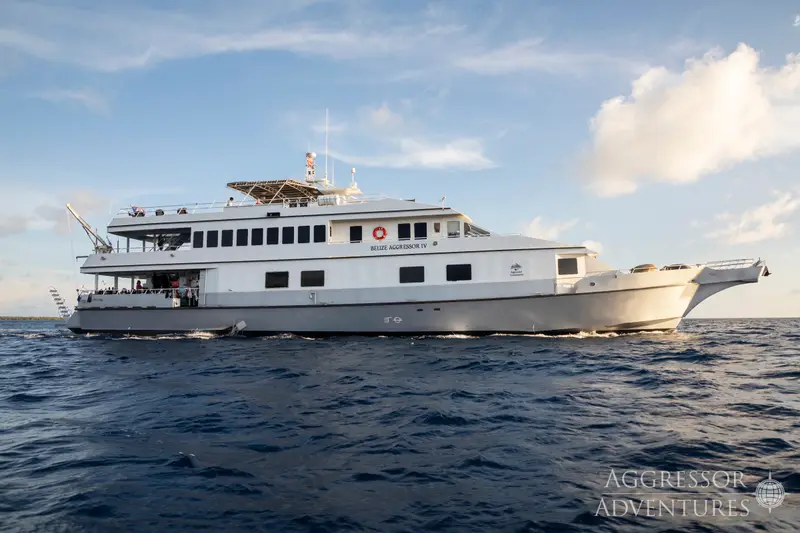
Belize Aggressor IV
Belize
20 guests42 m

Belize Aggressor III
Belize
18 guests34 m
Dive sites similar to Dos Chichas
Same character, same waters, six more sites divers love for the exact same reasons.Compare seasons, access and liveaboard routes, then pick the site that fits your trip best.
© EsriMaxar, Earthstar, GIS
3 Fathom Wall
Cayman Islands
3 Fathom Wall is an exciting and fish-filled dive site located in the Cayman Islands, specifically at the intersection of the renowned Bloody Bay Wall.
- Suitable for
- Intermediate
- Current
- Mild
- Access
- Liveaboard only
- Depth
- ≤ 3000 m
- Theme
- Reef
While specific details for a dive site named "3 Riff" are not present in the provided sources, general diving conditions and characteristics for the Dominican Republic…
- Suitable for
- Advanced
- Current
- Mild
- Access
- Dayboat
- Depth
- 30–55 m
- Theme
- Reef
The dive site known as 3 Rocks is located off the coast of Sosúa in Puerto Plata, Dominican Republic, offering an accessible and lively underwater experience.
- Suitable for
- Beginner
- Current
- Mild
- Access
- Dayboat
- Depth
- 2–8 m
- Theme
- Reef
4 Amigos is a notable dive site located in the Bay Islands of Honduras, an area renowned for its extensive Mesoamerican Barrier Reef System, which is the world's second-longest.
- Suitable for
- Intermediate
- Current
- Moderate
- Access
- Liveaboard or dayboat
- Depth
- 9–40 m
- Theme
- Reef
© EsriMaxar, Earthstar, GIS
6 Toed Cat
Mexico
The dive site known as "6 Toed Cat" is not a recognized dive location in Mexico; rather, it refers to the polydactyl felines, many with six toes, that inhabit the Ernest Hemingway Home and Museum in Key West, Florida.
- Suitable for
- Beginner
- Current
- Mild
- Access
- Liveaboard or dayboat
- Depth
- —
- Theme
- Reef
© EsriMaxar, Earthstar, GIS
Aaron's Backyard
Honduras
Aaron's Backyard is a noted dive site within the Roatan Marine Park in Honduras, part of the extensive Mesoamerican Barrier Reef System.
- Suitable for
- Intermediate
- Current
- Moderate
- Access
- Liveaboard or dayboat
- Depth
- 9–40 m
- Theme
- Reef