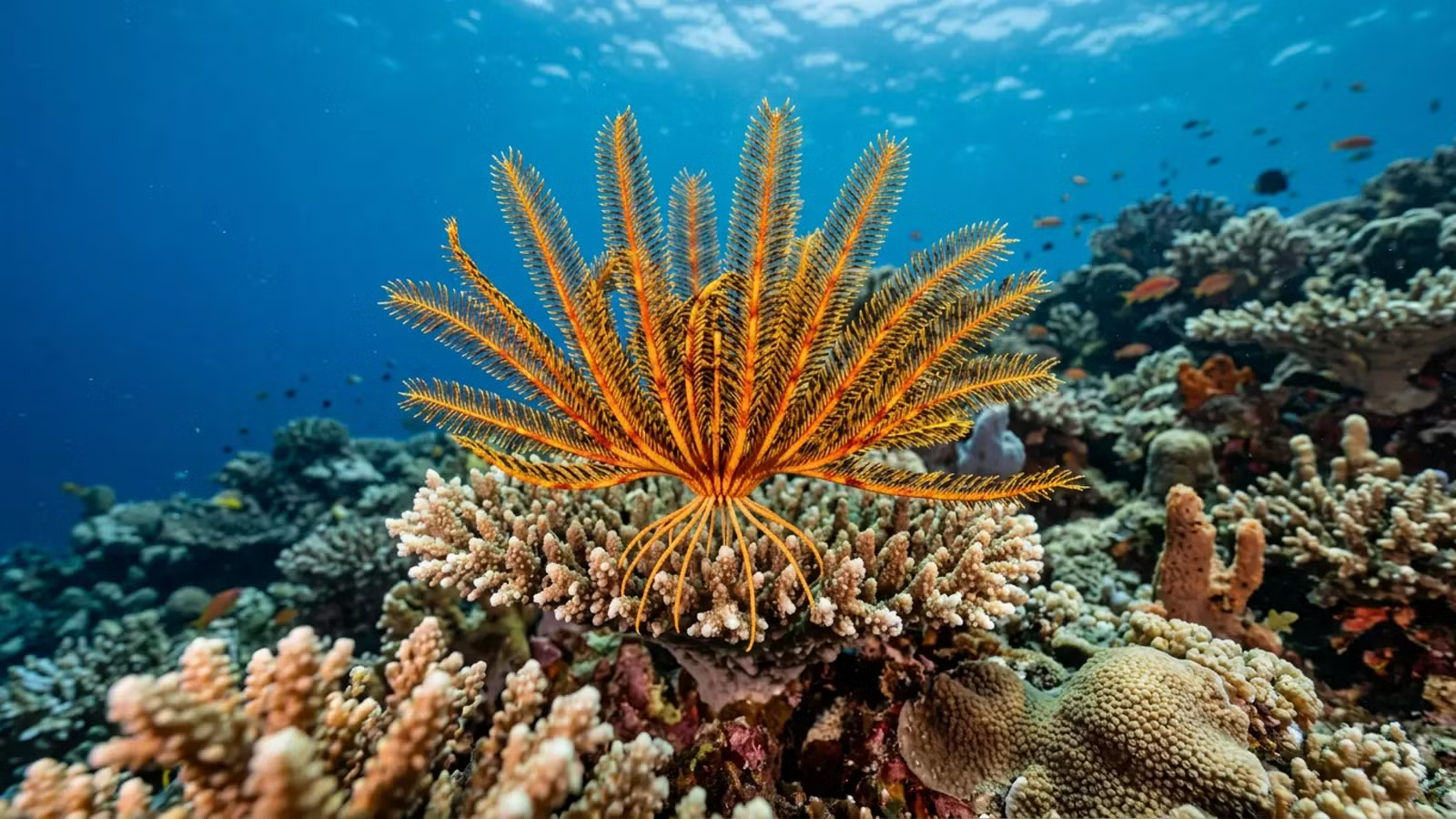
Crinoid in its natural habitat, diving encounters and best destinations

CrinoidWhere and when to see them

10-20 years or more

Want to dive with this animal?

Only destinations where this animal occurs.

The Crinoid at a glance

Class Crinoidea encompasses marine invertebrates belonging to the phylum Echinodermata, making them close relatives of starfish, brittle stars, sea urchins, and sea cucumbers. The class comprises two main anatomical groups: stalked forms attached to the sea floor known as sea lilies, and unstalked forms called feather stars or comatulids. Comatulids represent the largest crinoid order, Comatulida. Around 700 living species are recognised today, which is a fraction of their prehistoric abundance when vast limestone beds were formed almost entirely from disarticulated crinoid fragments during the Paleozoic and Jurassic periods.

Unlike other echinoderms whose mouths face downwards, adult crinoids possess a central cup-like body called a theca with their mouth and anus both located on the upper surface. The base of the theca consists of calcified bony plates known as the calyx, while the membranous upper surface, called the tegmen, contains ambulacral grooves leading to the central mouth. The anus is typically situated in an interambulacral area on a small elevated cone. The body contains relatively little soft tissue, being supported predominantly by calcareous ossicles.

Behaviour & reproduction

Size
Unknown
Weight
50-500 g
Lifespan
10-20 years or more
Status
Not Evaluated

Crinoids, ancient marine invertebrates, typically exhibit a largely sessile or passively mobile existence, attaching themselves to substrates or using cirri to crawl slowly across the seabed. Their activity patterns often involve extending their feathery arms to filter-feed on suspended particles, particularly during periods of favourable currents. Reproducing primarily through broadcast spawning, crinoids release gametes directly into the water column. While specific mating seasons can vary by species and location, reproduction often occurs synchronously, potentially triggered by environmental cues. Fertilisation is external, leading to a free-swimming, barrel-shaped doliolaria larva. This larval stage is typically non-feeding and relatively short-lived, before settling onto a substrate and metamorphosing into a small, stalked pentacrinoid juvenile. This juvenile stage then develops into the adult form, either remaining stalked or becoming free-swimming, with sexual maturity typically reached after several years.

Top Locations

Diving Tips

Crinoids are sensitive to external disturbances. Species such as the beaded crinoid (*Davidaster discoideus*) react strongly to changes in water temperature and light illumination, so divers should avoid shining high-intensity dive lights directly into reef crevices where they reside. Because individual crinoids frequently inhabit the exact same concealed spot on a reef for several years, divers must never attempt to pull, dislodge, or move them.

Physical contact should be strictly avoided. Crinoid arms and pinnules consist of jointed calcareous plates that can easily fracture under pressure, and handling disrupts their feeding apparatus. Divers should practice excellent buoyancy control, particularly in high-current zones where rheophilic species aggregate.

When observing species like *Anneissia bennetti*, which prefer exposed coral heads in strong currents, look closely along the arms and pinnules. These feather stars host a variety of small commensal species, including polychaete worms such as *Hololepidella laingensis* and *Paradyte crinoidicola*, which rely on the host crinoid for shelter, protection, and trapped food particles.

Fun facts about the Crinoid

  • Crinoids have a fossil record dating back to the Ordovician period, and ancient limestone deposits are sometimes composed almost entirely of their fossilised fragments.
  • Unlike starfish and sea urchins, which have their mouths on their underside, crinoids have both their mouth and anus located on their upper surface.
  • Free-swimming feather stars can branch their primary five arms into up to 200 feathery rays equipped with small appendages called pinnules.
  • Crinoid crowns frequently provide shelter to commensal organisms, including polychaete worms that live among the arms without harming the host.

Best time to see the Crinoid

Because many comatulids are resident on reefs year-round, diving encounters are not restricted to narrow seasonal windows. Species such as *Davidaster discoideus* maintain site fidelity in the same reef crevice or sponge for years at a time, allowing divers to encounter them throughout the year in regions like the Caribbean Sea and the Gulf of Mexico whenever local sea conditions permit diving.

Daily activity patterns play a more critical role in crinoid encounters than annual seasons. For instance, Bennett's feather star (*Anneissia bennetti*) is diurnally active, meaning its full fan of 31 to 120 feathery arms remains fully extended in the water column during daylight hours. Other crinoid species remain concealed during the day, extending only a few arms until ambient light drops or water currents increase.

Environmental current strength dictates prime observation times during any dive. Rheophilic species position themselves on exposed substrate where water currents flow most strongly. Divers seeking active feeding displays should plan dives during periods of moving water, such as tidal changes, when crinoids extend their arms to capture floating nutrients.

Where the Crinoid lives

Crinoids inhabit an extensive vertical range, living in shallow intertidal waters down to extreme ocean depths exceeding 9,000 metres. Comatulid feather stars occur across diverse marine environments from tropical coral reefs to temperate waters and deep-sea benthic habitats.

Specific species exhibit distinct depth and microhabitat preferences. Bennett's feather star (*Anneissia bennetti*) is widespread in the Indo-West Pacific—from the Bay of Bengal and the Maldives to the Marshall Islands, China, Australia, and Indonesia. It is most commonly found between 5 and 25 metres depth, with a less common deep-water variety living between 15 and 45 metres. It is rheophilic, preferring exposed coral heads exposed to strong currents.

The beaded crinoid (*Davidaster discoideus*) occurs in the Caribbean Sea, the Gulf of Mexico, and off northern South America at depths between 15 and 40 metres. It typically conceals its main body inside reef crevices or sponges, extending only its arms into the open water. Substrate attachment varies by substrate type: crinoids on hard surfaces use robust, curved cirri resembling birds' feet, whereas those on soft sediment utilize slender, rod-like cirri.

What the Crinoid eats

Crinoids are passive suspension feeders that extract phytoplankton, zooplankton, and small particles of organic detritus directly from the passing water column. To feed, a crinoid raises its jointed arms to form a broad fan held perpendicular to the prevailing current.

Along the feathery pinnules lining each arm, three tube feet of varying sizes are positioned at each plate junction. These tube feet lack suction pads and are specialized for food capture. The longest tube feet trap planktonic particles and push them into the ambulacral groove running along the oral surface of the pinnules, where smaller tube feet and flap-like lappets prevent the food from escaping.

Microscopic cilia lining the ambulacral grooves roll the captured organic particles into compact boluses and transport them continuously along the arms into the mouth, which is located on the upper surface of the body disc (tegmen). Feeding activity often coincides with ambient water movement, though diurnally active species like *Anneissia bennetti* feed actively throughout the day.

Crinoid: frequently asked questions

When is the best time to see Crinoid?
Because many comatulids are resident on reefs year-round, diving encounters are not restricted to narrow seasonal windows. Species such as *Davidaster discoideus* maintain site fidelity in the same reef crevice or sponge for years at a time, allowing divers to encounter them throughout the year in regions like the Caribbean Sea and the Gulf of Mexico whenever local sea conditions permit diving. Daily activity patterns play a more critical role in crinoid encounters than annual seasons. For instance, Bennett's feather star (*Anneissia bennetti*) is diurnally active, meaning its full fan of 31 to 120 feathery arms remains fully extended in the water column during daylight hours. Other crinoid species remain concealed during the day, extending only a few arms until ambient light drops or water currents increase. Environmental current strength dictates prime observation times during any dive. Rheophilic species position themselves on exposed substrate where water currents flow most strongly. Divers seeking active feeding displays should plan dives during periods of moving water, such as tidal changes, when crinoids extend their arms to capture floating nutrients.
How big does Crinoid get?
Crinoid: Unknown
Is Crinoid dangerous for divers?
Crinoids are sensitive to external disturbances. Species such as the beaded crinoid (*Davidaster discoideus*) react strongly to changes in water temperature and light illumination, so divers should avoid shining high-intensity dive lights directly into reef crevices where they reside. Because individual crinoids frequently inhabit the exact same concealed spot on a reef for several years, divers must never attempt to pull, dislodge, or move them. Physical contact should be strictly avoided. Crinoid arms and pinnules consist of jointed calcareous plates that can easily fracture under pressure, and handling disrupts their feeding apparatus. Divers should practice excellent buoyancy control, particularly in high-current zones where rheophilic species aggregate. When observing species like *Anneissia bennetti*, which prefer exposed coral heads in strong currents, look closely along the arms and pinnules. These feather stars host a variety of small commensal species, including polychaete worms such as *Hololepidella laingensis* and *Paradyte crinoidicola*, which rely on the host crinoid for shelter, protection, and trapped food particles.
What is the conservation status of Crinoid?
Crinoid: Not Evaluated
Plan your trip

Ready to dive with these animals?

Choose a destination or search every available vessel to find the liveaboard that matches the marine life you want to see.