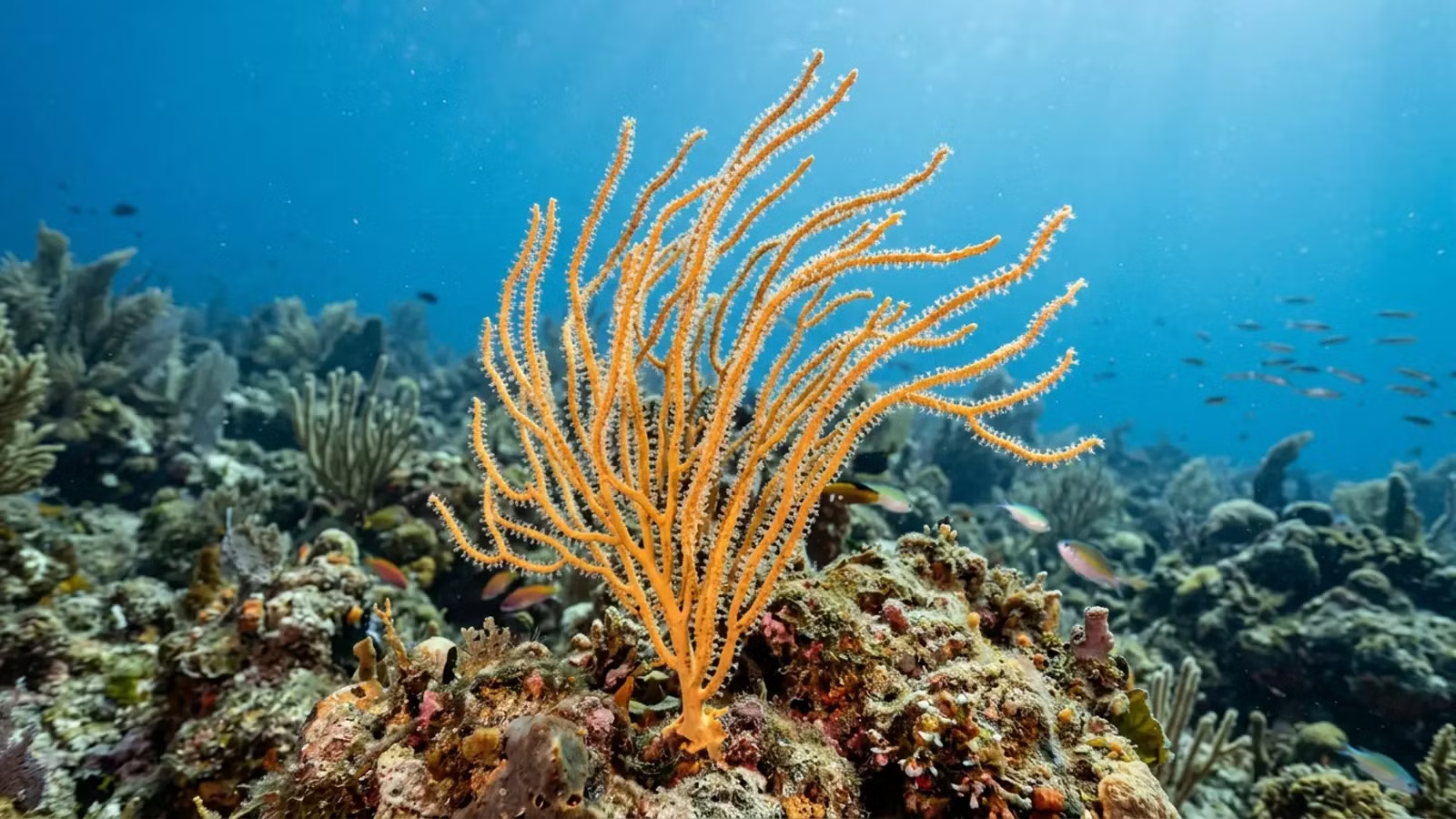
Sea Whip in its natural habitat, diving encounters and best destinations

Sea WhipWhere and when to see them

Up to 15 years

Want to dive with this animal?

Only destinations where this animal occurs.

The Sea Whip at a glance

The sea whip (Leptogorgia virgulata), also known as the colourful sea whip, is an octocorallian soft coral belonging to the family Gorgoniidae. Unlike stony corals, it lacks a heavy calcium carbonate skeleton, possessing instead a tough, flexible axial skeleton stiffened by microscopic sclerites and covered by an outer tissue layer called the coenenchyme. The colony features an upright growth pattern with slender, whip-like branches that branch sparsely near the base. Stems display vibrant, uniform colours ranging from yellow, orange, and bright red to mauve, violet, white, and creamsicle hues. Translucent white polyps line the branches in rows on both sides, with visible grooves running along older main branches.

Behaviour & reproduction

Size
Unknown
Weight
Varies by colony (sessile organisms)
Lifespan
Up to 15 years
Status
Not Evaluated

Adult colonies typically measure between 15 and 60 cm in height, though exceptional specimens can reach up to 1 metre (3.3 feet) in length. Because their internal framework is flexible, sea whip branches sway gracefully with ocean currents. The species reproduces sexually via broadcast spawning, with separate male and female colonies releasing gametes into the water column. Fertilized eggs develop into planktonic larvae that drift for 3 to 20 days before settling on suitable hard substrates and undergoing metamorphosis into founding polyps.

Top Locations

Diving Tips

Encounters with sea whips occur at shallow to moderate depths down to 20 metres (66 feet) on hard surfaces, including granite jetties, rocky reef ledges, shipwrecks, and wooden dock pilings. Because these slow-growing soft corals are easily dislodged, snagged, or broken by diving gear and passive fishing equipment like pots and traps, divers should maintain precise neutral buoyancy and keep fins well clear of the benthic substrate.

To get the most out of a sea whip encounter, slow down and examine the individual whip stems closely using a light. The flexible branches frequently harbour highly camouflaged organisms that are easy to miss during a quick swim. Look for the colourless sea whip slug (*Tritonia wellsi*), whose branching gills mimic extended polyps, or search for the small shrimp *Neopontonides beaufortensis* and the sea whip snail *Simnialena marferula* clinging to the stems. Avoid touching the coral tissues, as physical contact can disrupt feeding polyps, damage the protective coenenchyme, and expose the underlying axial skeleton to biofouling or infection.

Fun facts about the Sea Whip

  • Chemicals produced by the sea whip cause emetic responses in fish, effectively teaching predators to avoid eating the coral.
  • The sea whip slug (Tritonia wellsi) is completely colourless and features branching gills that closely resemble the soft coral's polyps.
  • The sea whip snail (Simnialena marferula) feeds on debris on the stems and absorbs the coral's pigments to match its exact colour.
  • The barnacle Conopea galeata is an obligate commensal whose presence prompts the sea whip's live tissue to grow around it, leaving only a tiny feeding aperture.

Best time to see the Sea Whip

Sea whip colonies are sessile, slow-growing soft corals that remain present year-round across their native range on temperate and sub-tropical Atlantic reefs. Dive conditions around sea whips vary primarily according to regional weather, water clarity, and seasonal oceanographic changes rather than coral migrations. In regions such as the Mid-Atlantic Bight, South Carolina, Georgia, and the Gulf of Mexico, diving is typically most accessible during months with calm sea conditions and minimal freshwater runoff.

Seasonal dynamics affect the species associated with sea whips. For instance, in coastal seagrass meadows dominated by *Thalassia testudinum*, the seasonal winter die-back of sea grass forces mobile organisms such as decapod crustaceans to migrate directly into nearby sea whip colonies for refuge. Reproductive events occur through broadcast spawning into the water column, after which planktonic larvae settle within 3 to 20 days. Divers planning to photograph these corals and their associated fauna should target dive windows when wave action along shallow jetties and inshore reefs is low.

Where the Sea Whip lives

Sea whips are distributed along the western fringes of the Atlantic Ocean, ranging from Chesapeake Bay southwards along the southeastern United States coastline and the Gulf of Mexico, extending as far south as Brazil. They inhabit shallow coastal shelf reefs, estuaries, and bays at depths ranging from near the surface down to 20 metres (66 feet).

These soft corals require a hard substrate for larval settlement and attachment. They readily colonize natural granite and limestone rock edges, outcroppings, and ledges, as well as man-made structures such as shipwrecks, artificial reefs, and coastal jetty rocks. Sea whips exhibit a tolerance for low salinity levels in estuaries, though they thrive best in high-salinity marine environments. In some shallow regions, colonies grow interspersed within *Thalassia testudinum* seagrass beds. Their presence adds essential vertical relief to otherwise uniform seafloors, creating crucial structural habitat for nearshore marine life.

What the Sea Whip eats

The sea whip is a carnivorous suspension feeder that relies on passing ocean currents to deliver food to the colony. Each translucent white polyp features eight tentacles equipped with specialized stinging cells called nematocysts, as well as eight mesenteries and a single siphonoglyph, characteristic of octocorallians.

The primary diet of *Leptogorgia virgulata* consists of zooplankton wafted past the branches by tidal and wave-driven currents. Polyps extend their tentacles into the water column to capture planktonic organisms, transferring them directly to the mouth for digestion. Feeding activity is tied to current movement rather than a strict time of day; polyps emerge and open whenever plankton-rich currents flow past the reef. When currents are still, or when the colony is disturbed by predators or divers, the polyps fully retract into distinct grooves along the main branches, giving the stems a smooth appearance.

Sea Whip: frequently asked questions

When is the best time to see Sea Whip?
Sea whip colonies are sessile, slow-growing soft corals that remain present year-round across their native range on temperate and sub-tropical Atlantic reefs. Dive conditions around sea whips vary primarily according to regional weather, water clarity, and seasonal oceanographic changes rather than coral migrations. In regions such as the Mid-Atlantic Bight, South Carolina, Georgia, and the Gulf of Mexico, diving is typically most accessible during months with calm sea conditions and minimal freshwater runoff. Seasonal dynamics affect the species associated with sea whips. For instance, in coastal seagrass meadows dominated by *Thalassia testudinum*, the seasonal winter die-back of sea grass forces mobile organisms such as decapod crustaceans to migrate directly into nearby sea whip colonies for refuge. Reproductive events occur through broadcast spawning into the water column, after which planktonic larvae settle within 3 to 20 days. Divers planning to photograph these corals and their associated fauna should target dive windows when wave action along shallow jetties and inshore reefs is low.
How big does Sea Whip get?
Sea Whip: Unknown
Is Sea Whip dangerous for divers?
Encounters with sea whips occur at shallow to moderate depths down to 20 metres (66 feet) on hard surfaces, including granite jetties, rocky reef ledges, shipwrecks, and wooden dock pilings. Because these slow-growing soft corals are easily dislodged, snagged, or broken by diving gear and passive fishing equipment like pots and traps, divers should maintain precise neutral buoyancy and keep fins well clear of the benthic substrate. To get the most out of a sea whip encounter, slow down and examine the individual whip stems closely using a light. The flexible branches frequently harbour highly camouflaged organisms that are easy to miss during a quick swim. Look for the colourless sea whip slug (*Tritonia wellsi*), whose branching gills mimic extended polyps, or search for the small shrimp *Neopontonides beaufortensis* and the sea whip snail *Simnialena marferula* clinging to the stems. Avoid touching the coral tissues, as physical contact can disrupt feeding polyps, damage the protective coenenchyme, and expose the underlying axial skeleton to biofouling or infection.
What is the conservation status of Sea Whip?
Sea Whip: Not Evaluated
Plan your trip

Ready to dive with these animals?

Choose a destination or search every available vessel to find the liveaboard that matches the marine life you want to see.