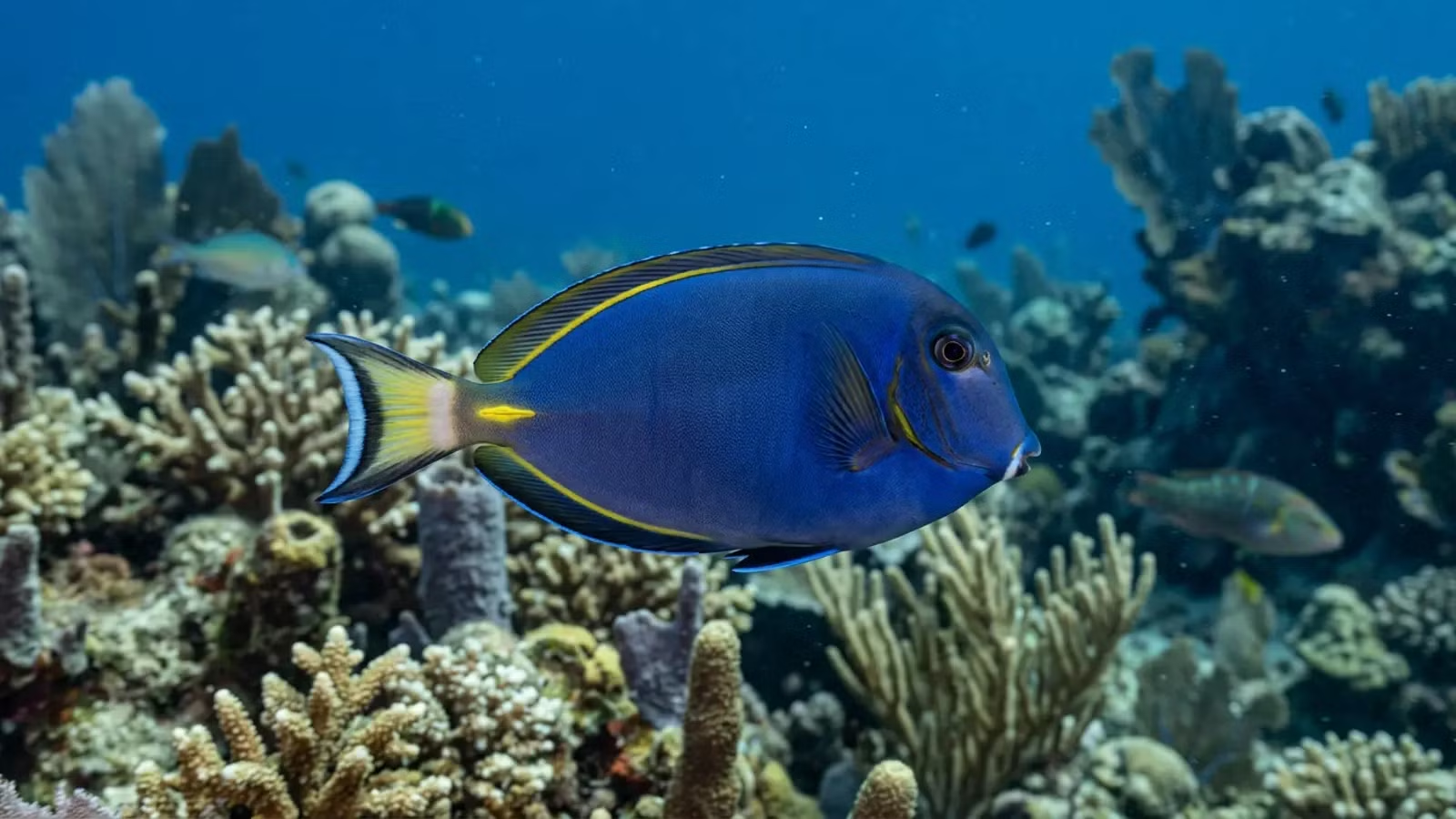
Blue Tang in its natural habitat, diving encounters and best destinations

Blue TangWhere and when to see them

12-15 years

Want to dive with this animal?

Only destinations where this animal occurs.

The Blue Tang at a glance

The blue tang is one of the most distinctive surgeonfishes encountered by divers on tropical reefs. Broadly referring to species such as Acanthurus coeruleus (Atlantic blue tang) and Paracanthurus hepatus (Indo-Pacific blue tang), these laterally compressed, pancake-shaped fish are easily identified by high-set eyes, small low-slung mouths, and vivid blue coloration. Mature Acanthurus coeruleus exhibit deep blue to purplish bodies accented by golden-blue fin edges, while Paracanthurus hepatus features a brilliant royal blue body, black palette-like markings, and a bright yellow tail fin.

Coloration in Acanthurus coeruleus changes dramatically across growth stages. Juveniles emerge bright yellow with blue-ringed eyes or blue fin margins, shifting into an intermediate adolescent phase characterized by a purplish-grey body, yellow tail fin, and blue-and-orange diagonal striping along the dorsal and anal fins. Transition into adult coloration is not purely size-dependent. Adults can also temporarily alter their shade from pale white to near-black when communicating or courting. Under blue or ultraviolet light, Acanthurus coeruleus exhibits green biofluorescence.

Behaviour & reproduction

Size
Unknown
Weight
1.1 kg
Lifespan
12-15 years
Status
Not Evaluated

During the day, adult blue tangs display three distinct social behaviours: territorial, wandering, or schooling. Schooling individuals form non-aggressive, multi-species foraging groups alongside doctorfish (Acanthurus chirurgus) and other surgeonfishes. Juveniles are secretive and solitary, remaining closely bound to protective reef shelter. Divers cherish blue tangs for their high-energy grazing patrols, brilliant palette of colours, and fascinating mutualistic interactions with turtles and cleaner fish across global reef ecosystems.

Diving Tips

Divers can easily observe blue tangs during daylight hours as they actively roam shallow reef flats and coral crests. When approaching schooling or feeding groups, maintain calm, neutral buoyancy and avoid sudden movements, as blue tangs easily move off if threatened. Be cautious around their caudal peduncle spines, which are razor-sharp and capable of inflicting painful wounds if a fish is cornered or handled. *Paracanthurus hepatus* also bears venomous fin spines.

Keep an eye out around coral outcrops for cleaning stations. Blue tangs act as both clients and cleaners. When visiting cleaner gobies, tangs adopt a distinctive headstand posture to signal readiness for parasite removal. At other stations, blue tangs act as cleaners for green sea turtles (*Chelonia mydas*), hovering around the turtle's flippers, head, and carapace to nip off ectoparasites and molted skin.

Night divers will find blue tangs resting motionless inside dark coral holes and crevices. During sleep, Atlantic blue tangs exhibit a stress or resting pattern marked by conspicuous white vertical stripes along their bodies. Always avoid shining dive lights directly into sleeping crevices to refrain from disturbing their rest.

Fun facts about the Blue Tang

  • Atlantic blue tangs undergo dramatic colour shifts, starting as bright yellow juveniles before transforming into deep blue adults.
  • When illuminated by blue or ultraviolet light, Atlantic blue tangs display green biofluorescence.
  • When visiting cleaner goby stations, blue tangs signal their readiness almost exclusively by posing in headstands.
  • Blue tangs act as cleaners for green sea turtles, picking off parasites and molted skin from their flippers, head, and carapace.

Best time to see the Blue Tang

Blue tangs can be encountered year-round on warm tropical reefs throughout their respective native ranges. However, specific seasonal phenomena offer unique observation opportunities for scuba divers. In Atlantic regions such as Florida, the Bahamas, and the Caribbean, spawning activity for *Acanthurus coeruleus* peaks during the winter months. Massive spawning aggregations gather three to eight days following the full moon, offering divers a chance to observe dramatic courting behaviours.

During these winter spawning events, small groups travel from adjacent reefs to coalesce into large aggregations numbering over one hundred individuals. Mating readiness is visually signaled as adults alter their body coloration, turning pale blue on their front half and dark blue on their rear half. Courting groups perform rapid upward spawning rushes toward the surface in the late afternoon to release eggs and sperm into strong offshore currents.

In Indo-Pacific locations like the Coral Sea and Australia's Great Barrier Reef, dense schools of juvenile *Paracanthurus hepatus* are commonly spotted during spring and late spring months (such as November at Osprey Reef) seeking cover among branching hard corals at shallow depths.

Where the Blue Tang lives

Blue tangs inhabit tropical marine environments ranging from 41° N to 33° S, living at depths between 2 and 40 metres in ocean temperatures typically between 24°C and 26°C. *Acanthurus coeruleus* ranges across the western Atlantic Ocean from New York and Bermuda down through Florida, the Gulf of Mexico, the Bahamas, the Caribbean Sea, and south to Brazil, as well as Ascension Island in the mid-Atlantic and the Mediterranean Sea (recorded since 2011). *Paracanthurus hepatus* occurs across the Indo-West Pacific, including nearly the entire length of the Great Barrier Reef and the Coral Sea.

Their primary habitat centers on hard-coral reefs, though they are frequently found near soft corals, coral rubble, algal beds, and seagrass beds. Juveniles heavily depend on high biogenic structure and dense coral cover to evade predators. Adults utilize open reef zones, while breeding aggregations specifically gather over flat, sandy substrate patches between coral heads where 6 to 10 metre depths and strong currents help sweep pelagic eggs out to sea. At night, individuals seek refuge inside tight coral holes and crevices.

What the Blue Tang eats

Adult blue tangs are primarily herbivorous grazers. In the Atlantic, *Acanthurus coeruleus* feeds mainly on filamentous algae, detritus, and plankton, whereas Indo-Pacific species like *Paracanthurus hepatus* consume zooplankton alongside algae and marine plants. Because blue tangs possess digestive systems efficient at absorbing crushed cellular contents but poor at processing cellulose, they must forage heavily and continuously throughout the day on abundant, fast-growing algae. High juvenile feeding rates are required due to this low food utilization efficiency.

By constantly cropping algae from coral substrates, blue tangs perform a vital ecological service, preventing fast-growing algal turf from suffocating live coral colonies. Their population density and territory size are directly tied to food availability; lower-structure reefs require larger home ranges to provide sufficient forage. In addition to substrate grazing, blue tangs exhibit cleaning behavior, feeding on molted skin and ectoparasites picked off client animals like green sea turtles (*Chelonia mydas*).

Blue Tang: frequently asked questions

When is the best time to see Blue Tang?
Blue tangs can be encountered year-round on warm tropical reefs throughout their respective native ranges. However, specific seasonal phenomena offer unique observation opportunities for scuba divers. In Atlantic regions such as Florida, the Bahamas, and the Caribbean, spawning activity for *Acanthurus coeruleus* peaks during the winter months. Massive spawning aggregations gather three to eight days following the full moon, offering divers a chance to observe dramatic courting behaviours. During these winter spawning events, small groups travel from adjacent reefs to coalesce into large aggregations numbering over one hundred individuals. Mating readiness is visually signaled as adults alter their body coloration, turning pale blue on their front half and dark blue on their rear half. Courting groups perform rapid upward spawning rushes toward the surface in the late afternoon to release eggs and sperm into strong offshore currents. In Indo-Pacific locations like the Coral Sea and Australia's Great Barrier Reef, dense schools of juvenile *Paracanthurus hepatus* are commonly spotted during spring and late spring months (such as November at Osprey Reef) seeking cover among branching hard corals at shallow depths.
How big does Blue Tang get?
Blue Tang: Unknown
Is Blue Tang dangerous for divers?
Divers can easily observe blue tangs during daylight hours as they actively roam shallow reef flats and coral crests. When approaching schooling or feeding groups, maintain calm, neutral buoyancy and avoid sudden movements, as blue tangs easily move off if threatened. Be cautious around their caudal peduncle spines, which are razor-sharp and capable of inflicting painful wounds if a fish is cornered or handled. *Paracanthurus hepatus* also bears venomous fin spines. Keep an eye out around coral outcrops for cleaning stations. Blue tangs act as both clients and cleaners. When visiting cleaner gobies, tangs adopt a distinctive headstand posture to signal readiness for parasite removal. At other stations, blue tangs act as cleaners for green sea turtles (*Chelonia mydas*), hovering around the turtle's flippers, head, and carapace to nip off ectoparasites and molted skin. Night divers will find blue tangs resting motionless inside dark coral holes and crevices. During sleep, Atlantic blue tangs exhibit a stress or resting pattern marked by conspicuous white vertical stripes along their bodies. Always avoid shining dive lights directly into sleeping crevices to refrain from disturbing their rest.
What is the conservation status of Blue Tang?
Blue Tang: Not Evaluated
Plan your trip

Ready to dive with these animals?

Choose a destination or search every available vessel to find the liveaboard that matches the marine life you want to see.