About Flying Fish
The Flying Fish dive site, located off the coast of Kaş, Turkey, is celebrated as one of the country's premier underwater destinations. It centers around an impressive underwater mountain whose peak lies just six meters below the surface. This site is particularly renowned for its historical wreck, an Italian WWII Savoia-Marchetti SM.79 "Sparviero" bomber, which adds a unique historical dimension to the dive experience. The topography transitions from the shallow peak down to deeper sections, with large rock formations providing shelter and interesting swim-throughs below 10 meters. The wreck itself rests at deeper levels, extending down to 70 meters, making it accessible for advanced and technical divers. The site is characterized by its incredible visibility, often exceeding 40 meters, which allows divers to fully appreciate the vast underwater landscape and the details of the wreck. While the Mediterranean is not always known for its dense biomass, Flying Fish frequently delivers sightings of larger pelagic species such as jacks, groupers, and tuna, especially where currents are present. Smaller reef fish, sea bream, and octopuses are also common in the calmer areas. The best time to experience this vibrant marine life is during the warmer months when water temperatures are comfortable and pelagic activity increases. Diving here often involves navigating currents, particularly during the descent. However, once below 10 meters, divers can find more sheltered areas to explore. This site offers a rich blend of history, diverse marine encounters, and dramatic underwater scenery, suitable for divers with varying experience levels who are comfortable with potential currents and deeper dives.
Highlights
Italian WWII bomber wreckUnderwater mountain topographyExceptional 40+ meter visibilityJacks, groupers, and tuna sightingsHistorical amphoraeVibrant reef ecosystems
Season calendar
Best months to dive here
Jan
Feb
Mar
Apr
May
Jun
Jul
Aug
Sep
Oct
Nov
Dec
Excellent
Good
Dive site facts: Flying Fish
- Depth
- 6–70 m
- Typical dive
- 20–40 m
- Current
- Moderate to strong (surface), mild (below 10m)
- Visibility
- 40+ m
- Water temperature
- 20–28 °C
- Entry
- Boat / negative entry often required
- Level
- Advanced Open Water Diver (AOWD) recommended
- Dive type
- Wreck, reef, deep
- Night dive
- Possible (check with operator)
- Region / port
- Kaş, Antalya
- Coordinates
- 36.19, 29.61
Conditions & Currents
Currents at Flying Fish are a significant factor, especially at the surface and during the initial descent to the main reef. While often strong at the surface, they tend to diminish or become more manageable below six meters. Divers should be prepared for potential drift and plan their entry and descent accordingly. Below 10 meters, large rock formations offer sheltered areas where divers can rest and observe marine life without battling strong flows. Visibility is consistently excellent, often exceeding 40 meters, even with currents, allowing for clear views of the wreck and surrounding topography. This makes current experience beneficial for fully enjoying the dive.
Marine life & sighting chances

Jacks
Summer, Autumn · common
Groupers
Year-round · common
Tuna
Summer, Autumn · occasional
Sea Bream
Year-round · common
Octopus
Year-round · occasional
Wrasse
Year-round · common
Mediterranean Monk Seal
Year-round · rare
Caretta caretta (Loggerhead sea turtle)
Summer · occasional
Green Sea Turtle
Summer · occasional
Moray Eels
Year-round · occasionalDive profile & how the dive runs
Divers typically begin their descent at the pinnacle of the underwater mountain, located about six meters below the surface. Due to potential currents, a swift, controlled descent is often recommended. The dive route generally follows the contours of the mountain, exploring rock formations and quieter areas between 10 and 30 meters. From 20 to 30 meters, divers can begin to see parts of the Italian aircraft wreck. For those wishing to explore the deeper sections of the wreck, which lie at 70 meters, specific planning and appropriate certification are required. The turn point is determined by air consumption and no-decompression limits, with the ascent usually made along the reef wall back towards the shallower sections. Safety stops are conducted in the clear, shallow water of the reef top, offering panoramic views of the surrounding blue.
Underwater photography
Flying Fish offers exceptional opportunities for both wide-angle and macro photography, thanks to its outstanding visibility and diverse subjects. For the Italian WWII bomber wreck, a wide-angle lens is ideal to capture its scale and the dramatic underwater topography, especially given the abundant natural light penetration. For marine life such as jacks, groupers, and sea bream, a wide-angle or fisheye lens will perform well in the clear water. Macro lenses are suitable for capturing smaller critters like octopuses or nudibranchs found in the reef's crevices. Given the potential for currents, maintaining excellent buoyancy control is crucial for sharp images and to avoid stirring up sediment. Consider using strobes to bring out the vibrant colors, particularly on the deeper parts of the wreck and any remaining coral growth.
Combine with nearby dive sites
- Canyon Dive (Kaş)
Famous for its underwater canyon and wreck
- SAS Wreck (Kaş)
Another significant wreck dive in the Kaş area
- Fener Adası (Kaş)
Known for diverse marine life and interesting topography
- Italian WWII Plane Wreck (Kaş)
The deeper parts of the Flying Fish wreck itself
- Amphora Reef
Features ancient amphorae and rich history
Getting there & logistics
The primary gateway to Flying Fish is through Kaş, a well-known diving hub in Turkey. Travelers typically fly into Antalya Airport (AYT) or Dalaman Airport (DLM), then take a transfer to Kaş, which is about a 2-3 hour drive from either. Dive trips are usually day excursions from Kaş, involving a short boat ride to the site. Most dive centers in Kaş offer packages including equipment, guides, and boat trips. There are no specific park fees for diving at Flying Fish, but dive center costs vary. Liveaboards occasionally visit this site as part of broader itineraries along the Turkish coast, combining it with other notable wrecks and reefs.
Safety & environment
Diving at Flying Fish requires careful attention to safety protocols, particularly due to the potential for strong currents and the depth of the wreck. It is essential to dive with a reputable, PADI-certified operator from Kaş. Divers must hold appropriate certifications, such as Advanced Open Water Diver, and be comfortable with deeper profiles. The nearest recompression chamber is in Antalya, emphasizing the importance of conservative dive planning and strict adherence to no-decompression limits. Divers should always carry valid dive insurance that covers emergency medical treatment and evacuation. Respecting the historical nature of the wreck by not touching or removing artifacts is also a crucial conduct rule at this site.
Who it suits — and who it doesn't
Suited for
- Advanced Open Water Divers
- Wreck diving enthusiasts
- Underwater photographers
- Divers seeking pelagic encounters
- Divers comfortable with currents
- Those interested in historical sites
Less suited for
- Beginner divers
- Divers uncomfortable with deep dives
- Those who dislike currents
- Divers with limited buoyancy control
- Individuals without appropriate certification
FAQ
Flying Fish FAQ
What kind of wreck is at the Flying Fish dive site?
The Flying Fish dive site features the wreck of an Italian WWII Savoia-Marchetti SM.79 "Sparviero" bomber. This historical aircraft rests in multiple sections, with some parts accessible at moderate depths and others extending to 70 meters, offering a unique exploration opportunity.
What is the typical visibility at Flying Fish?
Visibility at Flying Fish is exceptionally clear, often exceeding 40 meters. This outstanding clarity allows divers to fully appreciate the vast underwater landscape, the bomber wreck, and the diverse marine life from a distance, making it a favorite for underwater photographers.
Are there strong currents at Flying Fish?
Currents at Flying Fish can be moderate to strong, especially at the surface and during the initial descent. However, below 10 meters, large rock formations provide more sheltered areas. Divers with experience in currents will find it easier to navigate and enjoy this dynamic dive site.
What marine life can I expect to see?
Divers at Flying Fish can expect to encounter various marine species, including schools of jacks, large groupers, and occasional tuna. In the calmer reef sections, you might spot sea bream, Turkish wrasse, and octopuses. Mediterranean monk seals are rare but have been sighted in the wider region.
What is the best time of year to dive Flying Fish?
The prime diving season for Flying Fish, and Turkey in general, runs from May to November. During these months, water temperatures are warmer and visibility is at its best, enhancing the overall dive experience. Spring and autumn mornings are particularly recommended for calmer sea conditions.
Is Flying Fish suitable for beginner divers?
Flying Fish is generally not recommended for beginner divers due to its depth, potential strong currents, and the need for good buoyancy control around the wreck. It is best suited for Advanced Open Water Divers or those with equivalent experience who are comfortable with these conditions.
Why dive Flying Fish from a liveaboard?
Flying Fish is one of Turkey's signature dive sites. A liveaboard sleeps you on the water and puts you in the water for three to four guided dives per day, including dawn and night dives that day-boat operators rarely offer. You skip the daily commute back to port and reach quieter, less-crowded sites in the same region on a single trip.
Below are the liveaboards that include Flying Fish on their Turkey itineraries.
Liveaboards diving Flying Fish
These liveaboards may visit Flying Fish on selected itineraries — the exact dive sites depend on departure, weather and conditions.
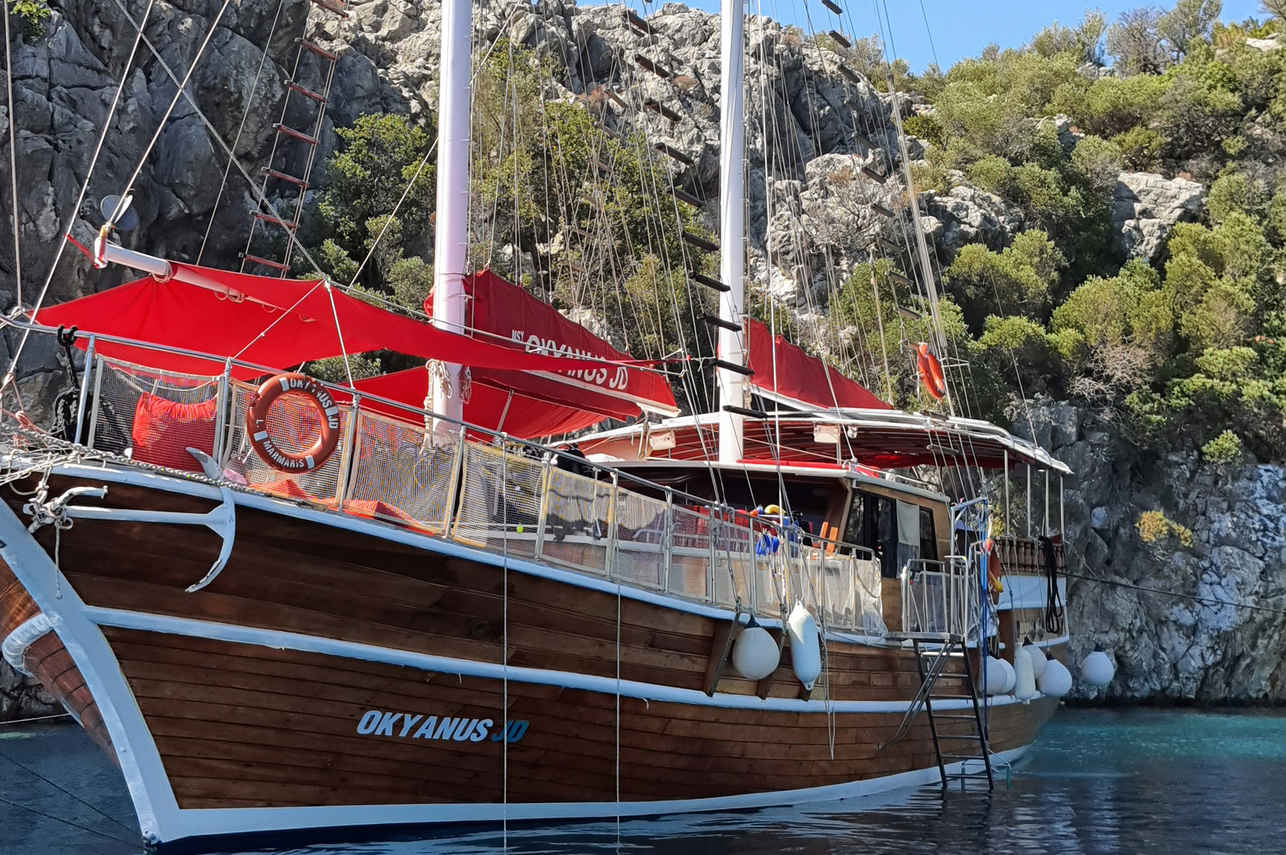
Okyanus JD
Turkey
12 guests24 m
$157/day
Dive sites similar to Flying Fish
Same character, same waters — six more sites divers love for the exact same reasons.Compare seasons, access and liveaboard routes — then pick the site that fits your trip best.
© Esri — Maxar, Earthstar, GIS
Catermaran Wreck
Turkey
The Turkish coast, particularly the Riviera, offers diverse diving experiences, including a variety of wrecks.
- Suitable for
- Intermediate
- Current
- Moderate
- Access
- Liveaboard or dayboat
- Depth
- —
- Theme
- Wreck
© Esri — Maxar, Earthstar, GIS
Tank Wreck
Turkey
The Güvercin Ada / Tank Wreck dive site, located near Kaş, Turkey, combines a calm reef with a unique blend of sunken elements, including a sculpture and various wreck components.
- Suitable for
- Intermediate
- Current
- Moderate
- Access
- Liveaboard or dayboat
- Depth
- 21–21 m
- Theme
- Wreck
© Esri — Maxar, Earthstar, GIS
Coastguard Wreck
Turkey
The Coastguard Wreck is a Fethiye boat dive, featuring a retired coast guard ship scuttled to form an artificial reef alongside a natural reef structure.
- Suitable for
- Intermediate
- Current
- Moderate
- Access
- Liveaboard or dayboat
- Depth
- 27–30 m
- Theme
- Wreck
© Esri — Maxar, Earthstar, GIS
Coast Guard Ship Wreck
Turkey
The Coast Guard Ship Wreck is an advanced dive site situated near Bodrum in the Aegean Sea.
- Suitable for
- Intermediate
- Current
- Moderate
- Access
- Liveaboard or dayboat
- Depth
- 3–29 m
- Theme
- Wreck
© Esri — Maxar, Earthstar, GIS
Saint Didier
Turkey
The Saint Didier is Turkey's largest accessible shipwreck, a significant historical site located a short boat ride from Antalya's yacht harbor.
- Suitable for
- Advanced
- Current
- Mild
- Access
- Dayboat
- Depth
- 16–31 m
- Theme
- Wreck
© Esri — Maxar, Earthstar, GIS
Monem Wreck
Turkey
The Monem Wreck lies in the clear Aegean waters near the Karaburun peninsula, west of İzmir, off the coast of Çeşme, Turkey.
- Suitable for
- Advanced
- Current
- Mild
- Access
- Dayboat
- Depth
- 18–18 m
- Theme
- Wreck / Reef