About Italian WWII Plane Wreck (Kaş)
The Italian WWII Plane Wreck, known locally as "Flying Fish," offers a compelling dive into history off the coast of Kaş. This well-preserved Savoia-Marchetti SM.79 Sparviero bomber, shot down in WWII, lies at significant depths, providing a technical diving experience. The wreck's propeller and wings remain largely intact, creating striking visual interest, while its fuselage has transformed into an artificial reef, attracting various Mediterranean marine species. It is considered one of Turkey's most iconic deep dives, demanding advanced certification and experience due to its depth and the technical nature of the descent. This site's deep location contributes to its excellent preservation and the pristine condition of its surroundings. The bomber settled on the seabed at depths ranging from 55 to 73 meters, with parts of the aircraft resting at 62 meters. Over time, some sections, like the propellers and fuselage, have shown signs of natural degradation due to oxidation and the elements, but the general form of the aircraft is still recognizable, offering a poignant glimpse into its past. The clear waters of Kaş provide exceptional visibility, often exceeding 30 meters, enhancing the experience of exploring this historical relic. While the site itself is primarily about the wreck, its artificial reef qualities attract various fish. The diving season in Kaş, stretching from April to November, allows for ample opportunities to visit, with autumn months offering a balance of warm water and fewer crowds. Access to the site is typically via a short boat ride from Kaş, making it convenient for divers based in the town or on liveaboards. Due to the depth and technical requirements, dives here are carefully planned and executed, often utilizing mixed-gas techniques. The site provides a profound experience for those seeking to combine historical exploration with advanced scuba diving.
Highlights
WWII Italian bomber wreckTechnical deep diveIntact propeller and wingsHistorical artifactArtificial reef habitatExceptional visibilitySignature Kaş dive site
Season calendar
Best months to dive here
Jan
Feb
Mar
Apr
May
Jun
Jul
Aug
Sep
Oct
Nov
Dec
Excellent
Good
Off-Season
Jun – Sep (Peak)
Warmest Mediterranean waters up to 27°C, visibility up to 40m, calmest seas. Perfect for all dive types.
May & Oct (Shoulder)
Pleasant conditions, fewer crowds. Water 20-22°C. Good visibility. Best value for money.
Nov – Apr (Winter)
Cold water (15-17°C), reduced visibility, rougher seas. Most dive centers close seasonally.
Dive site facts: Italian WWII Plane Wreck (Kaş)
- Depth
- 55–73 m
- Current
- Mild
- Visibility
- 30+ m
- Water temperature
- 16–29°C
- Entry
- Boat
- Level
- Technical diver
- Dive type
- Wreck, deep
- Night dive
- Not typical
- Region / port
- Kaş, Turkey
- Coordinates
- 36.1833, 29.6167
Conditions & Currents
The Italian WWII Plane Wreck site generally experiences mild currents. Entry techniques are typically straightforward, given the relatively calm conditions. Divers should be prepared for gentle water movement, which usually does not pose significant challenges but requires standard current diving protocols.
Marine life & sighting chances

Sponges
common
Barracuda
occasional
Grouper
occasional
Loggerhead Sea Turtle
Summer · occasional
Nudibranch
occasional
Ray
occasional
Seahorse
June–October · rare
Moray Eel
occasional
Octopus
occasional
Red Shrimp
rareDive profile & how the dive runs
The Italian WWII Plane Wreck dive begins with a boat descent over the wreck site, requiring precise negative entry due to its depth. Divers follow the guide down to the bomber, which lies between 55 and 73 meters. The dive typically involves exploring the intact sections of the aircraft, including the wings and propeller, while maintaining careful buoyancy to avoid disturbing the wreck or the seabed. The route often involves circumnavigating the main fuselage, observing the structural degradation and marine growth. Turnaround points are strictly dictated by gas management and decompression limits. Ascent is slow, with multiple decompression stops conducted in the clear blue water above the wreck, followed by a safety stop at 5 meters. This is a demanding technical dive requiring meticulous planning and execution.
Underwater photography
Capturing the Italian WWII Plane Wreck demands specialized equipment and skills due to its significant depth. A wide-angle lens is essential to encompass the bomber's structure and its surrounding environment, especially to convey the scale of the wreck against the deep blue. External strobes are highly recommended to bring out the colors and details lost to depth, and powerful video lights are crucial for filming. Excellent buoyancy control is paramount to avoid silting up the wreck and to maneuver safely in proximity to the fragile remains. Given the technical nature of the dive, photographers must be proficient in mixed-gas diving and adhere strictly to dive plans and decompression schedules. Documenting this historical site requires respectful interaction, ensuring no contact is made with the wreck to preserve its integrity.
Combine with nearby dive sites
- Canyon Dive (Kaş)
Features dramatic walls and a swim-through cavern, often combined with the nearby Dimitri-Pamuk wreck.
- SAS Wreck (Kaş)
An artificial wreck creating an exciting dive for various skill levels.
- Fener Adası (Kaş)
Known for its vibrant marine life and diverse topography.
- Lighthouse Reef (Kaş)
Offers reef diving with good opportunities for spotting local marine species.
- Sunken City of Kekova
Historic site with visible ruins, though diving directly on the protected areas is restricted.
Getting there & logistics
Access to the Italian WWII Plane Wreck is primarily from Kaş, a town on Turkey's southwest coast. The nearest airports are Antalya (AYT) and Dalaman (DLM), each approximately 2.5 hours' drive from Kaş. Divers typically stay in Kaş, departing daily by boat, or join liveaboard itineraries that include this site. Dive trips to the wreck are usually part of a multi-day diving package focusing on the Kaş region's diverse sites. As a technical dive, specialized equipment and guides are necessary, and these are generally arranged through local dive centers. No specific park fees are mentioned for this dive site, but standard dive operation costs apply.
Safety & environment
Diving the Italian WWII Plane Wreck is a deep technical dive, requiring advanced planning and adherence to strict safety protocols. Divers must be certified for technical diving, proficient in mixed-gas techniques, and have substantial deep diving experience. The nearest recompression chamber is located in Antalya, approximately 3-4 hours away, emphasizing the critical importance of avoiding decompression sickness. Comprehensive dive insurance covering technical diving and potential medical evacuation is mandatory. Site-specific hazards include depth-related risks, potential equipment malfunction in a demanding environment, and the need for impeccable buoyancy control to prevent entanglement or damage to the fragile wreck. Always dive with a reputable operator and an experienced technical guide.
Who it suits, and who it doesn't
Suited for
- Experienced technical divers
- Wreck enthusiasts
- Deep diving specialists
- Underwater historians
- Photographers with deep experience
Less suited for
- Beginner divers
- Open Water certified divers
- Divers without technical training
- Those prone to narcosis
- Divers without proper deep dive insurance
FAQ
Italian WWII Plane Wreck (Kaş) FAQ
What kind of wreck is the Italian WWII Plane Wreck?
This is the remains of an Italian Savoia-Marchetti SM.79 Sparviero bomber from World War II. It was shot down by British anti-aircraft fire and sank off the coast of Kaş. The wreck provides a historical insight into military aviation of that era.
What is the depth range of the plane wreck?
The Italian WWII Plane Wreck rests at significant depths, ranging from 55 to 73 meters. Divers will find parts of the aircraft at varying depths within this range, requiring advanced technical diving skills to explore safely.
What specific skills are required to dive this site?
Diving the Italian WWII Plane Wreck demands technical diving certification, proficiency in mixed-gas techniques, and extensive experience with deep dives. It is not suitable for recreational divers due to the extreme depth and complexity of the dive profile.
What marine life can be observed around the wreck?
While the primary attraction is the wreck itself, the fuselage has become an artificial reef. Divers may observe sponges, various Mediterranean fish species, and occasionally grouper or barracuda. The marine life here adapts to the deep, ambient conditions.
Is the wreck still intact or has it deteriorated?
The wreck, while remarkably preserved for its age and depth, has experienced natural deterioration due to oxidation and the elements. Some propellers have broken, and the fuselage and tail are no longer entirely intact, but the overall structure remains identifiable, offering a poignant visual.
How clear is the water at the Italian WWII Plane Wreck site?
Visibility at this dive site is exceptional, often exceeding 30 meters. The clear Mediterranean waters enhance the experience of exploring the deep wreck, allowing divers to appreciate its details and scale against a pristine blue backdrop.
Why dive Italian WWII Plane Wreck (Kaş) from a liveaboard?
Italian WWII Plane Wreck (Kaş) is one of Turkey's signature dive sites. A liveaboard sleeps you on the water and typically offers several guided dives per day (the exact number depends on the vessel and itinerary), including dawn and night dives that day-boat operators rarely offer. You skip the daily commute back to port and reach quieter, less-crowded sites in the same region on a single trip.
Liveaboards diving Italian WWII Plane Wreck (Kaş)
These liveaboards may visit Italian WWII Plane Wreck (Kaş) on selected itineraries, the exact dive sites depend on departure, weather and conditions.
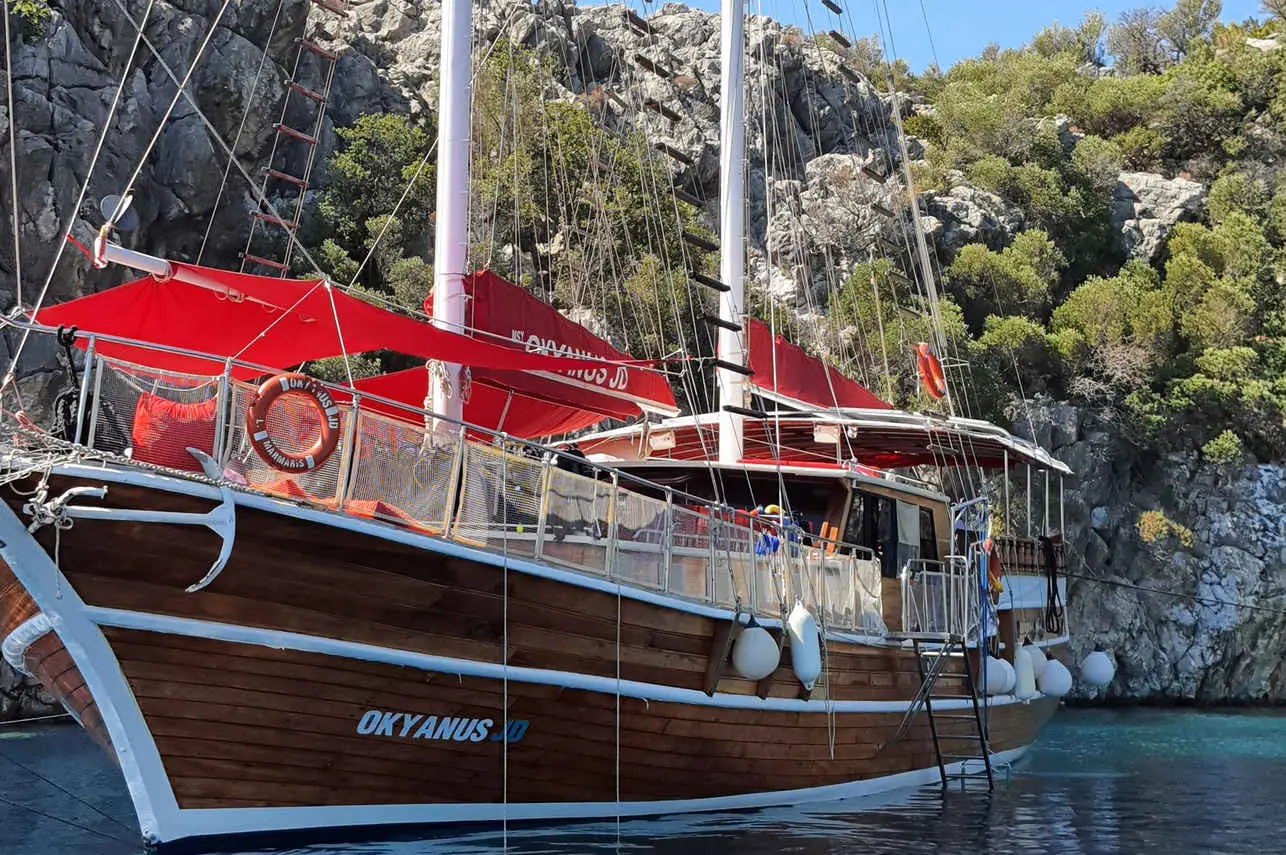
Okyanus JD
Turkey
12 guests24 m
Dive sites similar to Italian WWII Plane Wreck (Kaş)
Same character, same waters, six more sites divers love for the exact same reasons.Compare seasons, access and liveaboard routes, then pick the site that fits your trip best.
Abdi Reis is a highly regarded dive site situated near the Datça Peninsula in Turkey's Aegean Sea, specifically located within Abdi Reis Cove, near Yildiz Island.
- Suitable for
- Intermediate
- Current
- Moderate
- Access
- Liveaboard or dayboat
- Depth
- ≤ 33 m
- Theme
- Reef / Wall
© EsriMaxar, Earthstar, GIS
Adabanko Reef
Turkey
Adabanko Reef is an inviting dive site situated approximately two kilometers off the coast of Kuşadası in Turkey's Aegean Sea.
- Suitable for
- Beginner
- Current
- Moderate
- Access
- Liveaboard or dayboat
- Depth
- 5–40 m
- Theme
- Reef
© EsriMaxar, Earthstar, GIS
Adakule Cave
Turkey
Adakule Cave is a notable boat-access dive site located near Kuşadası, Turkey, offering an engaging experience centered around two distinct underwater caverns.
- Suitable for
- Beginner
- Current
- Mild
- Access
- Dayboat
- Depth
- 9–30 m
- Theme
- Cave & cavern
© EsriMaxar, Earthstar, GIS
Afkule Cave
Turkey
Afkule Cave, also referred to by some as Aladdin's Cave, is consistently ranked among the top dive sites in Turkey, particularly renowned for its cave diving opportunities.
- Suitable for
- Intermediate
- Current
- Moderate
- Access
- Liveaboard or dayboat
- Depth
- ≤ 50 m
- Theme
- Cave & cavern / Wall
© EsriMaxar, Earthstar, GIS
Afkule Monastery Reef
Turkey
Afkule Monastery Reef, prominently known as Afkule Wall, stands as a distinguished dive destination along Turkey's southwestern coast, close to Fethiye.
- Suitable for
- Intermediate
- Current
- Strong
- Access
- Liveaboard or dayboat
- Depth
- 6–40 m
- Theme
- Wall