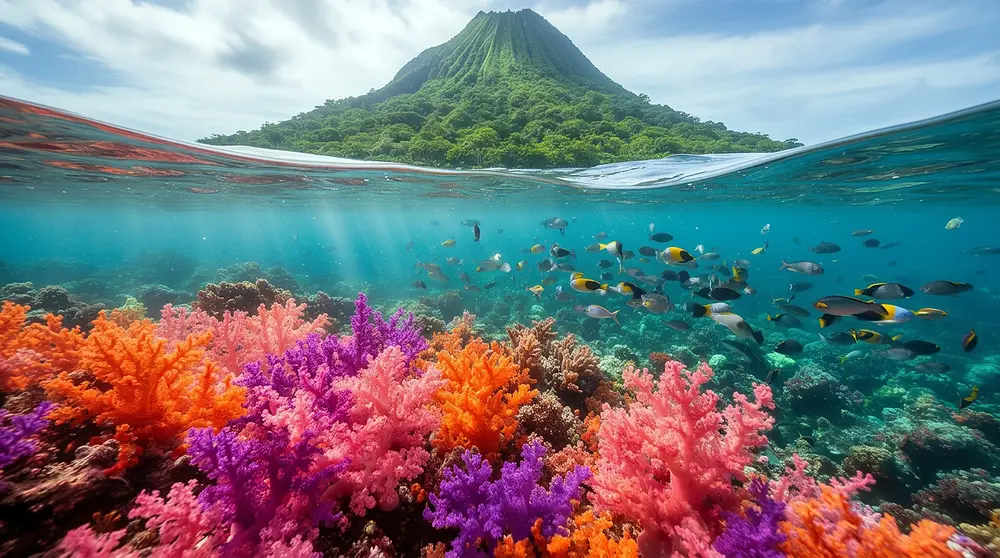
Pink Anemonefish in its natural habitat — diving encounters and best destinations

Pink Anemonefish

Up to 18 years

Want to dive with this animal?

Only destinations where this animal occurs.

The Pink Anemonefish at a glance

The pink anemonefish (Amphiprion perideraion), also known as the pink skunk clownfish, is a small, distinctively coloured damselfish reaching a maximum length of 10 centimetres. Its body ranges from pinkish-orange to peach with transparent fins, though males possess narrow orange borders along the dorsal and tail fins. It is easily identified by two white markings: a thin stripe running along the dorsal ridge from snout to caudal peduncle, and a single vertical head bar positioned just behind the eye. This specific combination of white markings distinguishes it from all other clownfish species.

Behaviour & reproduction

Size
Unknown
Weight
10-15 g
Lifespan
Up to 18 years
Status
Not Evaluated

Social life inside the host anemone follows a strict size-based dominance hierarchy. A single group consists of one large breeding female, a second-largest breeding male, and up to three smaller non-breeding sub-adults. As sequential protandrous hermaphrodites, all pink anemonefish mature first as males. If the dominant female dies, the breeding male's testicular tissue degenerates and transforms into ovaries, allowing him to become the new functional female, while the largest sub-adult steps up to become the breeding male.

Diving Tips

Encounters with pink anemonefish typically occur around host anemones located on shallow lagoon reefs and outer reef walls. Because these non-migratory fish rarely stray far from their host, locating a suitable sea anemone—particularly *Heteractis magnifica*—almost guarantees a sighting.

When approaching, divers should maintain neutral buoyancy and move smoothly to avoid startling the resident pair. Approach at eye level rather than dropping down from directly above. Anemonefish can be territorial and protective, darting out from tentacles to inspect visitors, but aggressive actions or sudden movements will cause them to retreat deep inside the stinging tentacles.

Photographers should exercise patience and refrain from prodding host anemones or surrounding substrate. Males frequently care for demersal egg batches deposited on bare rock beside the anemone base; disturbing this substrate can damage eggs or stress the male. Using moderate lighting and giving the fish space to emerge naturally yields the best images of their characteristic pink hue and dorsal stripe.

Fun facts about the Pink Anemonefish

  • It is the only species of anemonefish that feeds primarily on algae.
  • Along with Amphiprion clarkii, it is one of only two anemonefish species found on both the east and west coasts of Australia.
  • All individuals are sequential protandrous hermaphrodites, meaning they mature as males and can change into females if the dominant female dies.
  • While typically inhabiting depths up to 38 metres, autonomous underwater vehicles have documented this species on mesophotic reefs as deep as 65 metres.

Best time to see the Pink Anemonefish

Pink anemonefish are non-migratory tropical residents that can be observed by divers year-round throughout their distribution range. Preferred water temperatures for the species range between 25.2°C and 29.0°C. Because their host anemones remain attached to stable reef structures, encounter rates remain high regardless of the month.

Reproductive activity for the species occurs multiple times per year, with major spawning peaks documented between April and August, as well as activity noted in February. During these reproductive windows, divers are more likely to observe males performing egg-tending duties, such as fanning and aerating demersal egg clutches attached to the reef substrate near the base of the anemone.

Dive timing is generally governed by regional weather patterns rather than fish movement. In northern Australia and the Great Barrier Reef, the dry winter months (May to October) provide optimal visibility and calm sea conditions. Across the Indonesian Archipelago and the Philippines, diving conditions are typically best during the dry seasons between April and November, aligning well with the peak breeding period.

Where the Pink Anemonefish lives

The pink anemonefish resides in tropical marine environments, primarily inhabiting coral reef lagoons, shallow patch reefs, algal reefs, and outer seaward reef slopes. Its depth range typically spans 1 to 38 metres, though it is commonly recorded between 3 and 30 metres. Interestingly, deep-water surveys utilizing autonomous underwater vehicles have discovered populations on mesophotic coral reefs at depths between 50 and 65 metres, such as at Viper Reef and Hydrographers Passage in the central Great Barrier Reef.

Geographically, the species occurs across the Western Pacific and eastern Indian Ocean. Its range extends from Christmas Island, Cocos-Keeling, Ningaloo Reef, Rowley Shoals, and Ashmore Reef off Western Australia, eastward through Sumatra, the Gulf of Thailand, the Malay Archipelago, New Caledonia, Micronesia, Samoa, and Tonga, and north to Japan's Ryukyu Islands. Along with *Amphiprion clarkii*, it is one of only two anemonefish species found on both the eastern and western coasts of Australia.

What the Pink Anemonefish eats

The pink anemonefish is primarily a diurnal feeder, foraging actively during daylight hours when light conditions permit clear vision in the water column. It is unique among all anemonefish species in that its diet is predominantly composed of algae rather than micro-crustaceans or planktonic animals alone.

Its primary food sources include benthic algae as well as phytoplankton, specifically blue-green algae and diatoms. In addition to plant matter, the species supplements its diet with zooplankton (such as copepods), benthic marine worms, and small tunicates.

Feeding occurs close to the safety of the host anemone. Pink anemonefish pick floating plankton and micro-algae directly from the surrounding water column or graze on algae attached to nearby rocks. By remaining close to the host's stinging tentacles, the fish can immediately retreat if predatory fish like groupers approach, ensuring safe feeding throughout the day.

Pink Anemonefish: frequently asked questions

When is the best time to see Pink Anemonefish?
Pink anemonefish are non-migratory tropical residents that can be observed by divers year-round throughout their distribution range. Preferred water temperatures for the species range between 25.2°C and 29.0°C. Because their host anemones remain attached to stable reef structures, encounter rates remain high regardless of the month. Reproductive activity for the species occurs multiple times per year, with major spawning peaks documented between April and August, as well as activity noted in February. During these reproductive windows, divers are more likely to observe males performing egg-tending duties, such as fanning and aerating demersal egg clutches attached to the reef substrate near the base of the anemone. Dive timing is generally governed by regional weather patterns rather than fish movement. In northern Australia and the Great Barrier Reef, the dry winter months (May to October) provide optimal visibility and calm sea conditions. Across the Indonesian Archipelago and the Philippines, diving conditions are typically best during the dry seasons between April and November, aligning well with the peak breeding period.
How big does Pink Anemonefish get?
Pink Anemonefish: Unknown
Is Pink Anemonefish dangerous for divers?
Encounters with pink anemonefish typically occur around host anemones located on shallow lagoon reefs and outer reef walls. Because these non-migratory fish rarely stray far from their host, locating a suitable sea anemone—particularly *Heteractis magnifica*—almost guarantees a sighting. When approaching, divers should maintain neutral buoyancy and move smoothly to avoid startling the resident pair. Approach at eye level rather than dropping down from directly above. Anemonefish can be territorial and protective, darting out from tentacles to inspect visitors, but aggressive actions or sudden movements will cause them to retreat deep inside the stinging tentacles. Photographers should exercise patience and refrain from prodding host anemones or surrounding substrate. Males frequently care for demersal egg batches deposited on bare rock beside the anemone base; disturbing this substrate can damage eggs or stress the male. Using moderate lighting and giving the fish space to emerge naturally yields the best images of their characteristic pink hue and dorsal stripe.
What is the conservation status of Pink Anemonefish?
Pink Anemonefish: Not Evaluated
Plan your trip

Ready to dive with these animals?

Choose a destination or search every available vessel to find the liveaboard that matches the marine life you want to see.