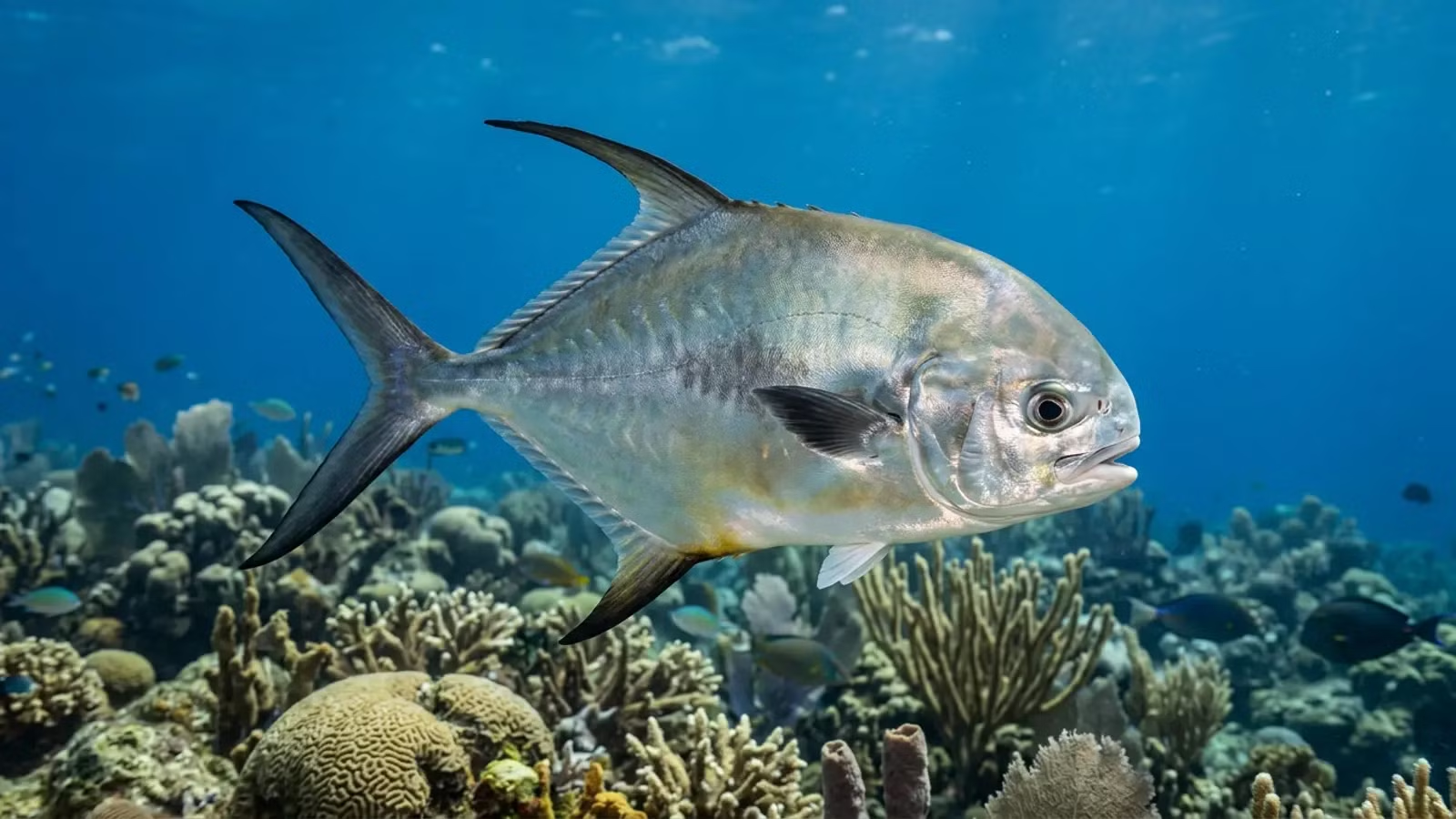
The permit (Trachinotus falcatus) is a prominent game fish and jack species belonging to the family Trachinotidae, native to the warm coastal and offshore waters of the western Atlantic Ocean. Easily recognised by its deep, laterally compressed body and dramatically elongated fins, the permit cuts a striking figure in tropical marine environments. The species earned its scientific name falcatus—Latin for "armed with scythes"—from its prominent, curved anterior dorsal fin, which frequently cuts through the surface water when schools feed on shallow flats.
In terms of identification, mature permit exhibit a sleek silvery-grey body that darkens to a bluish-grey or brownish shade along the back. The underside often displays a distinct orange-yellow patch forward of the anal fin, while the fins themselves are dark grey or black. The head slopes steeply into a blunt snout containing small, backward-curved conical teeth. As the fish matures, its overall body profile transitions from a nearly circular shape in juveniles to a more oblong, streamlined silhouette in larger adults.
Behaviour & reproduction
- Size
- Unknown
- Weight
- Up to 36 kg
- Lifespan
- Up to 23 years
- Status
- Not Evaluated
The social behaviour of the permit changes significantly throughout its life cycle. Young individuals and smaller adults tend to gather in small, active schools over shallow seagrass beds, sandflats, and coastal channels. As permit reach full maturity, they become increasingly solitary or travel in pairs, patrolling deeper reef drop-offs and open flats. However, during the spawning season, these usually spread-out fish migrate offshore to form massive aggregations numbering between 250 and 500 individuals over deep reefs and shipwrecks.


