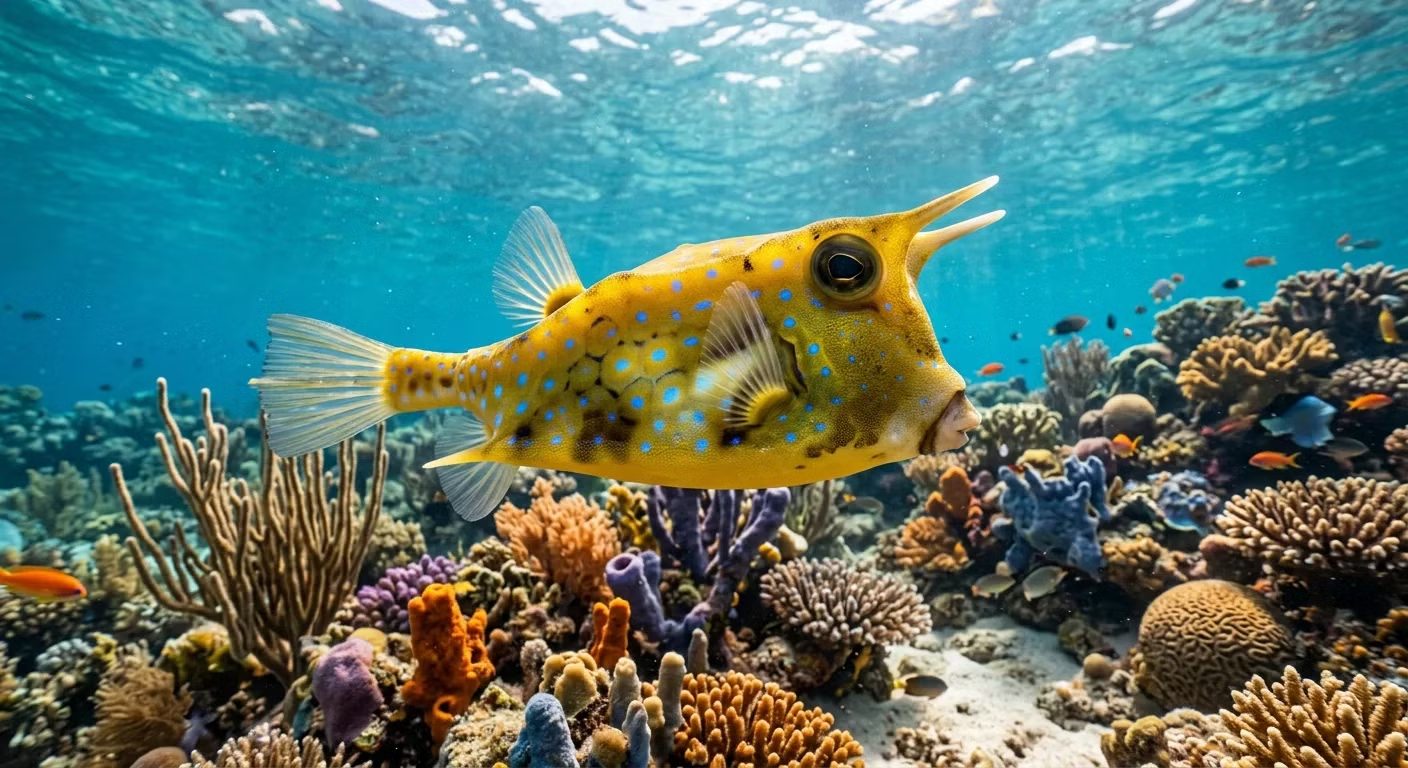
Cowfish are among the most charismatic and instantly recognisable reef dwellers in the world's tropical oceans. Belonging to the family Ostraciidae (boxfishes), these extraordinary teleosts are defined by their rigid, carapace-like dermal skeleton formed from fused polygonal bony plates. Instead of a flexible body plan, a cowfish is encased within an armour-plated box, leaving only the eyes, mouth, caudal peduncle, and translucent fins free to move. Their common name derives from the prominent, forward-pointing horns protruding from above their eyes, reminiscent of bovine cattle. Many species also possess a pair of posterior spines near the anal fin. Colouration varies dramatically across species and life stages: the longhorn cowfish (Lactoria cornuta) exhibits a luminous yellow to olive-tan hue adorned with electric-blue flecks, while the honeycomb cowfish (Acanthostracion polygonium) features a mesmerising, hexagonal mosaic pattern. Their eyes are large, independently mobile, and often expressive, giving these fish an endearing, inquisitive appearance.
Ranging across the warm tropical and subtropical waters of the Indo-Pacific, Atlantic, and Caribbean, cowfish are solitary and benthic-oriented. Because their fused carapace prevents the undulating body movements used by most fish, cowfish employ ostraciiform locomotion. They scull gently through the water column using synchronised beats of their pectoral and dorsal fins, complemented by their fan-like caudal fin for steering and brief bursts of speed. Despite their seemingly cumbersome shape, they are remarkably agile and can pivot effortlessly on their own axis. While juvenile cowfish prefer sheltered environments such as protected lagoons, mangrove fringes, and sea-grass beds, adults inhabit coral-rich outer reefs, rocky drop-offs, and sandy rubble zones. When threatened, cowfish rely first on their rigid armour and sharp spines, but if severely stressed, some species can release ostracitoxin—a potent, frothy mucosal surfactant that is lethal to surrounding marine life—from specialised epidermal cells.
Behaviour & reproduction
- Size
- Unknown
- Weight
- Up to 1.8 kg
- Lifespan
- 8-12 years
- Status
- Not Evaluated
Cowfish, encompassing species like Lactoria cornuta and Acanthostracion, typically exhibit solitary or small group behaviours, inhabiting coral reefs and seagrass beds where they forage during the day. Their activity pattern is predominantly diurnal, seeking shelter in crevices or among corals at night. Regarding reproduction, these fish are oviparous, meaning they lay eggs. Spawning generally occurs in pairs or small groups, often at dusk or dawn, with eggs being released into the water column for external fertilisation, characteristic of broadcast spawning. The pelagic eggs hatch into larvae that undergo a planktonic stage before settling onto the substrate as juveniles. Specific details regarding exact clutch sizes, gestation periods, or precise maturity ages are often not extensively documented across all species, but their development involves a transition from pelagic larvae to benthic juveniles, eventually reaching sexual maturity to continue their reproductive cycle.


