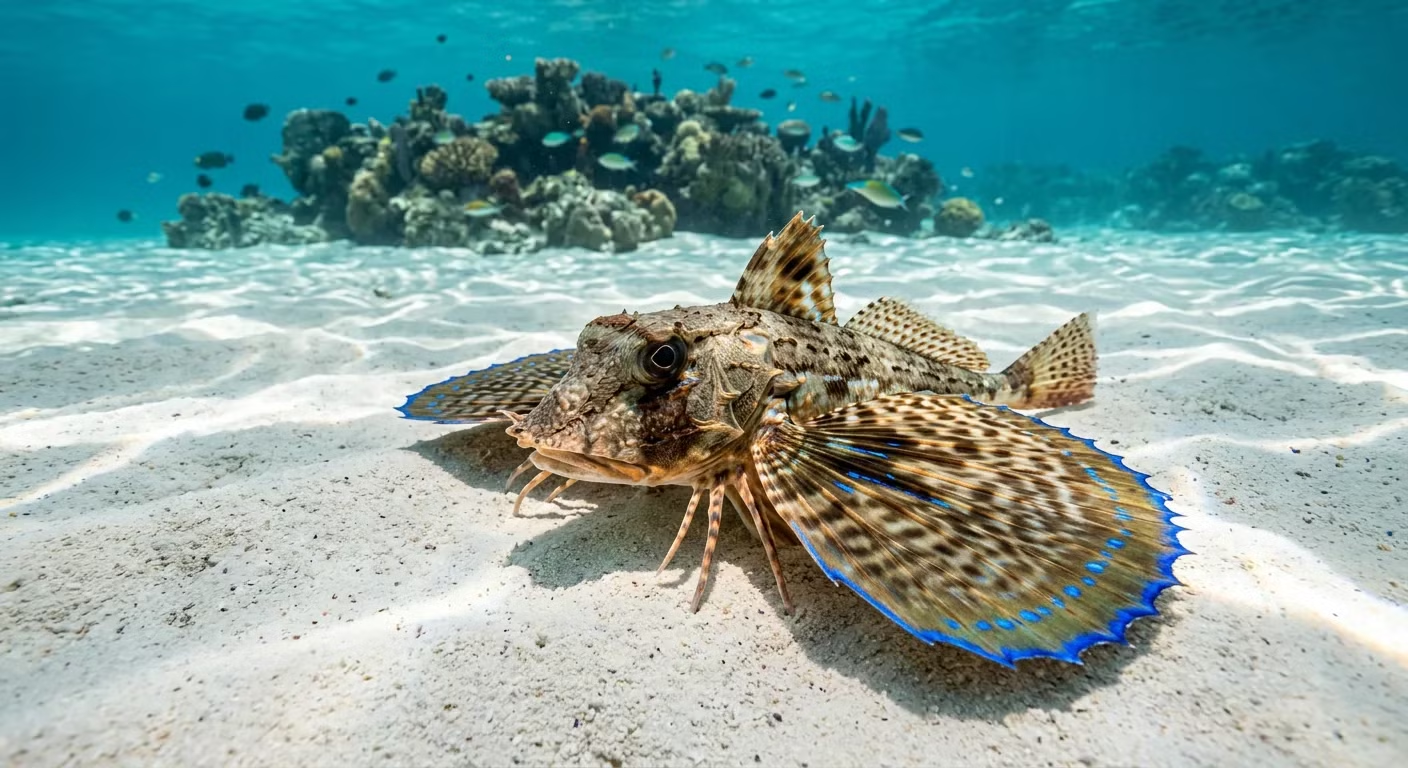
The flying gurnard is one of the ocean's most extraordinary benthic spectacles, instantly recognisable by its heavily armoured head, elongated body, and vast, wing-like pectoral fins. While the common name often refers to Dactylopterus volitans of the Atlantic and Mediterranean, it also encompasses closely related members of the family Dactylopteridae, such as the Oriental flying gurnard (Dactyloptena orientalis) found across the Indo-Pacific. At rest, the fish appears relatively unassuming, adorned in mottled shades of sandy brown, grey, and olive with dark rosettes that provide superlative camouflage against the seabed. Its head is encased in hard, bony plates equipped with prominent preopercular spines. However, when alarmed or displaying, the flying gurnard undergoes a breathtaking transformation: it unfurls enormous, fan-shaped pectoral fins edged with iridescent, neon-blue margins and intricate, spotted patterns that resemble the vivid eye-spots of an exotic butterfly.
Despite their avian moniker, flying gurnards cannot fly or glide above the water's surface; instead, they are strictly bottom-dwelling masters of the substrate. They inhabit shallow coastal shelves, expansive sandy plains, and seagrass meadows, relying on a specialised form of locomotion. The leading rays of their pelvic and pectoral fins are physically modified into flexible, finger-like appendages that allow the fish to literally "walk" across the sea floor in search of food. Their ecological role is that of a dedicated benthic carnivore, actively turning over sediment to uncover buried prey while using their heavy cranial armour and startling visual displays to deter potential predators. When threatened, they expand their magnificent pectoral fans to abruptly double their apparent size, presenting a disorienting, eye-spotted barrier that confuses hunting reef sharks, jacks, and barracudas before the gurnard darts away across the sand.
The Flying Gurnard (Dactylopterus volitans) exhibits a fascinating array of behaviours. Primarily a benthic species, it is often observed 'walking' across the seabed using its modified pectoral fin rays, while its greatly expanded, wing-like pectoral fins are typically kept folded. These large fins are only unfurled when the fish feels threatened, to startle predators, or during its distinctive gliding bursts just above the substrate. While generally considered solitary, individuals may occasionally be seen in pairs. This species is active during the day, foraging on small invertebrates found in the sand. Regarding its reproduction, the Flying Gurnard is oviparous, meaning it lays eggs. Spawning likely occurs during the warmer months, though specific seasonal peaks or mating behaviours are not extensively documented. The eggs are pelagic, floating in the water column before hatching into a larval stage. Juvenile development sees the young fish gradually adopting the benthic lifestyle of the adults. The time to maturity for this species is not precisely established in general literature but is assumed to be several years.
Behaviour & reproduction
- Size
- Unknown
- Weight
- Up to 1.8 kg
- Lifespan
- 8-12 years
- Status
- Not Evaluated
The Flying Gurnard (Dactylopterus volitans) typically exhibits a solitary or small-group social behaviour, inhabiting sandy or muddy substrates in tropical and subtropical waters. It is primarily active during daylight hours, using its large, fan-like pectoral fins, which resemble wings, to "walk" along the seabed in search of crustaceans, bivalves, and small fish, while also being capable of short glides in the water column if startled. Its impressive pectoral fins are also deployed as a defence mechanism against predators. Regarding reproduction, this species is known to be oviparous, releasing eggs directly into the water column, a mode often associated with broadcast spawning. While specific details on mating seasons, clutch size, and exact incubation periods for Dactylopterus volitans are not extensively documented in widely accessible literature, their pelagic eggs develop into larvae which are also pelagic, eventually settling as juveniles to assume the benthic adult lifestyle. The age or size at sexual maturity is likewise not precisely established for the species across its entire range.


