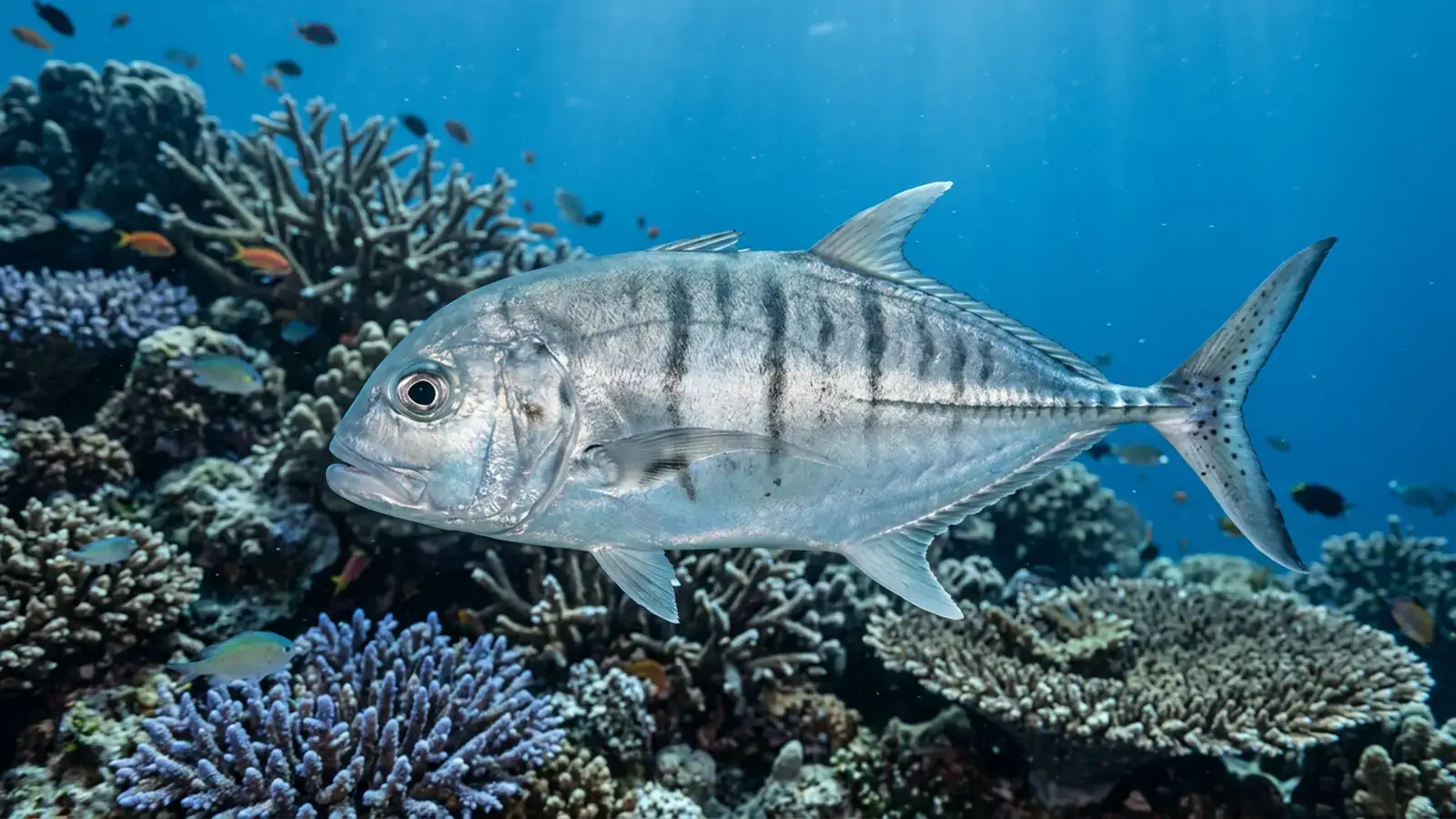
The bigeye trevally (Caranx sexfasciatus), also known as the bigeye jack, great trevally, or six-banded trevally, is a large marine fish belonging to the jack family, Carangidae. It is easily distinguished from other members of its genus by its prominent eyes featuring well-developed adipose eyelids, a small dark spot on the operculum, and a dark second dorsal fin featuring a distinctive white tip. Adult colouration ranges from dark bluish-green to gold along the dorsal side, fading into a paler yellowish-green or silvery tone beneath. The caudal fin is dark, while the soft dorsal and anal fins display dusky tips.
Behaviour & reproduction
- Size
- Unknown
- Weight
- Up to 18 kg
- Lifespan
- Up to 25 years
- Status
- Not Evaluated
The Bigeye Trevally, Caranx sexfasciatus, typically exhibits schooling behaviour, forming large aggregations during both day and night, though their activity often peaks at dusk and dawn when they actively forage. These schools, sometimes comprising thousands of individuals, are often observed in coastal waters, reefs, and estuaries. Reproduction in this species is via broadcast spawning, where eggs and sperm are released into the water column for external fertilisation. While specific spawning periods can vary geographically, it is generally documented as occurring during warmer months, often associated with specific lunar cycles. Females release numerous pelagic eggs, a characteristic of broadcast spawners, though precise clutch sizes are highly variable and not consistently quantified. After a short incubation period, larvae hatch and undergo a pelagic developmental stage, eventually settling into more sheltered nursery habitats such as mangroves and estuaries before maturing into adults, a process that typically takes a few years.


