Raga
Explore Thailand's underwater wonders in comfort and style aboard the Raga.
- Private bathrooms
- Air-conditioned cabins
- Hot water showers
5.0(91 reviews)
28 guestsfrom $255/day
 Free dive insuranceincluded with every booking
Explore Thailand's underwater wonders in comfort and style aboard the Raga.
5.0(91 reviews)
Explore Thailand's underwater marvels with comfort and personalized service.
4.9(91 reviews)
Explore Thailand's Andaman Sea on a comfortable liveaboard, offering exceptional diving and a relaxed atmosphere.
4.8(387 reviews)
Explore Thailand's underwater wonders on the MV Bavaria, where comfort meets incredible diving.
4.8(40 reviews)
Explore Thailand's underwater wonders in luxury and comfort.
4.8(90 reviews)
The Similan and Surin marine parks run north of Phuket along Thailand's Andaman coast. Liveaboards connect the Similans' granite boulders and beaches with manta sites at Koh Bon and Koh Tachai and the isolated pinnacle of Richelieu Rock.
The parks normally open from mid-October to mid-May. Khao Lak gives the shortest transfer to most boats, while Phuket is the main international gateway.
A full northern Andaman itinerary normally progresses from the Similan chain to Koh Bon, Koh Tachai, Surin and Richelieu Rock. Shorter trips may stop before Surin, so the words ‘Similan liveaboard’ do not automatically mean the celebrated northern pinnacle is included.
The southern Similans are defined by huge granite blocks, swim-throughs and sand channels; farther north, ridges and pinnacles are more exposed to current and pelagic traffic. Richelieu Rock is a submerged horseshoe-shaped formation covered in soft coral and packed with schooling fish and small life.
Choose the route that fits your experience and dream encounters — each region has its own season, character and story.
Thailand's flagship Andaman route links granite seascapes, Koh Bon, Koh Tachai and fish-packed Richelieu Rock.
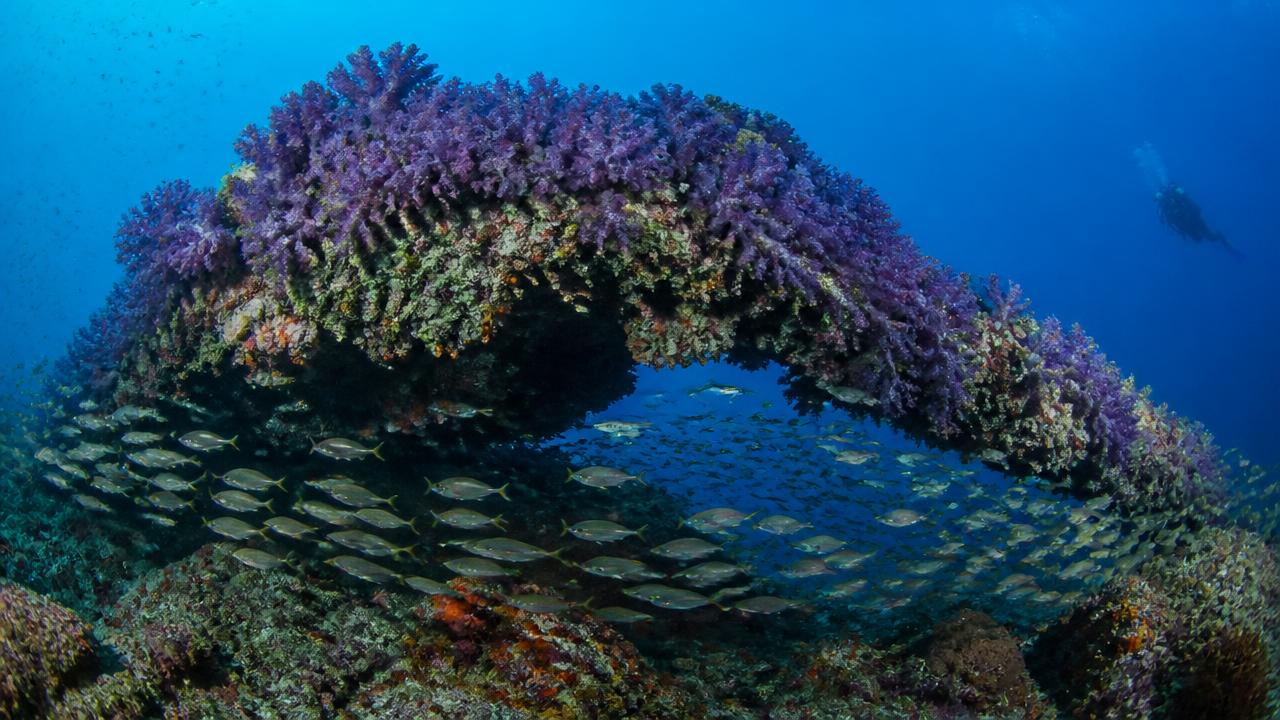
Thailand's most celebrated pinnacle concentrates schooling fish, soft coral and small marine life in one compact site. The pinnacle rewards both wide-angle and macro divers, from dense schools to pipefish and seahorses in the coral. Late in the season the site can also attract whale sharks, turning an already rich dive into a once-in-a-lifetime encounter.
Richelieu Rock anchors the northern Andaman route with exceptional fish life.
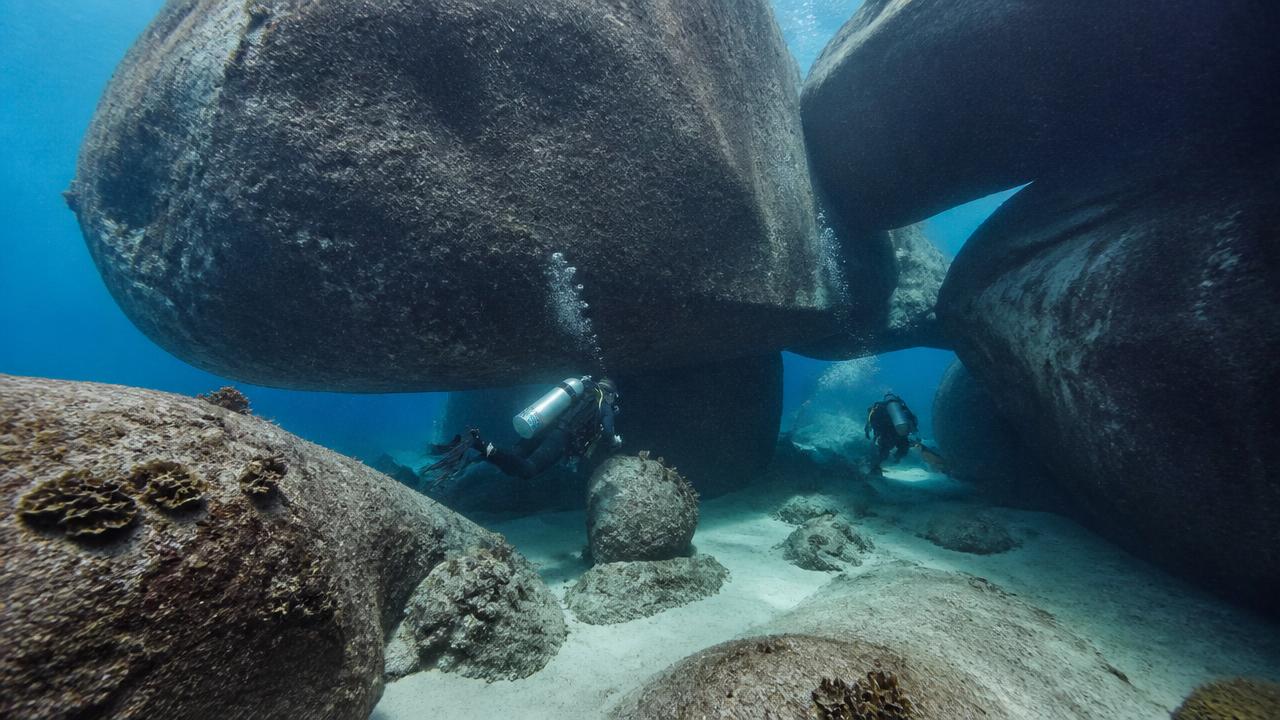
Swim-throughs, channels and immense rounded boulders make the Similan Islands instantly recognisable underwater. Sites such as Elephant Head Rock create channels and dramatic boulder passages unlike a conventional coral wall. The boulders create natural swim-throughs and channels that feel like an underwater mountain range.
Massive granite formations create the Similans' signature underwater scenery.

Koh Bon and Koh Tachai are the route's principal manta locations, with encounters shaped by current and season. Koh Bon's ridge and Koh Tachai are productive pelagic stops, but manta visits vary with plankton and current. Current direction and plankton blooms change daily, so guides may shift the manta focus between Koh Bon and Koh Tachai.
Koh Bon and Koh Tachai offer the route's best-known manta opportunities.
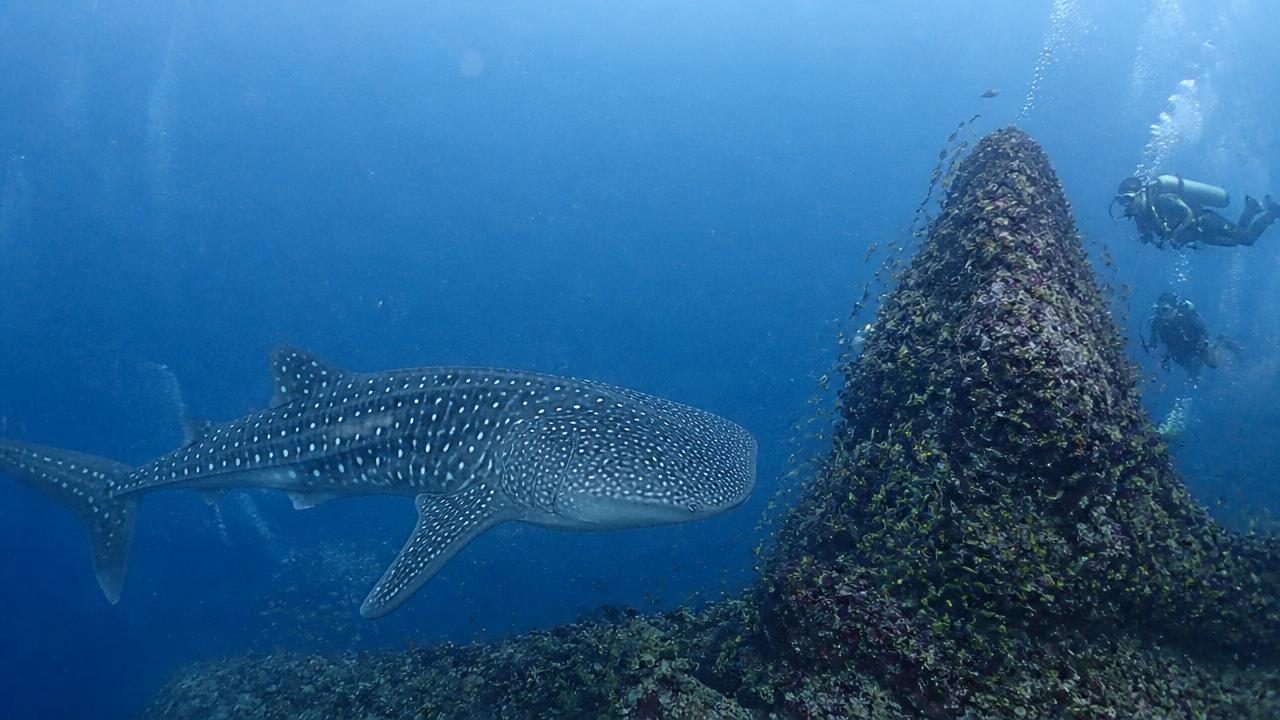
Richelieu Rock can produce unforgettable whale-shark encounters, although sightings are unpredictable and never guaranteed. Whale sharks are an unpredictable bonus, with late-season sightings most discussed around Richelieu Rock. Even without a whale shark, the rock's dense schools and soft coral make it the highlight of most northern Andaman trips.
Seasonal whale-shark sightings are a celebrated but unguaranteed bonus.
Choose the Similan & Surin Islands itinerary that matches your experience, season and wildlife priorities. Route names can look similar while covering different ports, sites and sea conditions, so compare the actual daily programme rather than the headline alone.
West of Eden, Elephant Head Rock, boulder swim-throughs and sheltered sand-channel reefs
accessible reefs plus current and depth at exposed pinnacles
Mid-October–mid-May; park dates remain subject to official closure decisions
The Similans, Koh Bon manta ridge, Koh Tachai pinnacle and Richelieu Rock
current experience for exposed northern ridges and negative entries
November–April; February–April is often targeted for pelagic potential
Surin's quieter reefs, Richelieu Rock and fish-rich northern pinnacles near the Myanmar border
exposed current, negative entries and open-water pickups around pinnacles
November–April; access depends on marine-park and weather conditions
Similan boulders, Koh Bon, Koh Tachai, Surin and Richelieu in one northbound circuit
multiple current-exposed sites and longer open-sea passages
November–April for the broadest full-route operating window
Operator rules vary, but the practical guidance below helps you choose a route you can enjoy safely.
| Route | Certification | Logged dives | Conditions | Gear |
|---|---|---|---|---|
| Similan Islands classic | Advanced Open Water recommended | 30+ recommended | Granite boulders and sand channels at 10–30 m, 20–30 m visibility, mild current with stronger flow at pinnacles | DSMB; nitrox recommended where available |
| Similan, Koh Bon & Richelieu | Advanced Open Water recommended | 30+ recommended | Exposed northern ridges at 12–30 m, 15–30 m visibility, current and surge around Koh Bon and Richelieu | DSMB; nitrox recommended where available |
| Surin & Richelieu focus | Advanced Open Water recommended | 30+ recommended | Offshore pinnacles in open water, 15–30 m visibility, strong tidal current and negative entries at Richelieu | DSMB; nitrox recommended where available |
| Northern Andaman extended | Advanced Open Water recommended | 30+ recommended | Full northbound route, 15–30 m visibility, several current-exposed pinnacles and longer open-sea passages | DSMB; nitrox recommended where available |
Official opening and closing dates can change with weather or park decisions. No operator can guarantee Richelieu, mantas or whale sharks if conditions make a northern crossing unsafe. The operator's published minimum, check-dive assessment and safety rules always take precedence.
These are the sites that define a Similan & Surin Islands liveaboard itinerary. Compare their topography, conditions and location against the daily programme rather than assuming every regional cruise visits the same places.
Thailand's Andaman liveaboard season follows the marine-park opening from roughly mid-October to mid-May. Water remains tropical, but dry-season wind, thermoclines and plankton create meaningful differences between early, peak and late-season departures.
Mid-Oct–Dec
27–29 °CThe parks reopen after the southwest monsoon and conditions progressively settle. Similan granite sites are often clear, while Koh Bon and Richelieu may carry richer plankton.
Jan–Feb
27–29 °CDry-season weather, broad route choice and generally good visibility make this the most dependable all-round window. Cooler thermoclines can pass exposed ridges and pinnacles.
Mar–mid-May
28–30 °CThe warmest period brings stronger plankton and the most discussed manta and whale-shark window, especially around Koh Bon, Koh Tachai and Richelieu Rock.
Late-May–Sep
28–30 °CSimilan and Surin marine parks close during the southwest monsoon. Rough seas and official closures mean these months are not a normal liveaboard alternative.
Richelieu Rock and Koh Tachai are more exposed than many Similan sites, so current and surface chop can change the plan even in peak season. A 3 mm suit suits most divers, but a hooded vest helps with repeated dives and cool thermoclines; official park dates always override advertised schedules.
Plan a Similan & Surin Islands liveaboard around the encounters that matter most to you. The bars show stronger historical windows, not promises, and the location line explains where each animal is normally sought.
Peak bars show historically stronger encounter windows; shoulder months can still produce excellent dives, while wild-animal encounters are never guaranteed.
Most Similan and Surin liveaboards use Phuket as the flight gateway and Thap Lamu near Khao Lak as the principal marina. Northern programmes may instead start or finish in Ranong.
Thap Lamu Pier / Khao Lak
The standard embarkation point for Similan, Koh Bon, Koh Tachai and Richelieu routes. It lies south of Khao Lak and roughly 75–90 minutes by road from Phuket airport.
Phuket International Airport (HKT)
The main international gateway, with frequent regional and long-haul connections. Operators commonly offer scheduled shared transfers north to Khao Lak or Thap Lamu.
Phuket / Chalong
Selected southern or extended Andaman itineraries board around Phuket rather than Thap Lamu. Cross-island traffic can make the marina transfer longer than the map suggests.
Ranong
Used by some Surin, Richelieu and northern Andaman departures. Ranong has limited domestic flights and is several hours by road from Phuket, so do not assume the same transfer.
Check-in may take place at a Khao Lak hotel or dive centre before guests are transferred together to the pier. Marine-park opening dates are set seasonally and can shift with monsoon weather; arrive before the operator's cutoff and confirm whether the final port is Thap Lamu, Phuket or Ranong.
Cruise into Thailand's clearest Andaman waters, from sculpted granite reefs to the swirling marine life of Richelieu Rock. Compare current departures and choose the voyage that makes these celebrated islands yours.
Similan & Surin Islands liveaboards
Trip length and whether Richelieu Rock is included drive much of the price difference.
A cabin, meals, tanks, weights, guides and the scheduled dives are normally included; exact inclusions vary by boat.
Budget separately for flights, transfers, marine-park or port fees, nitrox, rental gear, gratuities and any required hotel nights.
Prices move with season, cabin type, trip length and remaining availability. Open a departure for the final operator breakdown.
The calendar below shows how liveaboard prices shift month by month, so you can see exactly when your money goes furthest. We want every diver to get the best possible value, which is why we highlight the seasons that balance great conditions with the fairest rates.
$108–$255
per day liveaboard
Prices reflect typical costs for mid-range to premium options. Budget alternatives may be available.
Compare Similan & Surin Islands with its country overview and other strong liveaboard regions.
Explore our expedition vessels and find your perfect trip to Similan & Surin Islands