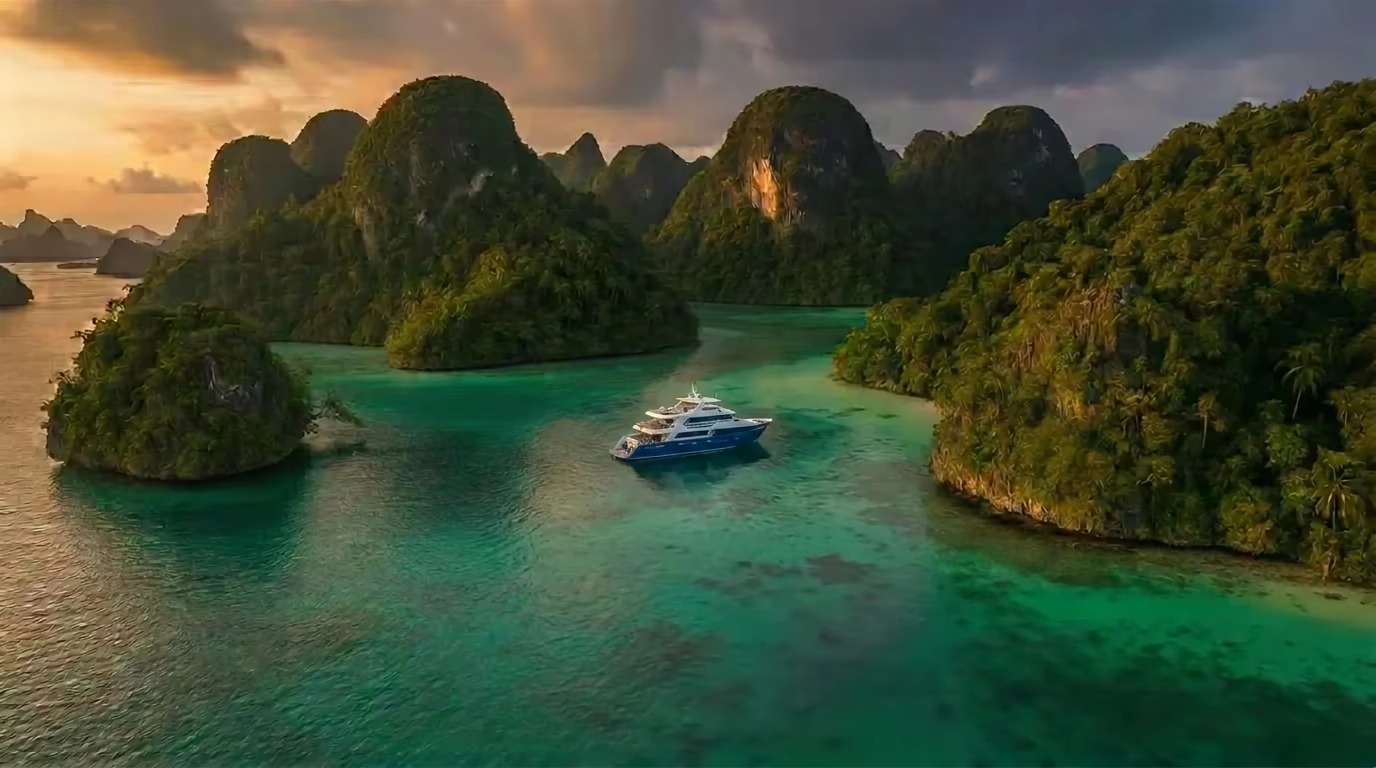
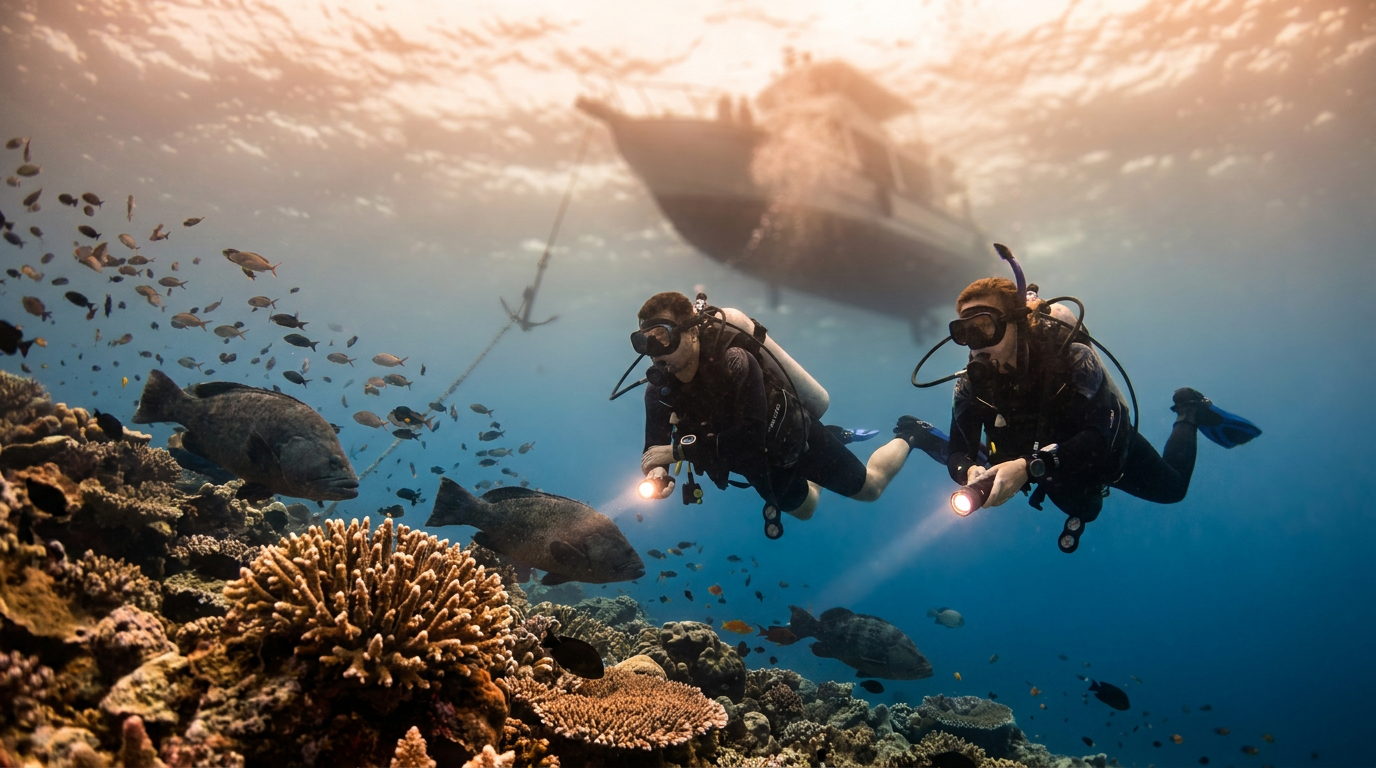
1. Maldives — Mantas, whale sharks & atolls
26 atolls of pristine reef in warm, clear water. Liveaboards reach Hanifaru Bay, Fuvahmulah's tigers, and southern channels that day boats can't access. Best season Dec–Apr (north) and Aug–Nov (south).
Visibility commonly hits 25–30 metres and water temperatures stay between 27–30°C all year, making the Maldives one of the most beginner-friendly big-animal destinations on this list. Most central-atoll itineraries (Malé–Ari–Vaavu) accept Open Water divers with as few as 25 logged dives, while southern routes to Huvadhoo and Addu reward Advanced divers with grey reef shark walls and untouched reef.
Typical trip length is 7 nights, and prices range from roughly $1,500 for older steel boats to $4,500+ for premium yachts with private bathrooms, nitrox, and dedicated camera rooms. Manta and whale shark encounters are the headline act, but night dives with nurse sharks at Alimathá and the cleaning stations of Lankan Manta Point are reasons enough on their own.
2. Egypt (Red Sea) — Wrecks, sharks & reef walls
The most affordable world-class diving on Earth. Routes cover the Brothers, Daedalus, Elphinstone, and the WWII wreck Thistlegorm. Year-round, with peak shark action May–Oct.
A standard week from Hurghada or Marsa Alam costs $900–$1,800 all-inclusive — unmatched value when you consider four dives a day, nitrox, and a serious offshore itinerary. The Red Sea is also one of the few destinations where you can combine wreck diving, drift diving, and pelagic encounters in a single trip.
Oceanic whitetips, threshers, hammerheads, and silky sharks gather at the deep offshore reefs in summer, while northern routes (SS Thistlegorm, Rosalie Moller, Abu Nuhas) deliver the world's best wreck cluster year-round. Water temperatures swing from 22°C in winter to 29°C in late summer, so a 5 mm wetsuit is the safe baseline. Most routes accept Advanced divers; Brothers/Daedalus/Elphinstone usually require 50+ dives and nitrox certification.
3. Galápagos — Hammerheads, mola-mola, marine iguanas
The single best big-animal liveaboard on the planet. Darwin and Wolf islands deliver schooling hammerheads, whale sharks (Jun–Nov), and unique endemics. Advanced certification + 50 dives required.
Trips depart from San Cristóbal or Baltra and run 7 or 10 nights — the longer itinerary is worth the upgrade because it adds extra days at Darwin and Wolf, where most of the magic happens. Expect strong currents, surge, and water temperatures from 18–24°C, so a 7 mm wetsuit with hood and gloves is standard kit.
Beyond the headline hammerhead schools, you can encounter Galápagos sharks, silky sharks, dolphins, mola-mola, marine iguanas grazing on algae, and red-lipped batfish — a list no other destination on Earth comes close to matching. Prices start around $5,500 for budget vessels and climb past $9,000 for premium yachts; park fees and hyperbaric surcharges add roughly $300 on top. Book 12–18 months in advance — top boats sell out fast.
4. Indonesia — Raja Ampat, Komodo, Banda
The Coral Triangle's epicentre. Raja Ampat alone hosts more reef-fish species than anywhere else on Earth. Komodo adds mantas and ripping current dives; Banda offers WWII wrecks and hammerheads.
Indonesia is best understood as three different destinations rather than one: Raja Ampat (Oct–Apr) for biodiversity and soft coral gardens, Komodo (Apr–Oct) for mantas and adrenaline currents, and Banda/Forgotten Islands (Sep–Nov) for remote pelagics and active volcanoes. Many liveaboards run dedicated crossings between these regions during shoulder seasons, opening rarely-dived sites along the way.
Traditional phinisi sailing yachts dominate the fleet here, ranging from no-frills budget boats around $2,500/week to ultra-luxury 5-star vessels above $10,000/week. Water is warm (28–30°C) and visibility ranges from 15 m in plankton-rich Komodo to 30 m in Raja Ampat. Most central routes accept Advanced divers, while current-heavy itineraries in Komodo or Misool reward 100+ dives of experience.
5. Cocos Island (Costa Rica) — Schooling hammerheads
A 36-hour crossing from Puntarenas to a UNESCO island known for hundreds of schooling scalloped hammerheads. Demanding, current-heavy diving for advanced divers only.
Cocos has no land-based diving — the only way to reach it is by liveaboard, and just three operators run trips year-round. That isolation is exactly what keeps the marine life intact: walls of hammerheads, tiger sharks, Galápagos sharks, mobula rays, and resident bottlenose dolphins are encountered on most dives.
Itineraries are 10–12 nights to make the long crossings worthwhile, with 21–28 dives in total. Expect strong down-currents, deep negative entries, and surface conditions that can be rough — this is not a destination for divers under 100 logged dives. Prices start around $5,500 and reach $8,500+ for the longer Cocos-Malpelo combo trips. Best season is June–November when warmer Pacific currents bring whale sharks and the largest hammerhead schools.
6. Socorro / Revillagigedo (Mexico) — Giant mantas
Friendly oceanic mantas, dolphins, false killer whales, and humpback song. 24-hour crossing from Cabo San Lucas. Best Nov–May.
Socorro is famous for one thing: giant oceanic mantas (up to 7 m wingspan) that actively seek out divers and hover overhead while being cleaned by clarion angelfish. The interaction is so reliable that operators routinely log 15–20 manta encounters per week.
Beyond mantas, the Revillagigedo archipelago delivers schooling hammerheads at El Boiler, tiger sharks and silky sharks at Roca Partida, and humpback whale song so loud it vibrates through your chest cavity from January to March. Trips are 8 or 10 nights, prices range $3,500–$6,500, and water sits at a comfortable 24–27°C. Advanced certification and 50+ dives are required, plus a $50/day marine-park fee paid on board.
7. Bahamas — Tiger Beach & Cat Island
Predictable, close-up tiger sharks at Tiger Beach (Oct–Jan) and oceanic whitetips at Cat Island (Apr–Jun). Calm, warm Caribbean water.
Tiger Beach is one of the only places on Earth where you can spend 60+ minutes kneeling in 6 metres of water surrounded by mature female tiger sharks, lemon sharks, and nurse sharks — without needing a cage. The shallow, white-sand setting also makes it a dream for underwater photography and free-diving safaris.
Other highlights include great hammerheads at Bimini (Dec–Mar), oceanic whitetips at Cat Island (Apr–Jun), and the iconic dolphin encounters of White Sand Ridge. Trips run 5–7 nights, depart from West Palm Beach or Freeport, and cost $3,000–$5,500 depending on shark species targeted. Water is warm (24–28°C) and visibility commonly exceeds 30 m — accessible to Advanced divers with no minimum dive count on most charters.
8. Philippines — Tubbataha, macro & thresher sharks
Tubbataha Reef (Mar–Jun only) is a UNESCO atoll with walls, sharks, and reef fish density rivalling Raja Ampat. Add Malapascua for daily thresher shark dives.
Tubbataha sits in the middle of the Sulu Sea and is dive-able only during a 3-month weather window each year, which keeps visitor numbers below 3,000 annually and the reef in spectacular shape. Vertical walls drop to 800 m, and you'll see whitetip and grey reef sharks, tuna, jacks, and turtles on virtually every dive.
Liveaboards depart from Puerto Princesa for 6–7 nights at $2,500–$4,500. Beyond Tubbataha, the Philippines also delivers world-class macro at Anilao, daily pelagic thresher sharks at Malapascua's Monad Shoal, and the WWII wrecks of Coron Bay. Water temperatures stay 27–29°C year-round and visibility regularly exceeds 30 m — most boats accept Advanced divers with 30+ logged dives.
9. French Polynesia — Tiger sharks, mantas, lagoons
Fakarava's south pass holds 700 grey reef sharks year-round. Tikehau, Rangiroa, and Tahiti add humpback whales (Jul–Oct) and crystal-clear lagoon dives.
The Tuamotu atolls offer one of the most dramatic shark experiences anywhere: drift diving Fakarava's south pass at slack tide, suspended above a wall of 700 grey reef sharks that hunt cooperatively at night. Spawning groupers in June and July add another layer of spectacle, drawing in even larger shark numbers.
Trips are typically 7–10 nights between Rangiroa, Fakarava, and Tikehau, with prices from $4,500 to $8,000+. Humpback whale season (Jul–Oct) brings in-water encounters in the Society Islands, while year-round visibility of 30–40 m and 26–29°C water make this one of the most photogenic destinations on the planet. Strong currents in the passes mean Advanced certification and 50+ dives are recommended.
10. Belize — Blue Hole & barrier reef
The Western Hemisphere's best barrier reef plus the iconic Blue Hole. Liveaboards reach Lighthouse Reef, Glover's Atoll, and Turneffe in calm Caribbean water.
Belize protects the second-longest barrier reef in the world, and only liveaboards can reach the three offshore atolls — Lighthouse Reef, Turneffe, and Glover's Reef — where the diving is dramatically better than anything accessible from Ambergris Caye day boats. Expect spotted eagle rays, reef sharks, turtles, and walls dropping into the indigo abyss.
The Great Blue Hole itself is a 124-m sinkhole featuring giant stalactites at 40 m — more about the geology than marine life, but a true bucket-list dive. Trips run 7 nights from Belize City for $2,500–$4,000, with warm water (26–29°C) and visibility of 30 m+ year-round. Best season is April–June (calm seas, no rain); hurricane risk closes most operators August–October. Open Water divers welcome on most reef sites; Advanced certification recommended for the Blue Hole.
Frequently Asked Questions
What is the best liveaboard destination for beginners?
The Maldives, Caribbean (Bahamas, Belize, Cayman), and Egypt's Red Sea coastal routes offer warm water, calm conditions, and vessels that accept Open Water divers with as few as 10–25 logged dives.
Where can I see hammerhead sharks?
Galápagos (Darwin and Wolf islands) for schooling scalloped hammerheads year-round, Cocos Island Jun–Nov, the Red Sea's Daedalus and Brothers May–Sep, and Bimini, Bahamas Dec–Mar for great hammerheads.
Where are the best manta ray liveaboards?
Maldives (Hanifaru Bay Aug–Nov, Ari Atoll year-round), Komodo (Manta Point year-round), Socorro (Nov–May for oceanic giants), and Raja Ampat (north Oct–Mar).
Which liveaboard destination has the best coral?
Raja Ampat in Indonesia is the global benchmark — over 75% of all known coral species in one region. Tubbataha (Philippines) and the Solomon Islands are close runners-up.
Continue reading
Ready to dive in?
Browse 200+ liveaboards across 35+ destinations.
Find your perfect liveaboardRelated Searches
Popular searches related to this guide