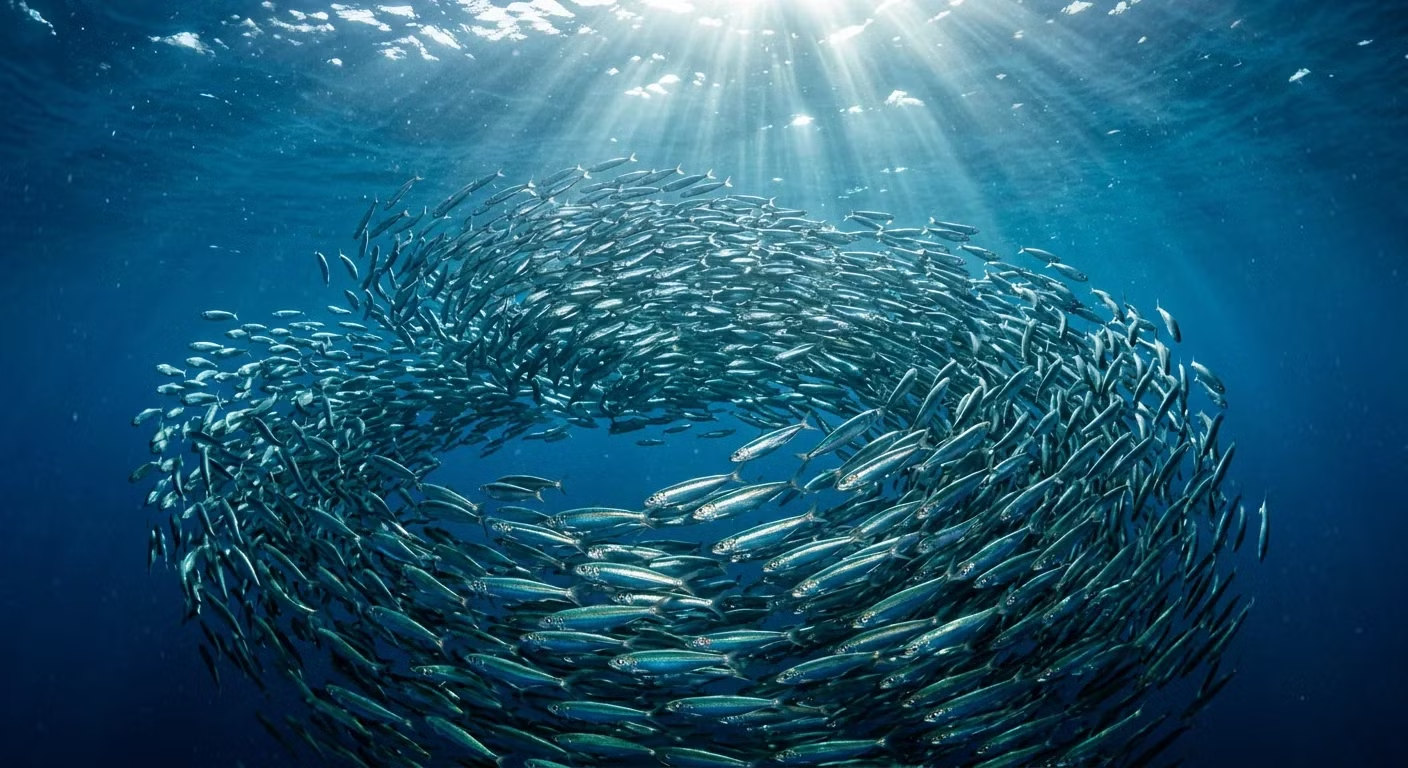
Sardine in its natural habitat, diving encounters and best destinations

SardineWhere and when to see them

Up to 12-14 years

Want to dive with this animal?

Only destinations where this animal occurs.

The Sardine at a glance

Sardines are small, slender, streamlined epipelagic fish belonging to the family Clupeidae, with prominent representatives including the Pacific sardine (Sardinops sagax) and the European pilchard (Sardina pilchardus). Characterised by an elongated, cylindrical body covered in delicate, deciduous cycloid scales, they exhibit classic pelagic countershading: a rich iridescent blue-green or olive dorsum that grades into brilliant, reflective silver along the flanks and belly. A single short dorsal fin sits centrally along the back, while the caudal fin is deeply forked to facilitate efficient, sustained cruising. Along their flanks, subtle dark spots often form a horizontal series, and their operculum (gill cover) features distinctive radiating grooves. With large, forward-facing eyes and a slightly protruding lower jaw equipped with tiny or vestigial teeth, sardines are built entirely for hydrodynamics and rapid aquatic schooling.

Behaviour & reproduction

Size
Unknown
Weight
Up to 200 g
Lifespan
Up to 12-14 years
Status
Not Evaluated

Sardinops sagax, commonly known as the sardine or Pacific sardine, exhibits highly social behaviour, forming vast, dense schools that often number in the millions. These schooling patterns are crucial for protection against predators and efficient foraging, moving through the water column both day and night, though often feeding more actively at night. Their reproduction strategy is characterised by broadcast spawning. Females release numerous pelagic eggs into the water column, which are then externally fertilised by males. Spawning typically occurs in warmer waters, often offshore, with seasons varying geographically but generally in spring and summer. A single female can produce tens of thousands of eggs per spawning event. The eggs are small and transparent, developing into larvae within a few days, depending on water temperature. These larvae are also pelagic, drifting with currents and feeding on zooplankton. Juveniles grow rapidly, reaching sexual maturity typically within one to two years, after which they join the adult population to continue the reproductive cycle.

Diving Tips

When diving with large sardine aggregations, maintaining excellent, neutral buoyancy and situational awareness is vital. Avoid swimming aggressively straight into the centre of a bait ball, as this fractures the school and disperses the fish; instead, hold your position along the perimeter and allow the shoal to swirl naturally around you. During high-octane predation events, such as the South African Sardine Run, remain mindful of larger predators—including sharks, seals, and plummeting seabirds—which may breach the shoal at tremendous speed with limited visibility. Keep your profile compact and stay close to your dive buddy or guide. For underwater photography, a wide-angle or fisheye lens is essential to capture the immense scale of the shoal. Rely on natural ambient light, fast shutter speeds (1/250s or higher), and moderate ISO to freeze the dynamic motion without backscatter from the swirling scales.

Fun facts about the Sardine

  • Sardines form defensive 'bait balls' that can measure over twenty metres in diameter and contain millions of individual fish.
  • They communicate and maintain school cohesion using their lateral line system to detect minute pressure changes created by neighbouring fish.
  • Sardines produce high-frequency clicking sounds by expelling gas from their swim bladders to aid in schooling and communication.
  • Their reflective silver scales act as microscopic mirrors, scattering ambient light to camouflage them from pelagic predators below.

Best time to see the Sardine

To witness the world’s most dramatic sardine congregations, timing is everything. The legendary Sardine Run along the Wild Coast of South Africa peaks from late May through July, when cold northward currents drive immense shoals past Port Saint Johns and East London. In Moalboal, situated on the island of Cebu in the Philippines, massive, resident bait balls are present year-round just metres from the shore, though the calmest sea conditions and best underwater visibility occur between November and May. In Baja California Sur, Mexico, particularly around Magdalena Bay, autumn aggregations between October and December offer spectacular encounters with striped marlin, sea lions, and pelagic sharks hunting dense sardine aggregations in pristine Pacific waters.

Where the Sardine lives

Sardines are epipelagic, schooling fish found predominantly in temperate, subtropical, and tropical coastal waters across the world's oceans. They inhabit the water column from the sunlit surface down to depths of roughly 200 metres, though they are most frequently encountered in the upper 50 metres. Sardines thrive within nutrient-dense coastal upwelling systems, boundary currents, and productive continental shelf waters. Key geographic ranges include the eastern Pacific from Alaska to Baja California and along the Humboldt Current off Peru and Chile, the eastern Atlantic from the North Sea down through the Mediterranean to West Africa, the Agulhas Current system off eastern South Africa, and the vibrant coastal drop-offs around the Indo-Pacific archipelago, such as the Philippines.

What the Sardine eats

Sardines are opportunistic filter feeders and particulate grazers that primarily consume microscopic planktonic organisms. Their diet is dominated by phytoplankton, such as diatoms and dinoflagellates, alongside nutrient-rich zooplankton including copepods, crustacean larvae, fish eggs, and juvenile krill. Feeding occurs through two distinct methods depending on the density and size of prey in the water column. When encountering dense patches of micro-algae or small plankters, sardines swim steadily with their mouths wide agape, using finely spaced, specialised gill rakers to strain food particles continuously from the sea. When larger prey items such as mature copepods or euphausiids are detected, the fish switch to selective particulate feeding, snapping up individual targets with rapid precision. Feeding activity is most intense during daylight and twilight hours within nutrient-rich upwelling zones.

Sardine: frequently asked questions

When is the best time to see Sardine?
To witness the world’s most dramatic sardine congregations, timing is everything. The legendary Sardine Run along the Wild Coast of South Africa peaks from late May through July, when cold northward currents drive immense shoals past Port Saint Johns and East London. In Moalboal, situated on the island of Cebu in the Philippines, massive, resident bait balls are present year-round just metres from the shore, though the calmest sea conditions and best underwater visibility occur between November and May. In Baja California Sur, Mexico, particularly around Magdalena Bay, autumn aggregations between October and December offer spectacular encounters with striped marlin, sea lions, and pelagic sharks hunting dense sardine aggregations in pristine Pacific waters.
How big does Sardine get?
Sardine: Unknown
Is Sardine dangerous for divers?
When diving with large sardine aggregations, maintaining excellent, neutral buoyancy and situational awareness is vital. Avoid swimming aggressively straight into the centre of a bait ball, as this fractures the school and disperses the fish; instead, hold your position along the perimeter and allow the shoal to swirl naturally around you. During high-octane predation events, such as the South African Sardine Run, remain mindful of larger predators—including sharks, seals, and plummeting seabirds—which may breach the shoal at tremendous speed with limited visibility. Keep your profile compact and stay close to your dive buddy or guide. For underwater photography, a wide-angle or fisheye lens is essential to capture the immense scale of the shoal. Rely on natural ambient light, fast shutter speeds (1/250s or higher), and moderate ISO to freeze the dynamic motion without backscatter from the swirling scales.
What is the conservation status of Sardine?
Sardine: Not Evaluated
Plan your trip

Ready to dive with these animals?

Choose a destination or search every available vessel to find the liveaboard that matches the marine life you want to see.