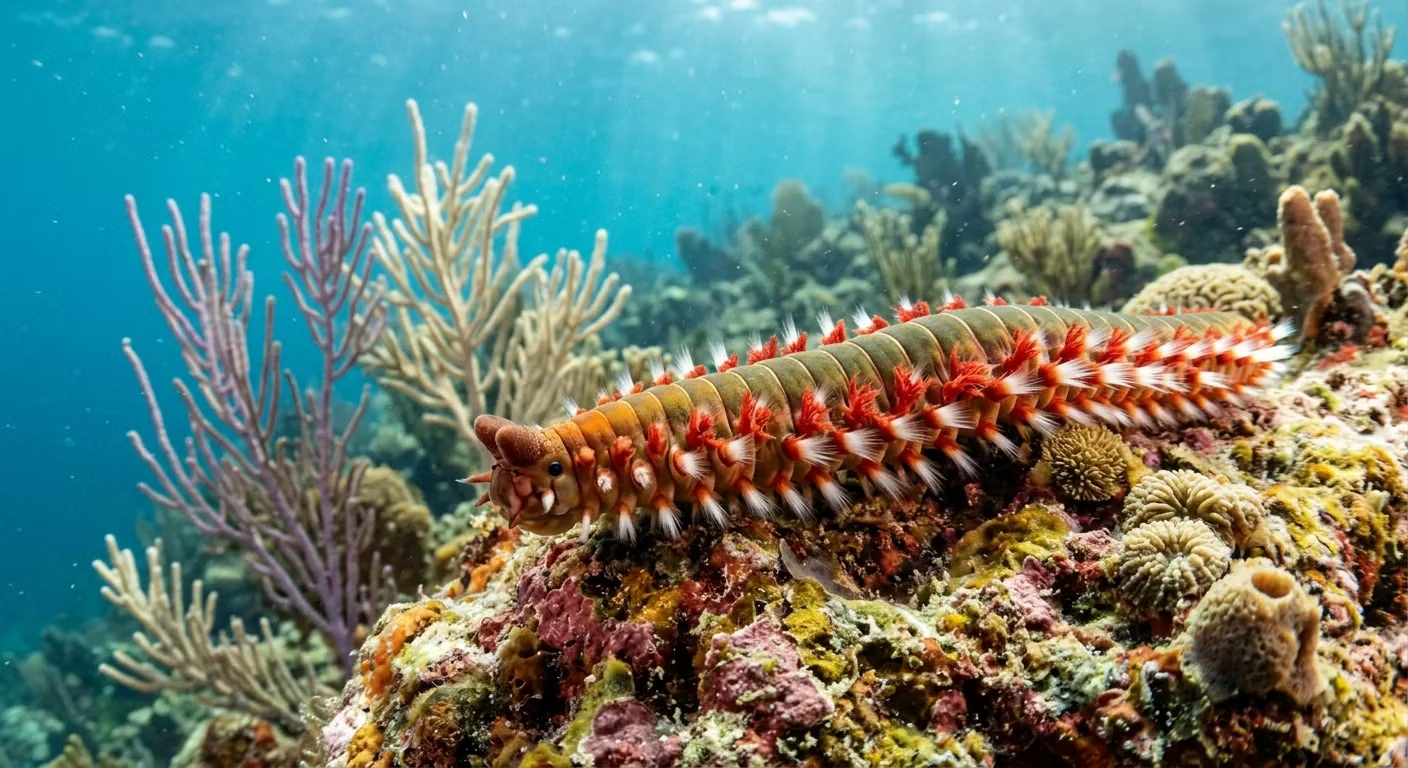
Fireworm in its natural habitat, diving encounters and best destinations

FirewormWhere and when to see them

2-5 years

Want to dive with this animal?

Only destinations where this animal occurs.

The Fireworm at a glance

The bearded fireworm (Hermodice carunculata) is a striking and notorious polychaete worm belonging to the family Amphinomidae. Measuring between 15 and 30 centimetres in length, this segmented bristle worm possesses a flattened, elongated body adorned with distinct, brightly coloured segments typically ranging from vibrant orange and olive-green to deep reddish-brown. Each segment features a pair of lateral appendages called parapodia, which are flanked by prominent, brilliant white tufts of fine, venomous bristles known as chaetae. The head region displays four sensory antennae and a characteristic sensory organ called a caruncle—a fleshy, brain-like red crest running along the dorsal side of the anterior segments. When unthreatened, the white bristles lie relatively flat against the flanks, but upon disturbance, the worm flares these chaetae into an alarming, defensive white halo that serves as an unequivocal warning to potential predators and inquisitive divers alike.

Behaviour & reproduction

Size
Unknown
Weight
Up to 80 g
Lifespan
2-5 years
Status
Not Evaluated

The bearded fireworm, Hermodice carunculata, is a common benthic predator often observed actively foraging during both day and night on coral polyps, anemones, and other soft-bodied invertebrates, utilising its eversible pharynx. While typically solitary, instances of aggregation have been noted around abundant food sources. This species primarily reproduces through broadcast spawning, releasing gametes into the water column for external fertilisation. Spawning events are often correlated with lunar cycles and occur predominantly during warmer months, although specific peak seasons can vary geographically across its range. Fertilised eggs develop into planktonic trochophore larvae, which undergo metamorphosis through several larval stages before settling to the benthos as juvenile worms. The exact duration of larval development and the age or size at which sexual maturity is reached can be variable and are not always precisely documented across all populations. There is no known parental care; eggs and larvae are dispersed by currents.

Diving Tips

Maintaining immaculate buoyancy control is the single most important safety rule when diving around fireworms. These worms frequently rest on coral heads, sponge formations, mooring lines, and wreck handrails, making accidental brushing a real hazard. Never touch underwater surfaces with bare hands or even thick neoprene gloves, as the brittle calcareous chaetae easily pierce fabrics and embed in the skin. If accidental contact occurs, avoid rubbing the area; instead, use adhesive tape to gently strip away the embedded bristles, followed by the application of vinegar or rubbing alcohol to alleviate the burning sensation. For macro photographers, fireworms make fantastic, slow-moving subjects: adopt a low, parallel angle with a dedicated macro lens (60mm or 100mm) and twin strobes to illuminate the contrasting textures of the red gills and white bristles. Approach slowly without creating heavy water displacement that might blow the worm off its perch.

Fun facts about the Fireworm

  • The defensive bristles of a fireworm are hollow, filled with neurotoxins, and brittle enough to snap off inside an attacker's flesh on the slightest contact.
  • Fireworms are known to reproduce in dramatic mass spawning events where females emit a bioluminescent green glow to attract males at the water's surface.
  • A single bearded fireworm can engulf the branch tip of a living stony coral and strip the coral polyps clean in just a few hours.
  • If severed by a predator, fireworms possess remarkable regenerative abilities and can successfully regrow missing segments of their body.

Best time to see the Fireworm

Fireworms are non-migratory and present year-round across their warm-water ranges, but encounter quality depends on sea conditions and visibility. In the Caribbean, destinations such as Bonaire, Curaçao, and the Cayman Islands offer superb conditions from December to May, when calm seas and exceptional water clarity facilitate slow macro foraging. The Red Sea and the Canary Islands provide prime viewing conditions between June and October, when water temperatures are at their warmest and marine invertebrates are particularly active across shallow drop-offs. In the Mediterranean Sea, where populations have surged around southern Italy and the Greek isles, the optimal diving window spans July to October, bringing calm summer waters and thriving shallow reef systems where fireworms crawl openly across sunlit boulders and Posidonia seagrass meadows.

Where the Fireworm lives

The bearded fireworm thrives across a broad range of coastal and benthic environments, typically occupying depths from the intertidal shallows down to approximately 40 metres, though specimens have occasionally been recorded at depths exceeding 100 metres. They demonstrate a strong affinity for complex hard substrates, frequently inhabiting living coral reefs, rocky boulder drop-offs, seagrass meadows (*Posidonia* and *Thalassia*), and artificial structures such as wrecks, jetties, and anchor chains. Geographically, fireworms inhabit tropical and warm temperate waters across the Atlantic Ocean, being especially common in the Caribbean Sea, the Gulf of Mexico, the Bahamas, and along the coastlines of Florida and Brazil. In the eastern Atlantic, they range from the Canary Islands and Cape Verde into the Mediterranean Sea, where their numbers have expanded significantly in recent decades, as well as parts of the Red Sea.

What the Fireworm eats

Fireworms are opportunistic predators, corallivores, and scavengers with a varied carnivorous diet. They feed extensively on sessile invertebrates, showing a strong preference for hard corals (particularly branching species like *Acropora*), soft corals, gorgonians, sea anemones, hydrozoans, and zoanthids. When attacking stony corals, the worm engulfs the branch tips with its muscular, eversible pharynx, stripping and digesting the living coral tissue down to the bare white skeleton over several hours. In addition to living cnidarians, fireworms readily consume dead fish, moribund crustaceans, and discarded organic matter on the seabed. They utilise keen chemical receptors to detect decaying animal proteins from considerable distances, often gathering in communal clusters around carrion. Feeding occurs intermittently throughout both day and night depending on food availability.

Fireworm: frequently asked questions

When is the best time to see Fireworm?
Fireworms are non-migratory and present year-round across their warm-water ranges, but encounter quality depends on sea conditions and visibility. In the Caribbean, destinations such as Bonaire, Curaçao, and the Cayman Islands offer superb conditions from December to May, when calm seas and exceptional water clarity facilitate slow macro foraging. The Red Sea and the Canary Islands provide prime viewing conditions between June and October, when water temperatures are at their warmest and marine invertebrates are particularly active across shallow drop-offs. In the Mediterranean Sea, where populations have surged around southern Italy and the Greek isles, the optimal diving window spans July to October, bringing calm summer waters and thriving shallow reef systems where fireworms crawl openly across sunlit boulders and Posidonia seagrass meadows.
How big does Fireworm get?
Fireworm: Unknown
Is Fireworm dangerous for divers?
Maintaining immaculate buoyancy control is the single most important safety rule when diving around fireworms. These worms frequently rest on coral heads, sponge formations, mooring lines, and wreck handrails, making accidental brushing a real hazard. Never touch underwater surfaces with bare hands or even thick neoprene gloves, as the brittle calcareous chaetae easily pierce fabrics and embed in the skin. If accidental contact occurs, avoid rubbing the area; instead, use adhesive tape to gently strip away the embedded bristles, followed by the application of vinegar or rubbing alcohol to alleviate the burning sensation. For macro photographers, fireworms make fantastic, slow-moving subjects: adopt a low, parallel angle with a dedicated macro lens (60mm or 100mm) and twin strobes to illuminate the contrasting textures of the red gills and white bristles. Approach slowly without creating heavy water displacement that might blow the worm off its perch.
What is the conservation status of Fireworm?
Fireworm: Not Evaluated
Plan your trip

Ready to dive with these animals?

Choose a destination or search every available vessel to find the liveaboard that matches the marine life you want to see.