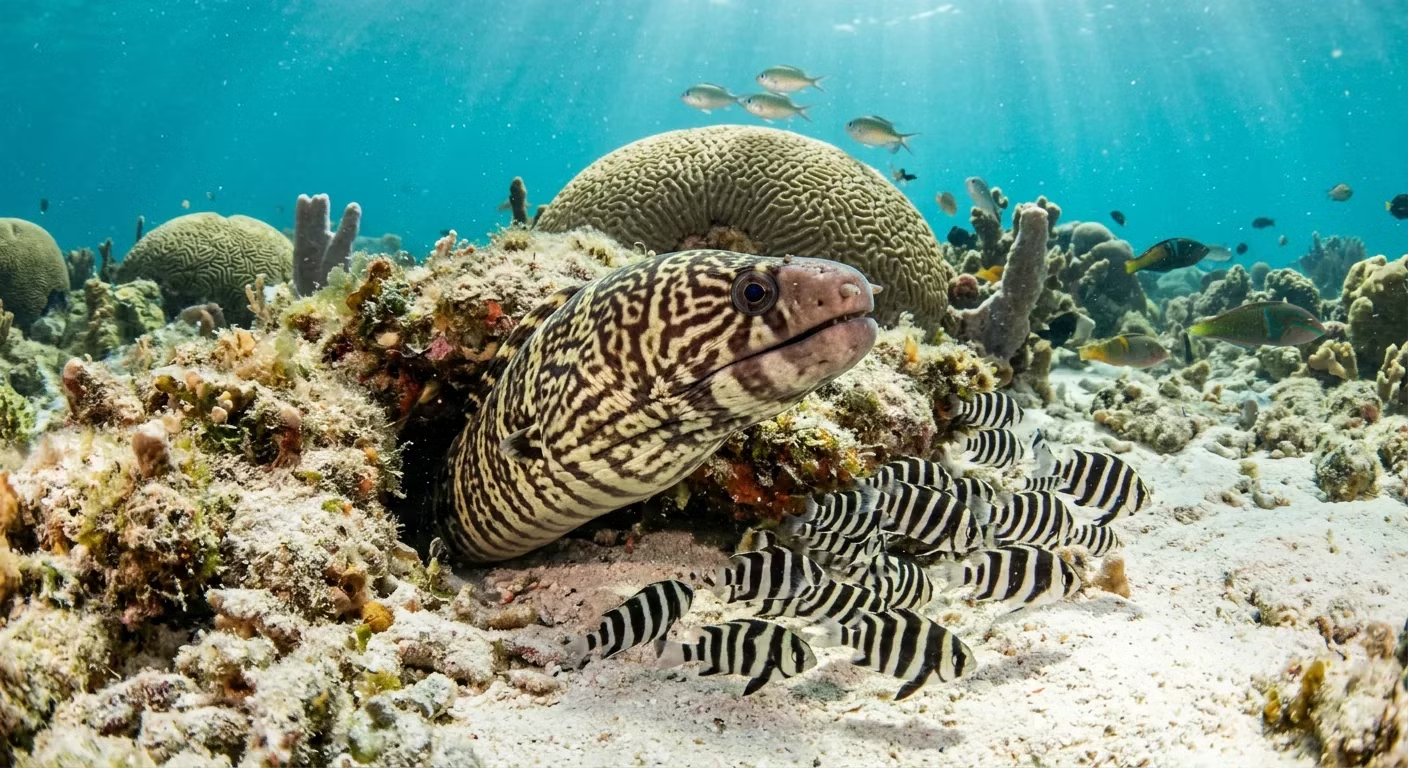
The convictfish (Pholidichthys leucotaenia), often referred to by divers and aquarists as the convict blenny or engineer goby, is an extraordinary, elongate teleost belonging to its own unique family, Pholidichthyidae. Despite its colloquial names, it is neither a true blenny nor a goby. Juveniles and adults present strikingly different colour morphs, a phenomenon that frequently confuses underwater observers. Juvenile convictfish display a bold pattern of velvety black with intense, horizontal white-to-yellow stripes, closely mimicking the venomous striped eel catfish (Plotosus lineatus). As they mature into adulthood, their slender, eel-like bodies transform, adopting an intricate, reticulated mosaic of vertical dark-brown and creamy-yellow bars and blotches resembling classic convict prison attire. They possess continuous dorsal and anal fins that merge seamlessly with a small, rounded caudal fin, a scaleless skin texture, and a blunt head featuring expressive, watchful eyes and fleshy lips adapted for shifting substrate.
Behaviour & reproduction
- Size
- Unknown
- Weight
- Up to 0.6 kg
- Lifespan
- 5-10 years
- Status
- Not Evaluated
Ecologically, the convictfish is famed for its subterranean engineering and unprecedented social system. Found widely across the warm tropical waters of the central Indo-Pacific, including the Coral Triangle, Indonesia, the Philippines, the Solomon Islands, and Papua New Guinea, these fish construct extensive, labyrinthine burrow systems beneath coral heads and sandy reef flats. Adults are almost entirely subterranean, spending their adult lives excavating, cleaning, and expanding intricate tunnels by scooping up mouthfuls of gravel and fine sand before spitting it out onto the surrounding seabed. In contrast, thousands of schooling juveniles emerge during daylight hours to forage above the reef, moving in a mesmerising, undulating ball that hovers over the home burrow entrance, darting back underground en masse at the slightest hint of danger.


