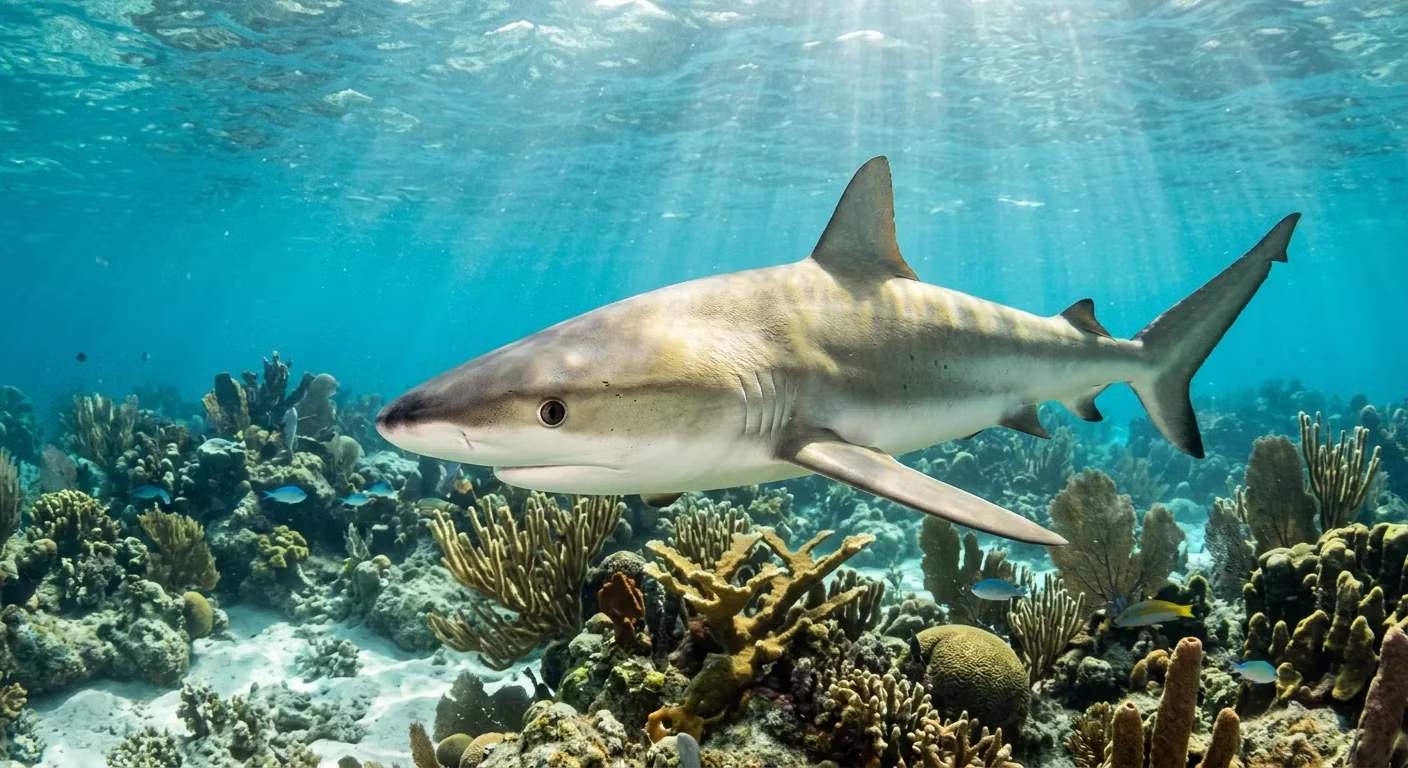
Blacknose Shark in its natural habitat, diving encounters and best destinations

Blacknose SharkWhere and when to see them

12-19 years

Want to dive with this animal?

Only destinations where this animal occurs.

The Blacknose Shark at a glance

The blacknose shark (Carcharhinus acronotus) is a small, slender requiem shark easily distinguished by a conspicuous dusky to jet-black smudge situated on the tip of its snout. This species possesses a streamlined, fusiform body with an elongated, rounded snout and relatively large, circular eyes adapted for acute vision in coastal waters. Its coloration ranges from yellowish-brown to greenish-grey along the dorsal surface, transitioning smoothly to a pale white or creamy-yellow underside. The fins are typically plain, although the second dorsal fin and the upper lobe of the caudal fin may exhibit faint dusky margins. Adults generally reach lengths between 1.2 and 1.4 metres, with females growing slightly larger than males, maintaining a compact and hydrodynamic silhouette that facilitates rapid bursts of acceleration in open shallows.

Behaviour & reproduction

Size
Unknown
Weight
Up to 18 kg
Lifespan
12-19 years
Status
Not Evaluated

The Blacknose Shark, Carcharhinus acronotus, is a relatively small, coastal species typically observed individually or in small, loose aggregations rather than large, cohesive schools. It is an active predator, primarily feeding on small bony fishes. This species exhibits viviparous reproduction, meaning live young develop within the mother and are born fully formed. Mating generally occurs in late spring or early summer, following which females undergo a gestation period estimated to be around 10 to 11 months. Litter sizes are typically small, ranging from 3 to 6 pups. These pups are born in shallow, coastal nursery areas, offering protection from larger predators. Growth is relatively slow, and individuals reach sexual maturity at approximately two to three years of age for males and three to four years for females.

Diving Tips

When diving with blacknose sharks, a calm and non-threatening demeanor is essential to prevent startling these naturally wary animals. Maintain neutral buoyancy and position yourself along the reef edge or slightly above the seabed, avoiding abrupt fin movements or aggressive pursuit. Blacknose sharks display an agonistic hunching display when feeling cornered or stressed; if an individual arches its back, lowers its pectoral fins, and swims with exaggerated lateral movements, calmly back away and give it space. Underwater photographers should prepare for swift subjects by selecting a medium-to-wide focal length (such as a 24-70mm lens) with a high shutter speed of 1/200s or faster to freeze motion in the bright, shallow reef light. Using twin strobes on low power will help illuminate the subtle dark snout marking without washing out the white ventral surface.

Fun facts about the Blacknose Shark

  • The blacknose shark gets its common name from the dark, charcoal-coloured smudge on the tip of its snout, which is most prominent in juveniles.
  • When threatened, this species exhibits a distinct threat display by arching its back, lowering its pectoral fins, and swimming in an exaggerated, stiff manner.
  • Like many requiem sharks, it is viviparous, giving birth to live pups after an eight-to-eleven-month gestation period.
  • Despite its small size, it is an exceptionally fast swimmer capable of overtaking agile schooling baitfish with sudden explosive bursts.

Best time to see the Blacknose Shark

The best diving encounters with the blacknose shark occur in the Bahamas and off the coast of Florida, where year-round resident populations thrive. In the Bahamas, particularly around New Providence, Grand Bahama, and the Exumas, diving conditions are optimal between November and May, characterised by calm seas and outstanding underwater visibility. Off Florida and North Carolina, summer months from June to September offer the greatest abundance as coastal waters warm and migratory schools assemble over nearshore reefs and shipwrecks. In the Gulf of Mexico, late spring through autumn (May to October) yields regular sightings over artificial reefs and sandy drop-offs. For liveaboard divers traversing Caribbean itineraries, winter to early spring presents the most comfortable diving climate and dependable reef visibility.

Where the Blacknose Shark lives

The waters this animal calls home are located exclusively in the western Atlantic Ocean, stretching from the coastal regions of North Carolina and Florida down through the Gulf of Mexico, the Bahamas, the Caribbean Sea, and along the South American coastline to southern Brazil. The blacknose shark primarily inhabits shallow continental and insular shelves, showing a strong affinity for sandy shoals, seagrass meadows, coral reef fringes, and shallow bays. While commonly observed at depths between 5 and 30 metres, it is capable of descending to around 65 metres along deeper coastal drop-offs and channel walls. It thrives in warm-temperate to tropical water temperatures, frequently venturing nearshore into surf zones, lagoons, and artificial reef habitats.

What the Blacknose Shark eats

The blacknose shark is a swift, opportunistic carnivore with a diet focused heavily on small bony fishes. Key prey species include pinfish, croakers, menhaden, grunts, damselfish, porgies, and anchovies, which the shark captures through sudden bursts of speed. It also feeds on benthic invertebrates such as small squids, octopuses, and coastal crabs when the opportunity arises. As an energetic meso-predator, the blacknose shark relies on keen olfactory cues and its lateral line system to detect erratic movements of baitfish schools. While foraging can take place throughout the day, predatory activity intensifies during the low-light hours of dawn and dusk, when schooling fishes are disoriented and more vulnerable along the reef periphery and across open sandy flats.

Blacknose Shark: frequently asked questions

When is the best time to see Blacknose Shark?
The best diving encounters with the blacknose shark occur in the Bahamas and off the coast of Florida, where year-round resident populations thrive. In the Bahamas, particularly around New Providence, Grand Bahama, and the Exumas, diving conditions are optimal between November and May, characterised by calm seas and outstanding underwater visibility. Off Florida and North Carolina, summer months from June to September offer the greatest abundance as coastal waters warm and migratory schools assemble over nearshore reefs and shipwrecks. In the Gulf of Mexico, late spring through autumn (May to October) yields regular sightings over artificial reefs and sandy drop-offs. For liveaboard divers traversing Caribbean itineraries, winter to early spring presents the most comfortable diving climate and dependable reef visibility.
How big does Blacknose Shark get?
Blacknose Shark: Unknown
Is Blacknose Shark dangerous for divers?
When diving with blacknose sharks, a calm and non-threatening demeanor is essential to prevent startling these naturally wary animals. Maintain neutral buoyancy and position yourself along the reef edge or slightly above the seabed, avoiding abrupt fin movements or aggressive pursuit. Blacknose sharks display an agonistic hunching display when feeling cornered or stressed; if an individual arches its back, lowers its pectoral fins, and swims with exaggerated lateral movements, calmly back away and give it space. Underwater photographers should prepare for swift subjects by selecting a medium-to-wide focal length (such as a 24-70mm lens) with a high shutter speed of 1/200s or faster to freeze motion in the bright, shallow reef light. Using twin strobes on low power will help illuminate the subtle dark snout marking without washing out the white ventral surface.
What is the conservation status of Blacknose Shark?
Blacknose Shark: Not Evaluated
Plan your trip

Ready to dive with these animals?

Choose a destination or search every available vessel to find the liveaboard that matches the marine life you want to see.