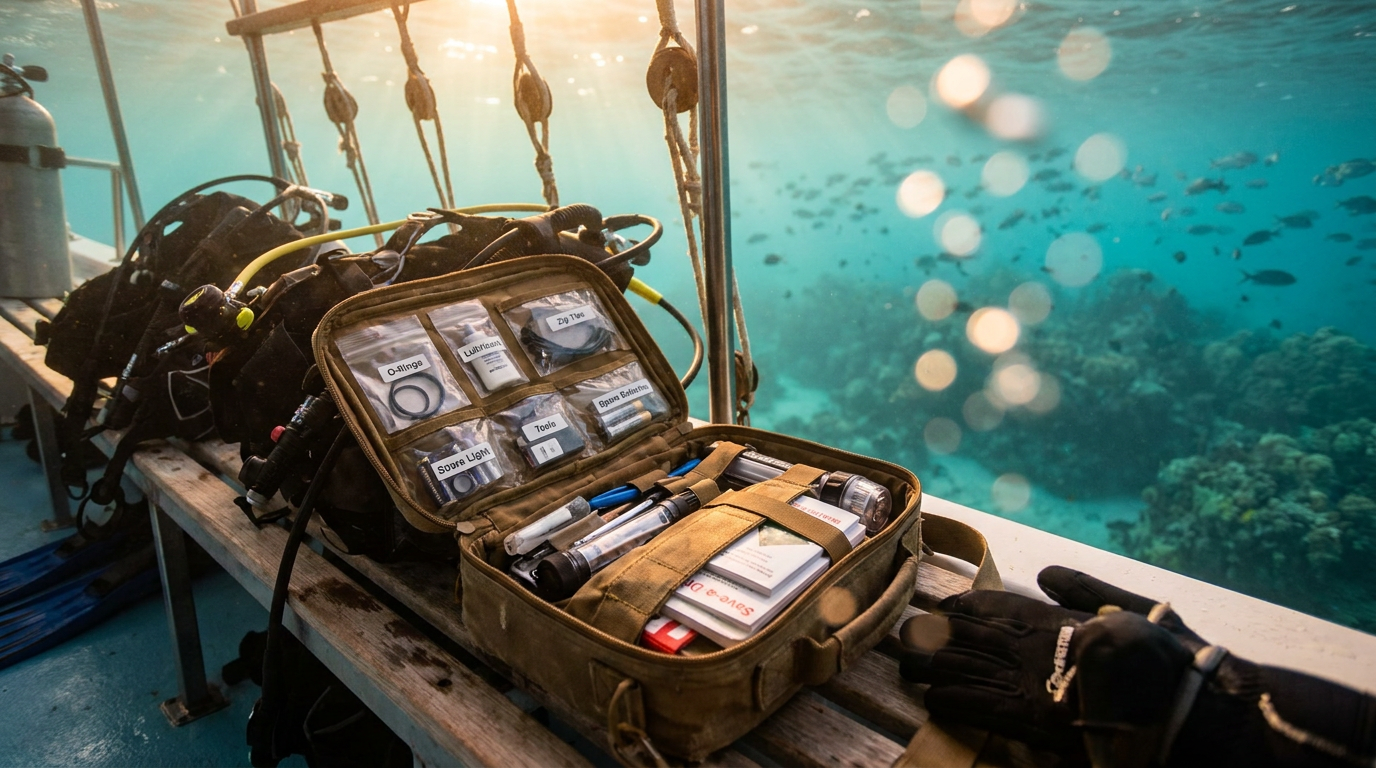
At a glance
- Purpose: To enable quick field repairs of minor scuba equipment issues
- Typical Contents: O-rings, mask straps, fin straps, mouthpiece ties, silicone grease, zip ties, small tools
- Portability: Small, compact, easily stored in a dive bag
- Key Benefit: Prevents missed dives due to minor equipment malfunctions
- Required Skill: Basic understanding of equipment and simple repair techniques
- Frequency of Use: Infrequent, but critical when needed
How a save-a-dive kit is used
A save-a-dive kit is utilised when a diver encounters a minor equipment issue that can be resolved with a simple replacement part or tool. For example, if a mask strap breaks before a dive, a spare strap from the kit can be quickly installed. Similarly, a worn or missing O-ring on a regulator can be replaced using the correct size from the kit and a dab of silicone grease to prevent air leaks.
The process generally involves identifying the problem, selecting the appropriate spare part or tool from the kit, and performing the repair. Many repairs, such as changing a mouthpiece or replacing a fin buckle, are straightforward and require minimal technical knowledge. For more complex issues, divers may consult with a dive guide or divemaster who can assist, often using parts from the diver's own kit.
Beyond immediate repairs, a save-a-dive kit can also be used for preventative maintenance, such as applying silicone grease to O-rings during regulator assembly, which extends their life and ensures a better seal. Regularly checking and replenishing the kit after use ensures it remains ready for future incidents.
Basic vs. Advanced Save-a-Dive Kits
| Feature | Basic Kit | Advanced Kit | Professional Kit |
|---|---|---|---|
| Target Diver | Recreational Diver | Experienced/Technical Diver | Dive Professional/Instructor |
| Contents Focus | Common consumable spares | Broader range of spares & tools | Extensive spares, specialised tools, diagnostic items |
| Examples (Spares) | Mask/fin straps, O-rings, mouthpiece | Hose protectors, swivel O-rings, battery/o-rings for dive computer | Regulator service kits, pressure gauge spares, drysuit seal patches |
| Examples (Tools) | Small screwdriver, zip ties, pliers | Adjustable spanner, hex key set, O-ring picks | Specialised regulator tools, multi-meter, spare bolt snaps |
| Weight/Size | Compact and lightweight | Moderate size and weight | Larger, heavier, often a dedicated toolkit |
Target Diver
Basic Kit: Recreational Diver
Advanced Kit: Experienced/Technical Diver
Professional Kit: Dive Professional/Instructor
Contents Focus
Basic Kit: Common consumable spares
Advanced Kit: Broader range of spares & tools
Professional Kit: Extensive spares, specialised tools, diagnostic items
Examples (Spares)
Basic Kit: Mask/fin straps, O-rings, mouthpiece
Advanced Kit: Hose protectors, swivel O-rings, battery/o-rings for dive computer
Professional Kit: Regulator service kits, pressure gauge spares, drysuit seal patches
Examples (Tools)
Basic Kit: Small screwdriver, zip ties, pliers
Advanced Kit: Adjustable spanner, hex key set, O-ring picks
Professional Kit: Specialised regulator tools, multi-meter, spare bolt snaps
Weight/Size
Basic Kit: Compact and lightweight
Advanced Kit: Moderate size and weight
Professional Kit: Larger, heavier, often a dedicated toolkit
What a save-a-dive kit means for your liveaboard trip
On a liveaboard, a save-a-dive kit transforms from a convenient accessory into an essential piece of travel gear. Liveaboards operate far from conventional infrastructure, meaning that if a mask strap breaks or a hose O-ring fails, obtaining a replacement part might be impossible without a personal kit. This can lead to significant frustration and missed dives, which undermines the purpose of a dedicated diving holiday.
Having your own save-a-dive kit provides peace of mind and self-sufficiency. It ensures that minor, easily fixable issues do not interrupt your dive schedule. While many liveaboards carry some spare parts, their stock may be limited, and specific to certain brands or models. Your personal kit is tailored to your own equipment, offering a much higher chance of a successful repair.
Furthermore, the ability to quickly resolve an equipment problem allows you to maximise your time underwater, fully experiencing the often-remote and pristine dive sites that liveaboards are designed to visit. It’s an investment in uninterrupted diving pleasure and ensures you get the most value from your liveaboard experience.
Essential Contents for a Liveaboard Save-a-Dive Kit
| Category | Item | Why it's essential | Metric/Imperial Example |
|---|---|---|---|
| Mask & Fins | Spare Mask Strap | Common failure, easy replacement | Universal fit neoprene strap |
| Mask & Fins | Spare Fin Straps / Buckles | Can break when donning/doffing | Specific to your fin model |
| Regulator | Assorted O-rings | Critical for seals, prone to wear/drying | DIN (G5/8") & Yoke (AS568-904) tank valve O-rings |
| Regulator | Mouthpiece & Zip Ties | Can tear or detach, easy replacement | Standard silicone mouthpiece & 150 mm (6 inch) zip ties |
| Tools/Misc. | Silicone Grease | Lubricates O-rings, improves seal | Small tub, e.g., 15 g (0.5 oz) |
Mask & Fins
Item: Spare Mask Strap
Why it's essential: Common failure, easy replacement
Metric/Imperial Example: Universal fit neoprene strap
Mask & Fins
Item: Spare Fin Straps / Buckles
Why it's essential: Can break when donning/doffing
Metric/Imperial Example: Specific to your fin model
Regulator
Item: Assorted O-rings
Why it's essential: Critical for seals, prone to wear/drying
Metric/Imperial Example: DIN (G5/8") & Yoke (AS568-904) tank valve O-rings
Regulator
Item: Mouthpiece & Zip Ties
Why it's essential: Can tear or detach, easy replacement
Metric/Imperial Example: Standard silicone mouthpiece & 150 mm (6 inch) zip ties
Tools/Misc.
Item: Silicone Grease
Why it's essential: Lubricates O-rings, improves seal
Metric/Imperial Example: Small tub, e.g., 15 g (0.5 oz)
Common misconceptions
Myth: A save-a-dive kit is only for professional divers or instructors. Fact: While dive professionals certainly benefit, a save-a-dive kit is recommended for every diver, regardless of experience level. Minor equipment failures can happen to anyone, and having a basic kit ensures preparedness, preventing missed dives for recreational divers too.
Myth: Liveaboards always have spare parts for everything. Fact: While most liveaboards carry some common spare parts, their stock is usually limited and may not cover all brands or specific component types. Relying solely on the liveaboard's supply means you might be out of luck if they don't have exactly what you need for your equipment.
Myth: My dive equipment is brand new, so I don't need a save-a-dive kit. Fact: Even new equipment can experience minor issues. A fin strap might be defective, an O-ring might be pinched during setup, or a mouthpiece could be bitten through. A kit covers unforeseen circumstances, irrespective of equipment age.
Myth: My dive buddy will have what I need. Fact: Relying on a buddy's kit is risky. Their kit might be tailored to their specific gear, or they might not have replenished it. Personal responsibility for your own equipment preparedness is a fundamental principle of safe diving, especially in remote liveaboard settings.
