Custom Itinerary
Galapagos Master · Galápagos · 13D/12N
About this route
This custom itinerary from San Cristobal explores the unparalleled marine diversity of the Galápagos archipelago. Expect encounters with hammerhead sharks, whale sharks (seasonally), manta rays, and Galápagos sharks in strong currents and diverse underwater topography, including walls, pinnacles, and lava tunnels. The route navigates through nutrient-rich waters supporting a complex food web from small reef fish to large pelagic species, offering dynamic drift dives and varied dive experiences. This journey provides an immersive dive adventure for experienced divers exploring both the northern and central islands.
Regions on this route
Day-by-day plan
Day 1: Embarkation & Check Dive
San Cristobal Island
Board the Galapagos Master in Puerto Baquerizo Moreno in the afternoon. After cabin assignments, vessel orientation, and safety briefings the team enjoys a relaxed check dive at Isla Lobos to dial in weights and trim with juvenile sea lions for company.
Dive sites: Isla Lobos
Day 2: Central Islands Warm-Up
North Seymour & Mosquera
Three gentle drift dives in the central archipelago build confidence with the cooler thermoclines. Expect resting white-tip reef sharks under ledges, eagle rays cruising the channel, and big schools of king angelfish and grunts moving across the cleaning stations.
Dive sites: Punta Carrion, Mosquera Islet, North Seymour Channel
Day 3: Cousin's Rock & Northbound Transit
Cousin's Rock
Two morning dives on the terraced volcanic walls of Cousin's Rock, draped in black coral and gorgonians. Look for seahorses, longnose hawkfish, and frogfish on the macro front while squadrons of eagle rays and sea lions tear through the blue. After lunch the boat begins the long overnight crossing north to Wolf Island.
Dive sites: Cousin's Rock
Good to know: Long overnight navigation to Wolf Island.
Day 4: Wolf Island – Hammerhead Walls
Wolf Island
Four dives at Wolf, hooking into the volcanic shelves to watch dense walls of scalloped hammerheads, Galapagos sharks, and silkies move along the cleaning stations. Bottlenose dolphins, turtles, and big schools of jacks regularly pass overhead in the blue.
Dive sites: El Derrumbe (The Landslide), La Ventana (The Window), Shark Bay
Good to know: Strong currents likely; reef-hook recommended.
Day 5: Wolf to Darwin
Wolf & Darwin Islands
A final morning of dives at La Banana and The Pinnacle before crossing north to Darwin in the early afternoon. The first dives at the legendary Darwin plateau reveal why this is considered the planet's most reliable big-animal site — endless waves of hammerheads, silkies in the shallows, and curious dolphins.
Dive sites: La Banana, The Pinnacle, Darwin's Arch (El Arenal)
Day 6: Darwin Island – The Arena
Darwin Island
A full day at Darwin to maximise pelagic encounters. From the plateau you watch the famous wall of scalloped hammerheads, and in season (roughly June to November) the giant silhouette of a whale shark frequently emerges from the blue. Tuna, marlin, and silkies round out the action.
Dive sites: Darwin's Arch (El Arenal)
Good to know: Whale shark season peaks June–November.
Day 7: More Darwin Magic
Darwin Island
A second full day at Darwin makes the most of the journey north. Conditions vary by dive — sometimes a single school of hammerheads stays parked overhead for the full bottom time, sometimes the whole reef explodes with feeding tuna and dolphins driving baitballs into the wall.
Dive sites: Darwin's Arch (El Arenal), Cleaning Station
Day 8: Darwin & Return to Wolf
Darwin & Wolf Islands
A last morning at Darwin before recrossing south to Wolf for the afternoon. Dives around the Anchorage and Hat Island add reef sharks, moray eels, and turtles to the list, with the chance of a final hammerhead encounter at the safety stop.
Dive sites: Darwin's Arch (El Arenal), Anchorage, Hat Island
Day 9: Western Upwelling – Fernandina
Fernandina Island
Wake up in the cold, plankton-rich water of the Cromwell Current. At Cape Douglas marine iguanas graze on algae underwater while flightless cormorants and Galapagos penguins dart through the shallows after fish. Topside, the volcanic flows of Fernandina rise out of the sea — the youngest and most pristine island of the archipelago.
Dive sites: Cape Douglas, Punta Espinoza
Good to know: Cold water; 7 mm hooded suit recommended.
Day 10: Isabela – Volcanic Walls
Isabela Island
Diving continues along the western flank of Isabela. Punta Vicente Roca is famous for Mola mola sightings in season, red-lipped batfish on the sand, and turtles in every direction. Roca Redonda is a submerged volcanic caldera with hot fumaroles bubbling through the reef, scalloped hammerheads patrolling the wall, and swirling schools of barracuda.
Dive sites: Punta Vicente Roca, Roca Redonda
Day 11: Cabo Marshall & Bartolome
Isabela / Santiago
The route swings east via Cabo Marshall, well known for cruising manta rays cleaning along the wall, and the iconic Bartolome Pinnacle where Galapagos penguins regularly join divers in the shallows. Sea lions, white-tips, and turtles round out the action.
Dive sites: Cabo Marshall, Bartolome Pinnacle
Day 12: Final Dives & Highlands Tour
Santa Cruz Island
Two final morning dives at Gordon Rocks — a flooded volcanic crater nicknamed the washing machine for its currents and famous for resident schools of scalloped hammerheads. The afternoon is spent ashore in the highlands of Santa Cruz, walking among free-roaming giant tortoises before the short overnight back to San Cristobal.
Dive sites: Gordon Rocks
Good to know: Highlands tour and giant tortoise visit included.
Day 13: Disembarkation
San Cristobal Island
After a final breakfast on board, disembark in Puerto Baquerizo Moreno by 08:30. With a later flight you can visit the Interpretation Centre or stroll the malecón to spot sea lions on the benches before your transfer to the airport.
Good to know: Disembarkation by 08:30 AM.
Upcoming departures
- 2027-04-26 – 2027-05-08from 12,480 USDBook
All routes of this liveaboard
About the vessel
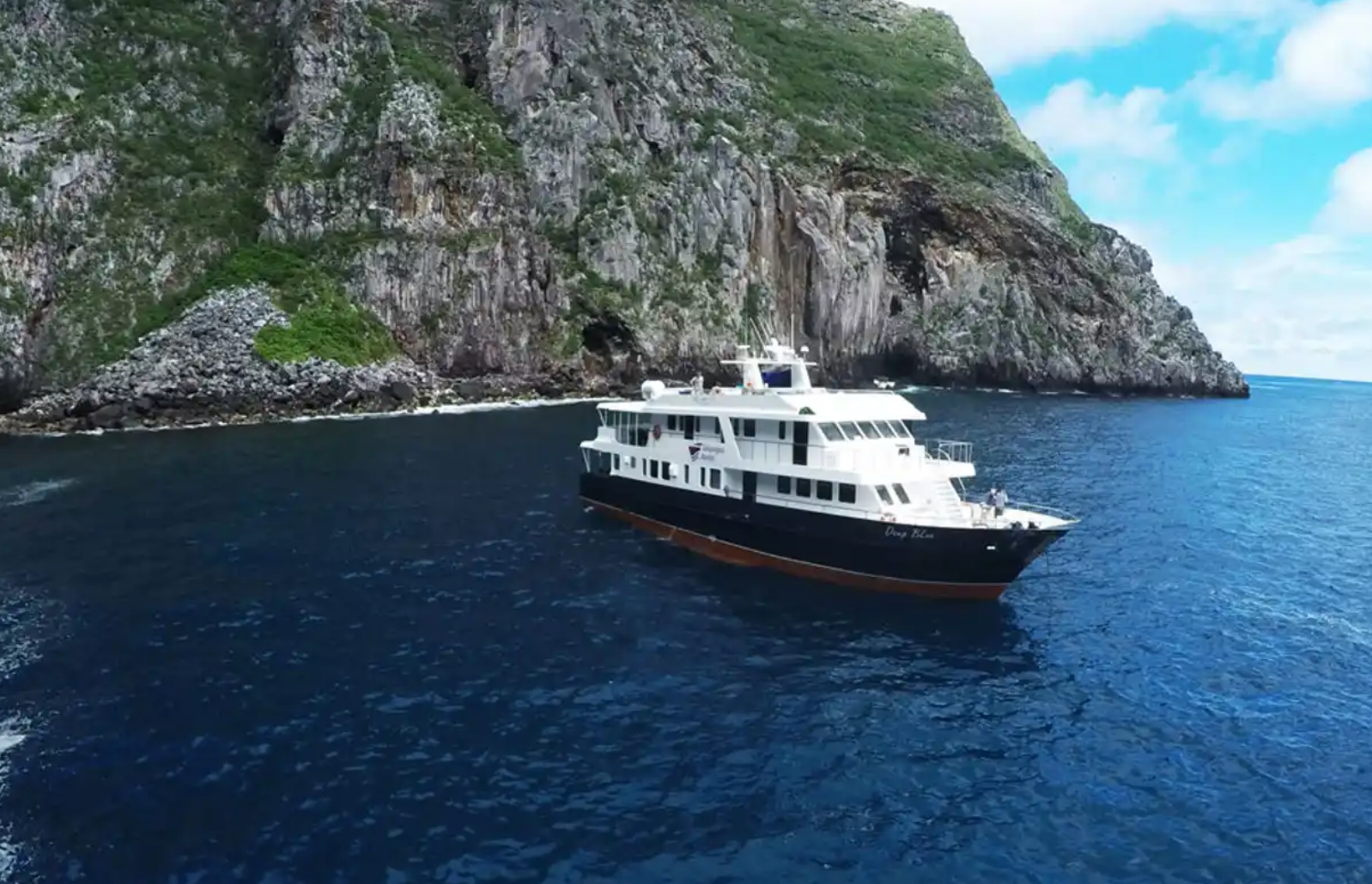 Galapagos MasterGalápagos