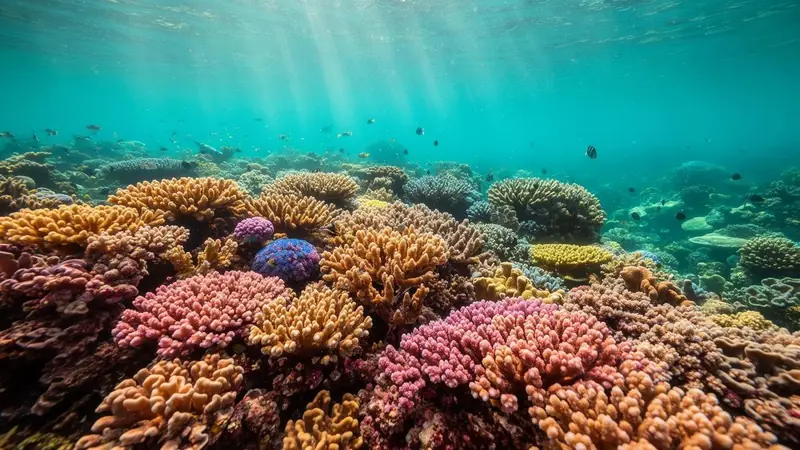
Shoot manual: 1/125–1/250s, f/8–f/13 for wide-angle with strobes, ISO 200–400, and shoot raw. Go slower shutter and wider aperture for available-light blue water.
Underwater photography rewards manual control, because auto exposure is constantly confused by bright blue water and dark reef in the same frame.
Wide-angle with strobes is the standard reef setup: shutter 1/125 to 1/250 second to control the blue background and freeze motion, aperture f/8 to f/13 for depth of field and to keep the corners sharp, ISO 200 to 400, and strobes on manual at about half power, angled outward to avoid lighting the water column between you and the subject. Shoot raw so you can recover the blues in post.
Macro is a different discipline: aperture f/16 to f/22 for depth of field on a tiny subject, shutter 1/160 to 1/250, ISO 100 to 200, single strobe or snoot close to the subject, and manual focus or focus-lock because autofocus hunts on low-contrast critters.
Available light, for big animals and silhouettes: drop the shutter to 1/60 to 1/125, open up to f/4 to f/5.6, raise ISO to 400 to 800, shoot upward towards the surface, and set a custom white balance at depth.
The bigger gains, though, are not in settings: get closer, shoot slightly upward, minimise the water between lens and subject, and be patient. A well-composed frame at mediocre settings beats a perfect exposure of a distant fish every time.
