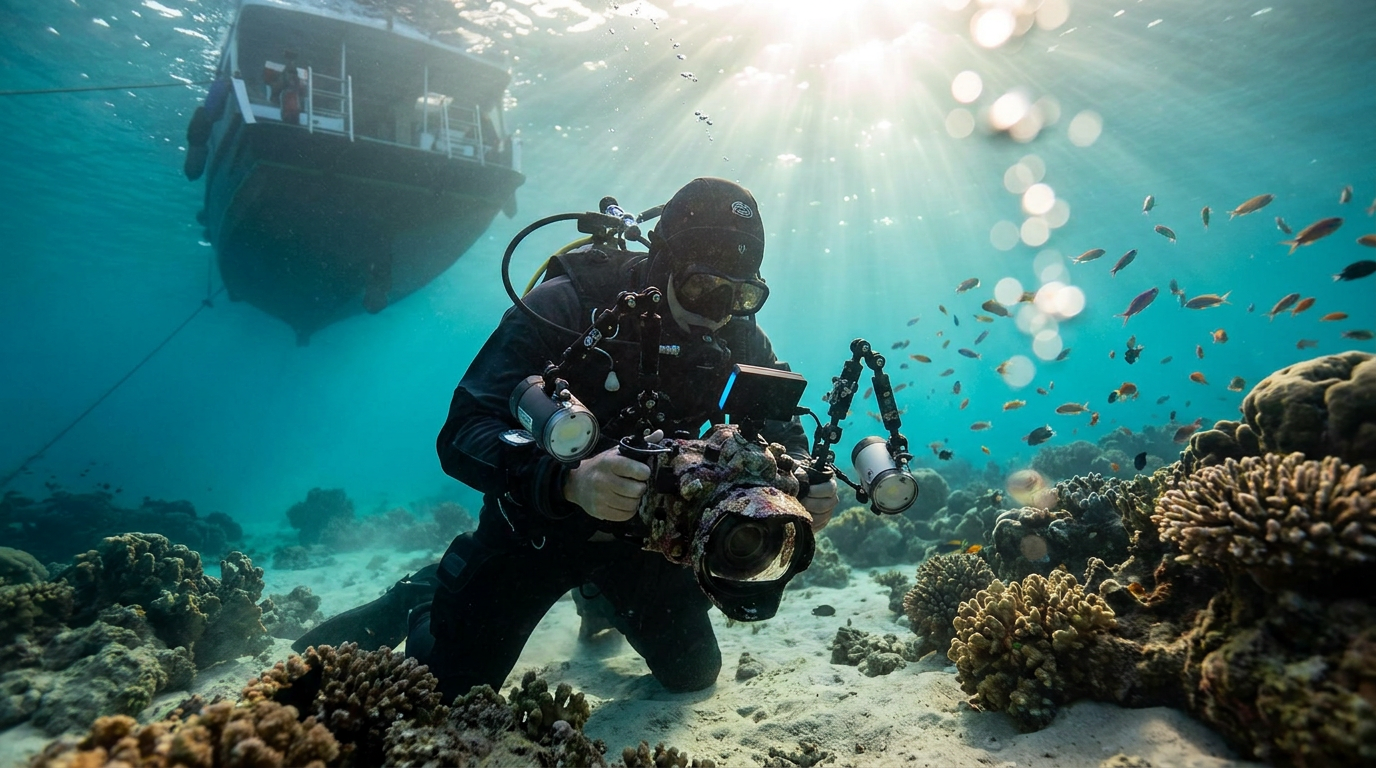
The four camera tiers
• Action cams ($300–$600) — GoPro Hero 13, DJI Osmo Action 5. Wide-angle only, fully waterproof, fits in a BCD pocket. Great for video memories, mediocre for low-light reef.
• Compact in housing ($1,000–$2,000 total) — Olympus TG-7, Sony RX100 series. RAW shooting, manual controls, tiny rig. The macro champion.
• Mirrorless in housing ($3,000–$6,000 total) — Sony A7C II, OM System OM-1. Interchangeable lenses, full-frame or M4/3 sensor, professional results.
• DSLR / pro mirrorless ($8,000–$15,000+ total) — Nikon Z8, Canon R5, Sony A7R V in aluminium housings. The serious hobbyist and professional rigs.
You will need lights
Below 5m red light disappears; everything looks blue/green without artificial light. Two options:
• Continuous video lights ($150–$1,500 each) — for video and macro stills. Brightness measured in lumens (3,000–8,000 lumens typical).
• Strobes ($300–$1,200 each) — for stills only. Brightness measured in guide number; recharge in 1–3 seconds.
One light is OK; two lights eliminate harsh shadows. Mount on flexible arms ($80–$300 per arm).
Wide-angle vs macro
Wide-angle (sharks, reefscapes, divers) and macro (nudibranchs, shrimp, eyes) require different lenses and different shooting techniques. Most divers eventually own both. Action cams are wide-angle only — for macro work you need a compact camera or larger.
Liveaboard practicalities
• Camera tables — most liveaboards provide dedicated camera-room tables with rinse tanks, charging stations and air guns
• Power — confirm voltage (110V vs 220V) and plug type before booking
• Spare batteries — bring at least 3 per camera body and 2 per light. Charging takes 2–4 hours
• Dehumidifier sachets — silica gel inside the housing prevents fogging on warm/cold transitions
• Insurance — DiveAssure, DAN and many travel insurers offer dedicated underwater photography riders ($50–$200/year)
Travel weight reality
A typical mirrorless underwater rig (camera + housing + 2 lights + arms + spare batteries + tools) weighs 8–14 kg in its travel case. Pack it as carry-on if airline rules permit; the housing alone often costs more than your entire luggage allowance.