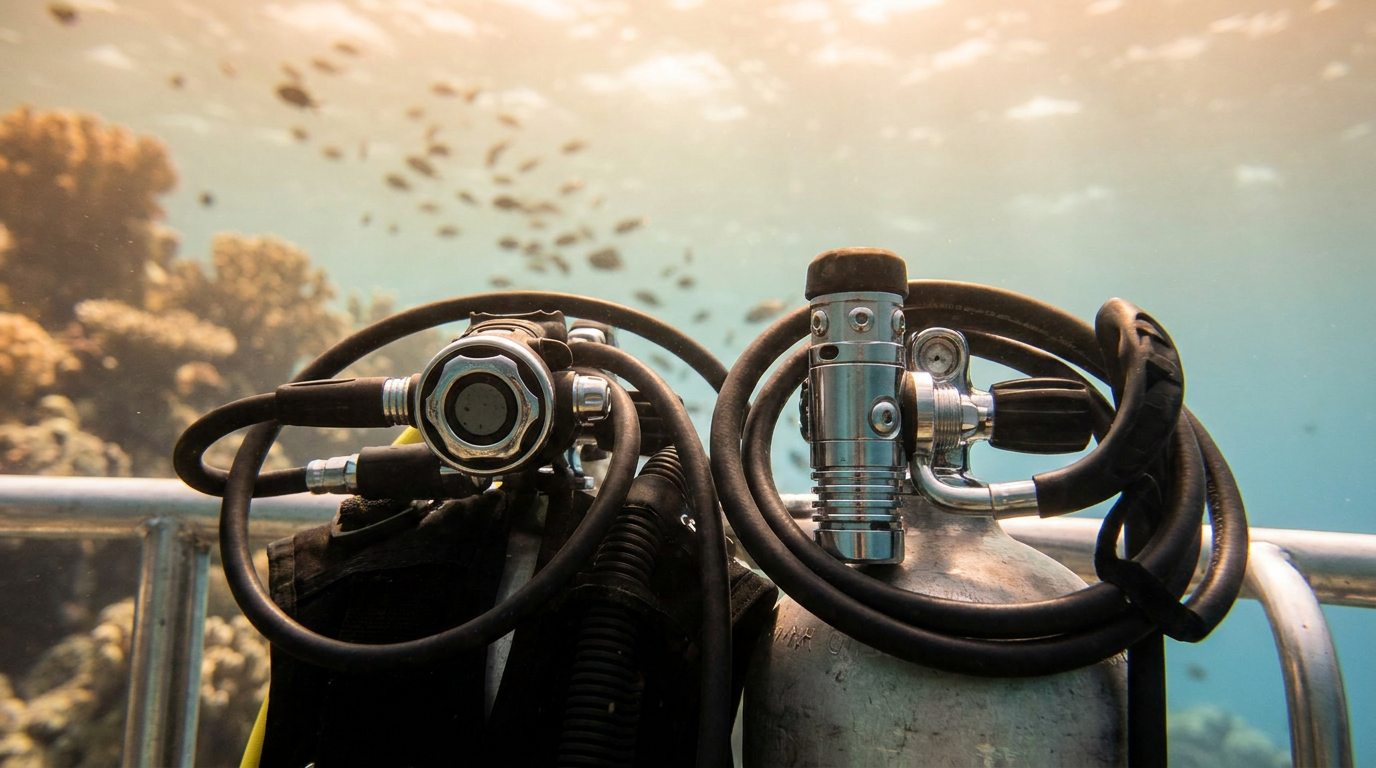
How a regulator works
The first stage attaches to the tank valve and reduces high tank pressure (200 bar) to a manageable 9–10 bar intermediate pressure. The second stage delivers that air at ambient pressure when you inhale. A properly tuned modern regulator should breathe identically at 5m and 40m.
Diaphragm vs piston
For liveaboards in tropical water, balanced piston (Apeks, Scubapro) and sealed diaphragm (Aqualung, Mares) regulators all perform excellently. Choose based on dealer support in your area.
| Type | Pros | Cons |
|---|---|---|
| Sealed diaphragm | Cold-water capable, sealed against silt, low maintenance | Slightly more expensive |
| Balanced piston | Highest gas flow, simplest mechanism | Less suitable for cold or silty water |
| Unbalanced piston | Cheap, reliable, fine for warm water | Breathing effort increases with depth and low tank pressure |
Sealed diaphragm
Pros: Cold-water capable, sealed against silt, low maintenance
Cons: Slightly more expensive
Balanced piston
Pros: Highest gas flow, simplest mechanism
Cons: Less suitable for cold or silty water
Unbalanced piston
Pros: Cheap, reliable, fine for warm water
Cons: Breathing effort increases with depth and low tank pressure
What "balanced" means
A balanced second stage gives identical breathing performance whether your tank is full or down to 20 bar. Worth paying for. An unbalanced second stage gradually feels harder to breathe as the tank empties.
DIN vs Yoke connection
• DIN — screws into the tank valve, rated for 300 bar, slightly safer (no o-ring exposure). Standard in Europe and on most liveaboards.
• Yoke (A-clamp) — clamps over the valve, rated for 232 bar. Standard in North America and on Caribbean dive boats.
A removable DIN-to-Yoke adapter ($15–$25) lets one regulator work on any tank worldwide.
What you actually need
A complete regulator setup includes:
• First stage
• Primary second stage (the one you breathe from)
• Octopus / alternate second stage (for sharing air)
• SPG (submersible pressure gauge)
• Inflator hose for your BCD
Pre-built regulator sets ($600–$1,000) bundle all five items. Annual service is mandatory and costs $80–$150.
Best regulators 2026 by budget
• Under $400 — Mares Rover 2S, Aqualung Calypso
• $400–$700 — Apeks XTX 50, Scubapro MK17 EVO/G260, Aqualung Core
• $700+ — Apeks MTX-RC, Scubapro MK25 EVO/A700, Atomic Aquatics ST1