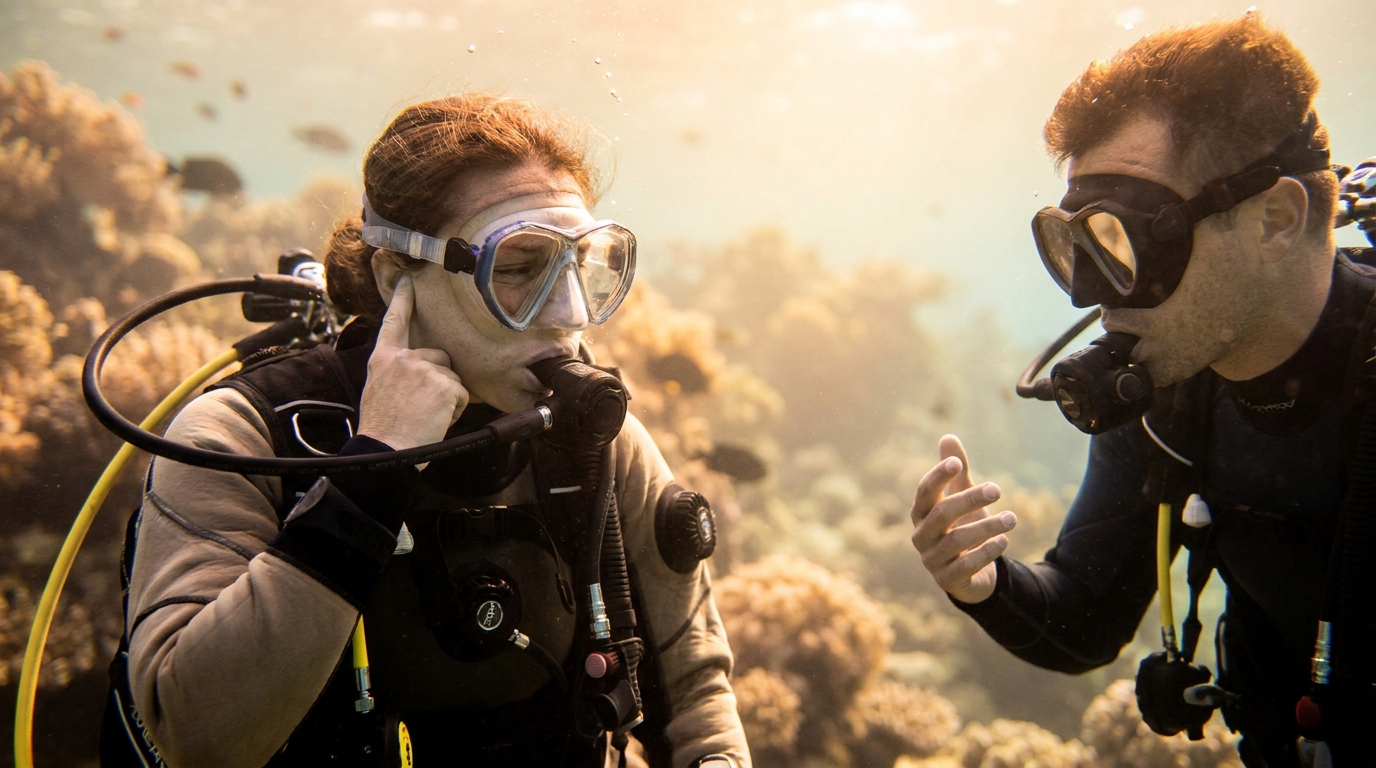
Why ears hurt: the 1.0 ATA squeeze
Every metre of descent adds pressure on your eardrum. Without equalizing, the eardrum is pushed inward, blood vessels rupture, and you can perforate the eardrum at as little as 2m depth. The Eustachian tube connects your middle ear to your throat — equalization opens it briefly to balance pressure. Most divers have closed Eustachian tubes by default, requiring active opening.
Technique 1: Valsalva (the standard)
Pinch your nose, gently blow against it like inflating a balloon. Easy to learn, but hard on the inner ear if forced. Never blow hard — gentle pressure for 2 seconds, descend, repeat. Most beginner divers learn Valsalva and never try anything else.
Technique 2: Frenzel (the pro's choice)
Pinch nose, close throat (like holding breath at the back), then push the back of your tongue up against the roof of your mouth like saying 'k'. The tongue acts as a piston, opening the Eustachian tubes from the back. Hands-free, gentler, works at any depth, and you can equalize while inverted. Worth a YouTube tutorial.
Technique 3: Toynbee (swallowing)
Pinch nose and swallow. Saliva production triggers Eustachian tube opening. Useful when descending feet-first from a giant stride. Combine with Valsalva or Frenzel for best results.
Technique 4: BTV (no hands)
Voluntary Tubal Opening — tense the muscles at the back of your throat (like yawning with mouth closed) to open the Eustachian tubes. Some people are born able to do this; others learn after months of practice. The holy grail for free-divers and tech divers.
What to do when you can't clear
STOP. Ascend 1–2 metres until pressure releases, then re-attempt slowly. If still no clearance after 3 attempts, abort the dive — perforation pain is permanent damage. Common causes: dehydration (mucus thickens), sinus congestion (cold/flu), allergies (antihistamines help — Sudafed-type decongestants are debated for diving). Never use nasal sprays if they list 'rebound congestion' as a side effect.
Liveaboard prep: protecting your ears for 4 dives a day
Avoid alcohol the night before — dries out mucus membranes. Stay hydrated. Skip dairy and excessive sugar (mucus production). Practice equalization 5× a day on land. If you're prone to ear issues, descend feet-first slowly (head-down inverted is much harder). Use ear-rinse solutions like Auralgan / Ear Plane after every dive day to prevent surfer's ear and infections.