Forgotten Islands - Ring of Fire (13 Nights, Maumere - Ambon)
Seahorse · Indonesia · 14 Days / 13 Nights
About this route
A fourteen-day voyage tracing the volcanic arc of the Banda Sea — the Ring of Fire — from Flores eastward through the remote Forgotten Islands to the historic Banda archipelago and on to Ambon. The route traverses some of Indonesia's most isolated and biodiverse waters: the coral-rich channel dives of Alor, the untouched reefs of Wetar and Nila, the offshore seamount of Nil Desperandum, and the volcanic marvels of Manuk where resident sea snakes coexist with schooling hammerhead sharks. The trip closes with the superlative muck diving of Ambon Bay's Laha site.
Day-by-day plan
Day 1: Day 1 — Maumere, Flores (Check-In)
Guests embark at Maumere on the north coast of Flores before noon. After welcome briefings and introductions to the cruise director and dive guides, the vessel departs in the early afternoon for an overnight navigation southeast toward the Sunda arc.
Day 2: Day 2 — Kawula Island
An early arrival at Kawula — a seldom-visited volcanic island in the Solor Archipelago — opens the diving programme with steeply dropping walls and current-swept ridges. The reefs remain largely unexplored, with pristine hard coral coverage and healthy schools of fish.
Day 3: Day 3 — Alor
The Alor Archipelago is famous for some of Indonesia's strongest currents and correspondingly intense marine life. Steep walls dense with sea fans and black corals drop into the abyss at Kal's Dream and Batu Tiga, with swift drifts past enormous schools of jacks and barracuda. Pygmy seahorses hide in virtually every gorgonian along the wall.
Day 4: Day 4 — Alor (continued)
A second full day allows exploration of the calmer bay sites and shallow reef terraces. Exceptional macro life — painted frogfish, flamboyant cuttlefish and ghost pipefish — inhabits the rubble zones, while a night dive at anchor reveals Alor's extraordinary nocturnal fauna.
Day 5: Day 5 — Wetar Island
Wetar is among the least dived islands of the entire Indonesian archipelago. Walls and ridges host schooling barracuda in the upper reef, enormous sea fans cascading down the slope, and a complete absence of fishing pressure that leaves the resident marine life uncharacteristically bold.
Day 6: Day 6 — Nila Island
The small volcanic island of Nila in the central Banda Sea provides dramatic topside scenery matched by equally dramatic underwater terrain. Steep drop-offs are festooned with large barrel sponges and branching black corals, with tuna, kingfish and Spanish mackerel hunting in the blue water column.
Day 7: Day 7 — Nil Desperandum Reef
Nil Desperandum is an isolated offshore reef rising from deep open Banda Sea as a vast plateau of hard corals and barrel sponges with vertical walls on all sides. The site is a known aggregation point for schooling hammerhead sharks, with early morning entries delivering the best chances of encounters.
Day 8: Day 8 — Serua Island
Serua consists of two tiny volcanic islands in the middle of the open Banda Sea and harbours one of the region's most reliable hammerhead aggregation sites. Early morning entries are timed for the arrival of schooling scalloped hammerheads, with colourful walls teeming with anthias and reef fish in the afternoon.
Day 9: Day 9 — Manuk Island
Manuk is one of Indonesia's most extraordinary dive destinations: a volcanic island and nesting home for tens of thousands of seabirds. Underwater, sulphur gas vents bubble from the reef and the dark volcanic substrate is patrolled by an almost inconceivable density of sea snakes; hammerheads are also regularly encountered in small groups around the island.
Day 10: Day 10 — Hatta Island (Banda group)
Hatta is part of the historic Banda Islands spice group and combines superb diving with rich colonial history. The drop-offs plunge steeply from healthy coral reefs into the abyss with Napoleon wrasses, large groupers and occasional hammerheads. A guided visit to a nutmeg plantation reveals the crop that brought European empires to blows in the seventeenth century.
Day 11: Day 11 — Banda Neira
Banda Neira, the administrative centre of the Banda Islands, offers a magnificent land visit to Fort Belgica, the Dutch colonial museum and plantation houses. Diving around Banda and the adjacent Gunung Api includes a traverse of the 1988 lava flow, now a sculptural underwater landscape reclaimed by corals and enormous sponges.
Day 12: Day 12 — Ai & Run Islands
The outer islands of Ai and Run — Run was famously traded by the English to the Dutch in exchange for Manhattan in 1667 — offer superb diving on well-developed drop-offs with excellent visibility. Large sea fans and black coral trees line the walls, with schooling hammerheads occasionally drawn in by nutrient-rich water.
Day 13: Day 13 — Suanggi Island
Suanggi, roughly 20 nautical miles northeast of Banda, is one of the Banda Sea's premier hammerhead hotspots. Guests station along the deep wall in the early morning when schooling scalloped hammerheads are most active, with a gentler reef-top dive in the afternoon.
Day 14: Day 14 — Nusa Laut & Ambon Bay / Check-Out
A morning dive at Nusa Laut's celebrated Ahmet site is followed by a transit into Ambon Bay for the famous Laha muck dive, where divers search volcanic silt for Rhinopias scorpionfish, flying gurnards and bobtail squid. The Seahorse docks at Ambon (Pattimura) harbour for disembarkation before noon.
Upcoming departures
All routes of this liveaboard
- * Raja Ampat - Halmahera (Sorong → Ternate) · 12D11N
- Raja Ampat - Halmahera - Lembeh (Sorong - Bitung) · 11 nights
- * Triton Bay - Raja Ampat (Kaimana → Sorong) · 12D11N
- Bali - Sumbawa - West Flores (Denpasar - Labuan Bajo) · 11 Days / 10 Nights
- Raja Ampat Ultimate (Sorong - Sorong) · 12 nights
- Raja Ampat - Halmahera - Lembeh (Sorong - Bitung) · 13 Days / 12 Nights
- * Halmahera - Raja Ampat (Ternate → Sorong) · 12D11N
- West Flores - Sumbawa - Bali (11 Nights, Labuan Bajo - Denpasar) · 12 Days / 11 Nights
- * Komodo Ultimate - 9Nights (Labuan Bajo) (Labuan Bajo → Labuan Bajo) · 10D9N
- * Raja Ampat - Triton Bay (Sorong → Kaimana) · 12D11N
- Forgotten Islands - Ring of Fire (Maumere - Ambon) · 13 Days / 12 Nights
- Forgotten Islands - Ring of Fire (Saumlaki - Ambon) · 12 Days / 11 Nights
- West Flores - Sumbawa - Bali (Labuan Bajo - Denpasar) · 10 nights
- Ring of Fire - Forgotten Islands (Ambon - Saumlaki) · 11 nights
- Ring of Fire - Raja Ampat (Ambon - Sorong) · 11 nights
- Raja Ampat Ultimate (Sorong - Sorong) · 11 nights
- * West Flores - Sumbawa - Bali · 11 nights
About the vessel
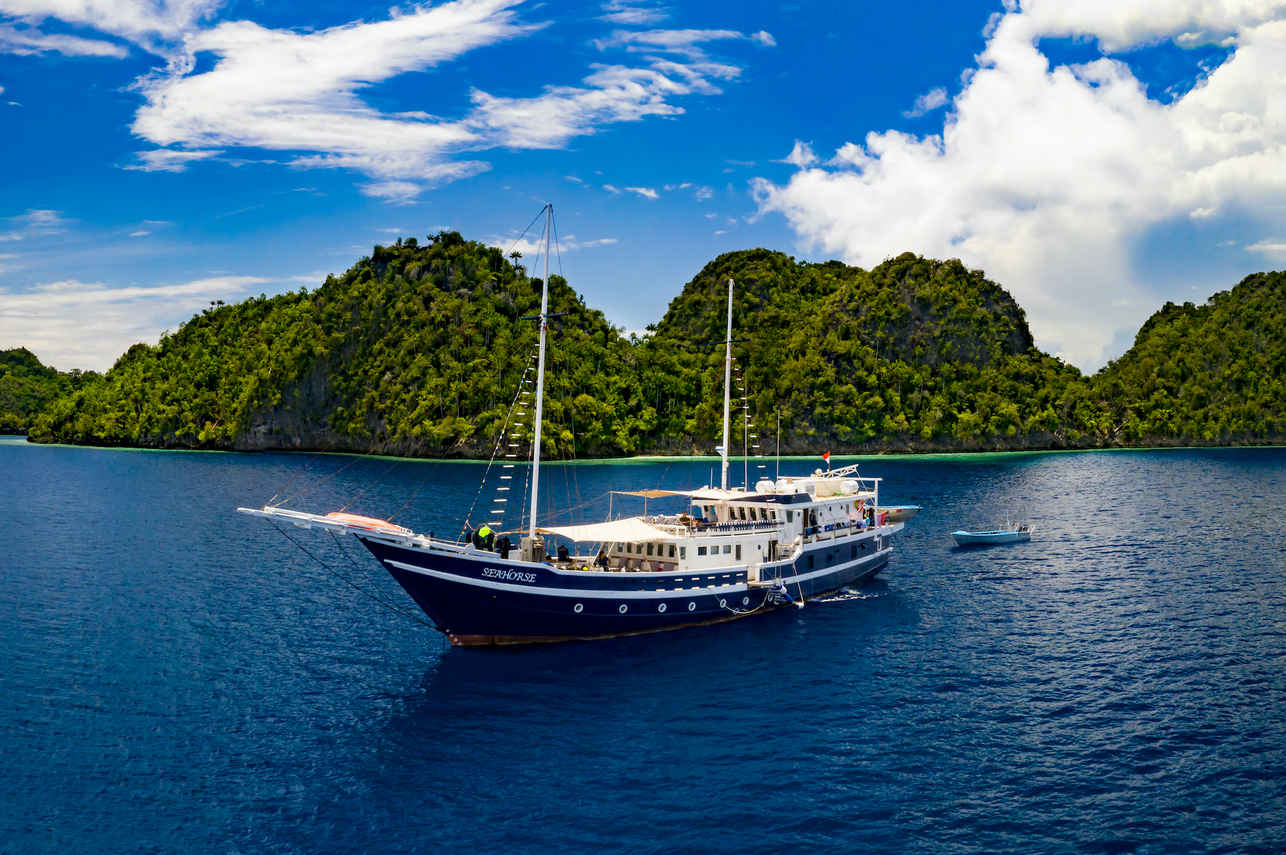 SeahorseIndonesia