Itinerary B5A4 - Galapagos Cruise (Baltra - Baltra)
Archipel I · Galápagos · 7 nights
About this route
This 7-night cruise explores the intriguing colonization history and unique wildlife of the Galápagos Islands, focusing on three of the four inhabited islands: San Cristobal, Floreana, and Santa Cruz. Guests will discover the southeastern route of the archipelago, where evolutionary forces have shaped distinct sub-species. The itinerary also includes visits to untouched islands like Santa Fe, known for its endemic species, and South Plaza, offering chances to see land iguanas and giant cactus forests. While primarily a cruise, the focus is on land and snorkeling excursions to appreciate the diverse ecosystem.
Regions on this route
Highlights
Chinese Hat
Chinese Hat is a small, distinctive volcanic islet named for its resemblance to a traditional Chinese hat. Its relatively calm and shallow waters make it an excellent snorkeling spot, where guests can often see Galápagos penguins, reef sharks, and various tropical fish. The islet's unique geological formations provide a fascinating underwater landscape and a scenic view above the surface.
- Volcanic islet
- Snorkeling opportunities
- Galapagos penguins
- Unique geological formations
Española Island
Española is the oldest and southernmost island of the Galápagos, celebrated for its high level of endemism and abundant wildlife. It is the sole breeding ground for the waved albatross during certain seasons, alongside large colonies of blue-footed boobies, Nazca boobies, and sea lions. The island's rugged coastline and dramatic cliffs provide excellent opportunities for observing marine birds and iguanas.
- Waved albatross breeding
- High endemism
- Blue-footed booby colonies
- Dramatic coastal cliffs
Floreana Island
Floreana Island is rich in both natural history and human intrigue, known for its diverse wildlife and historical significance. Key sites include Cormorant Point with its green-sand beach and Devil's Crown, an excellent snorkeling spot. The island is also home to American flamingos and offers a glimpse into early human settlements in the Galápagos through sites like Post Office Bay.
- Historical intrigue
- Green-sand beach
- Flamingo breeding
- Snorkeling at Devil's Crown
Gardner Bay
Gardner Bay is a picturesque white-sand beach located on Española Island, famous for its large colony of sea lions. The tranquil waters make it an ideal spot for swimming and snorkeling, offering opportunities to observe marine life in a calm environment. The bay is also a nesting site for sea turtles.
- Sea lion colony
- White-sand beach
- Snorkeling opportunities
- Sea turtle nesting
North Seymour
North Seymour is a flat, uplifted island known for its significant populations of marine birds. It hosts one of the largest colonies of magnificent frigatebirds and blue-footed boobies, making it a prime location for birdwatching. Land iguanas are also commonly seen here, foraging among the island's vegetation. The island's main trail offers close-up views of nesting sites.
- Frigatebird colonies
- Blue-footed boobies
- Land iguanas
- Nesting sites
Post Office Bay
Located on Floreana Island, Post Office Bay is a historical site dating back to the 18th century. Whalers and buccaneers established a wooden barrel here to send mail to and from Europe and the United States. Visitors today can continue this tradition by leaving postcards in the barrel and picking up others to deliver by hand. The area also features a tranquil beach and shallow waters.
- Historic mail barrel
- Whaling history
- Tranquil beach
- Unique tradition
San Cristobal
San Cristobal is one of the four inhabited islands in the Galápagos, offering a blend of natural beauty and historical significance. Its eastern location makes it a haven for various seabirds, including the unique presence of all three booby species at Pitt Point. The island also features stunning beaches, volcanic landscapes, and cultural sites like the Interpretation Center.
- Diverse seabird populations
- Pitt Point boobies
- Volcanic landscapes
- Cultural interpretation
Santa Fe Island
Santa Fe Island is known for its unique endemic species, including the Santa Fe land iguana and a specific variety of opuntia cactus. The island's tranquil bay is a popular spot for snorkeling, providing chances to swim with playful sea lions and observe various reef fish. The landscape features a palo santo forest and towering cactus trees.
- Endemic land iguanas
- Endemic opuntia cactus
- Snorkeling with sea lions
- Palo santo forests
Shore excursions
- Snorkeling with sea lions and colorful reef fish at Lobos Islet.
- Observing the breeding colony of American flamingos on Floreana Island.
- Visiting the exclusive easternmost point of Pitt Point to see blue- and red-footed boobies.
- Encountering Galápagos giant tortoises in their natural ambiance.
- Participating in breeding programs for emblematic Galápagos giant tortoises.
- Exploring the 'Crown jewel' Santa Fe Island with its mainly endemic species.
- Visiting South Plaza, a must-see highlight for land iguanas and giant cactus forests.
Day-by-day plan
Day 1: Embarkation – Baltra Island
The journey begins with arrival at Baltra Airport (GPS), where guests will be transferred for embarkation. After settling into cabins and receiving a welcome briefing, the afternoon includes a visit to the Charles Darwin Research Station and Fausto Llerena Breeding Center on Santa Cruz Island. This day focuses on logistical arrangements and an initial introduction to the unique conservation efforts of the Galápagos.
Day 2: Floreana Island – Iconic Landscapes
Today's activities focus on Floreana Island, a site steeped in human history and natural beauty. The morning is dedicated to exploring Cormorant Point, known for its unique green sand beach and diverse birdlife, and Devil's Crown, a partially submerged volcanic cone offering excellent snorkeling opportunities. In the afternoon, guests visit Baroness Lookout and the historic Post Office Bay, where whalers and sailors traditionally left mail. While primarily a land and snorkeling day, Devil's Crown is renowned for its marine life and underwater topography, featuring volcanic rock formations and a vibrant reef.
Dive sites: Cormorant Point, Devil's Crown, Baroness Lookout, Post Office Bay
Day 3: Española Island – Wildlife Encounters
The day is spent discovering the unique wildlife of Española Island, the southernmost and one of the oldest islands in the Galápagos. Morning activities are centered around Gardner Bay, famous for its picturesque white sand beach and large colony of sea lions. In the afternoon, guests explore Punta Suarez, a prime landing site known for its diverse bird populations, including blue-footed boobies, Nazca boobies, and the endemic waved albatross during nesting season. This day offers exceptional opportunities for wildlife photography and observing the island's unique ecosystem.
Dive sites: Gardner Bay, Punta Suarez
Day 4: San Cristobal – Eastern Wildlife
Today's itinerary focuses on San Cristobal Island, starting with a morning visit to Pitt Point. This easternmost point of the island is notable for being the only place in the Galápagos where all three species of boobies (blue-footed, red-footed, and Nazca) can be found together, alongside frigatebirds and sea lions. The afternoon takes guests to Witch Hill, a tuff cone formation offering stunning views and a beautiful beach, often frequented by marine iguanas and various seabirds. The area provides excellent opportunities for birdwatching and enjoying the scenic coastal landscapes.
Dive sites: Pitt Point, Witch Hill
Day 5: San Cristobal – Island Exploration
This day continues exploration of San Cristobal Island, beginning with a morning visit to Isla Lobos, a small islet known for its resident population of sea lions and nesting blue-footed boobies. The calm waters around the islet are ideal for snorkeling, offering chances to swim alongside sea lions and observe colorful reef fish. In the afternoon, the journey proceeds to an interpretation center, followed by a hike to Frigatebird Hill, providing panoramic views of the coastline and an opportunity to spot both magnificent and great frigatebirds. This day blends wildlife encounters with educational insights into the archipelago's natural history.
Dive sites: Isla Lobos, Frigatebird Hill
Day 6: Santa Fe & South Plaza – Endemic Species
Today's excursion brings guests to two distinctive islands, each offering unique ecological experiences. The morning is dedicated to Santa Fe Island, renowned for its endemic species such as the Santa Fe land iguana and a particular variety of opuntia cactus. The island's tranquil bay is an excellent spot for snorkeling among sea lions and reef fish. In the afternoon, the journey continues to South Plaza Island, a small but ecologically rich island famous for its vibrant red sesuvium plants, towering opuntia cacti, and a large colony of land iguanas.
Dive sites: Santa Fe, South Plaza
Day 7: North Seymour & Chinese Hat – Abundant Wildlife
The penultimate day features visits to two notable wildlife havens. The morning is spent at North Seymour Island, a flat, uplifted island known for its large colonies of blue-footed boobies, frigatebirds, and land iguanas. A trail leads through nesting sites, providing close-up views of these iconic Galápagos creatures. In the afternoon, the expedition heads to Chinese Hat, a small volcanic islet named for its distinct shape.
Dive sites: North Seymour, Chinese Hat
Day 8: Disembarkation – Baltra Island
On the final day, guests disembark from the Archipell I. The morning begins with a visit to Twin Craters, large sinkholes formed by collapsing magma chambers, offering a glimpse into the geological history of Santa Cruz Island and the surrounding Miconia forest. Following this, a transfer will take guests to Baltra Airport (GPS) for their departing flights. This concludes the Galápagos adventure.
Dive sites: Twin Craters
Upcoming departures
- 2026-10-29 – 2026-11-05from 4,501 USDBook
- 2026-11-12 – 2026-11-19from 5,295 USDBook
- 2026-11-26 – 2026-12-03from 5,295 USDBook
- 2026-12-10 – 2026-12-17from 5,295 USDBook
- 2026-12-24 – 2026-12-31from 6,089 USDBook
- 2027-01-07 – 2027-01-14from 5,450 USDBook
- 2027-01-21 – 2027-01-28from 5,450 USDBook
- 2027-02-04 – 2027-02-11from 5,450 USDBook
- 2027-02-18 – 2027-02-25from 5,450 USDBook
- 2027-03-04 – 2027-03-11from 5,450 USDBook
- 2027-03-18 – 2027-03-25from 5,450 USDBook
- 2027-04-01 – 2027-04-08from 5,450 USDBook
All routes of this liveaboard
About the vessel
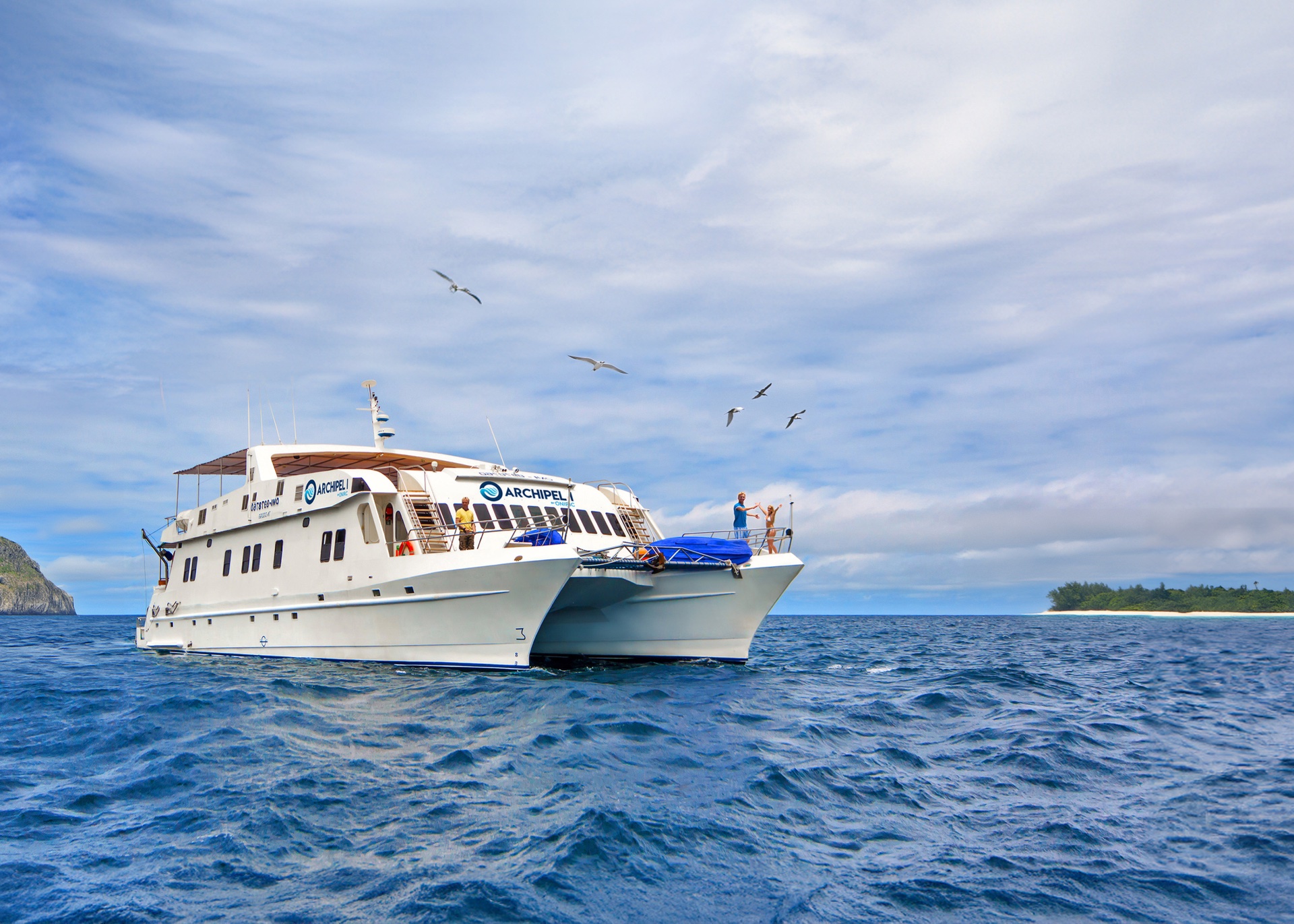 Archipel IGalápagos