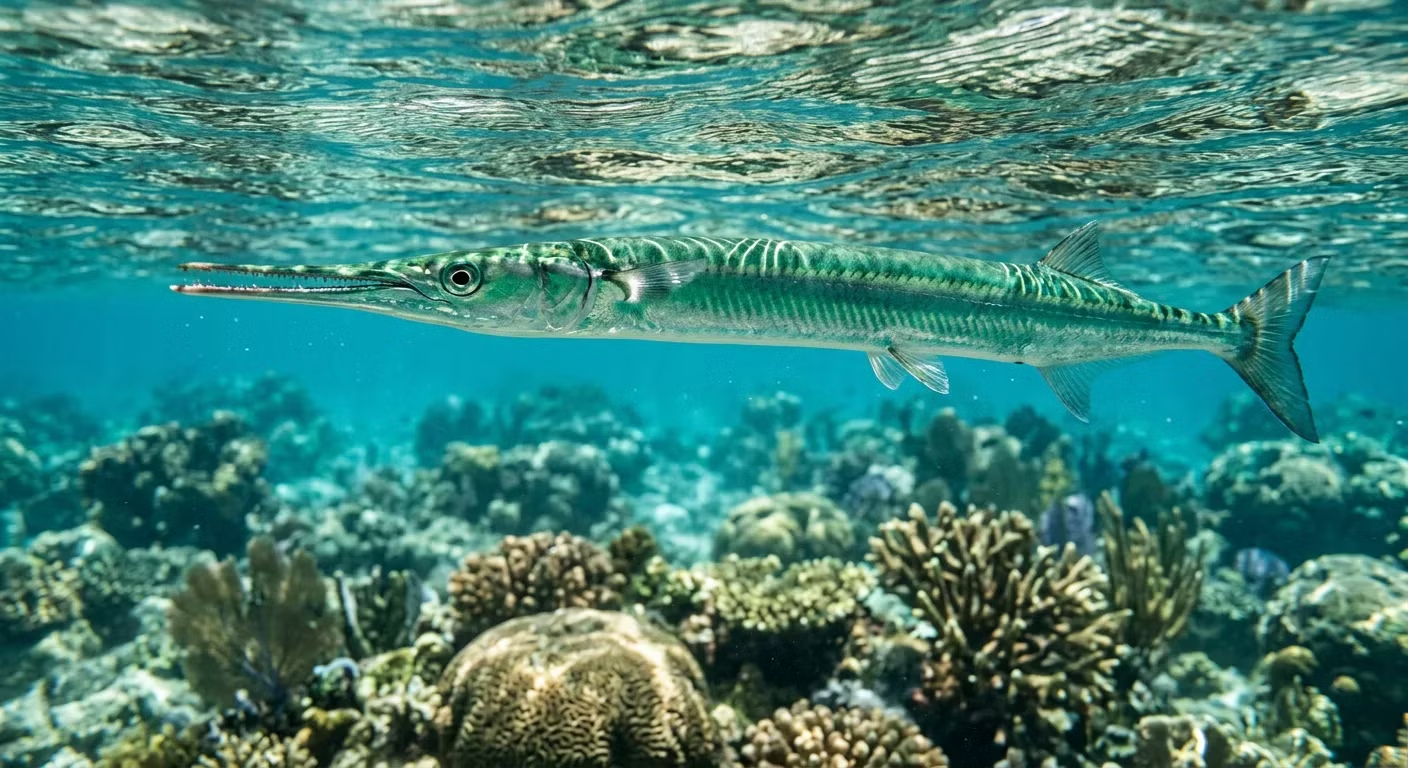
Needlefish comprise roughly thirty-five recognised species within the family Belonidae, characterised by their remarkably elongate, slender bodies and distinctive beak-like jaws studded with fine, needle-sharp teeth. Unlike their close relatives the halfbeaks, needlefish feature both upper and lower jaws extended into protracted, pointed rostra, with the lower jaw developing first in juveniles before the upper catches up. These pelagic surface-dwellers exhibit classic countershading, featuring iridescent bluish-green, dark green, or silver-grey dorsums that blend seamlessly into open water, fading into bright silvery flanks and immaculate white underbellies. Their dorsal and anal fins are positioned far back along the torso near the caudal peduncle, an anatomical arrangement that generates explosive bursts of acceleration when propelled by lateral undulations of the body. Species within the family range from modest inshore varieties measuring twenty centimetres to the formidable houndfish (Tylosurus crocodilus), which can span up to one and a half metres in length.
Behaviour & reproduction
- Size
- Unknown
- Weight
- Up to 4.5 kg
- Lifespan
- 3 to 8 years
- Status
- Not Evaluated
Needlefish, such as the large crocodile needlefish (Tylosurus crocodilus), are primarily solitary or form small, loosely associated schools, often seen near the surface of coastal and oceanic waters. They are active predators, utilising their elongated jaws to ambush smaller fish, displaying rapid bursts of speed. Their activity pattern is typically diurnal, though some nocturnal feeding has been observed. Regarding reproduction, needlefish are oviparous, laying eggs that are typically attached to floating vegetation or debris by sticky filaments. The specific spawning season can vary geographically but often occurs during warmer months. Clutch size can range from tens to hundreds of eggs, depending on the species and female size. Incubation periods are generally short, lasting a few days to weeks. Juveniles exhibit a similar body plan to adults, albeit in miniature, and undergo direct development without a distinct larval stage. Sexual maturity is reached within one to three years, allowing them to participate in subsequent reproductive cycles.


