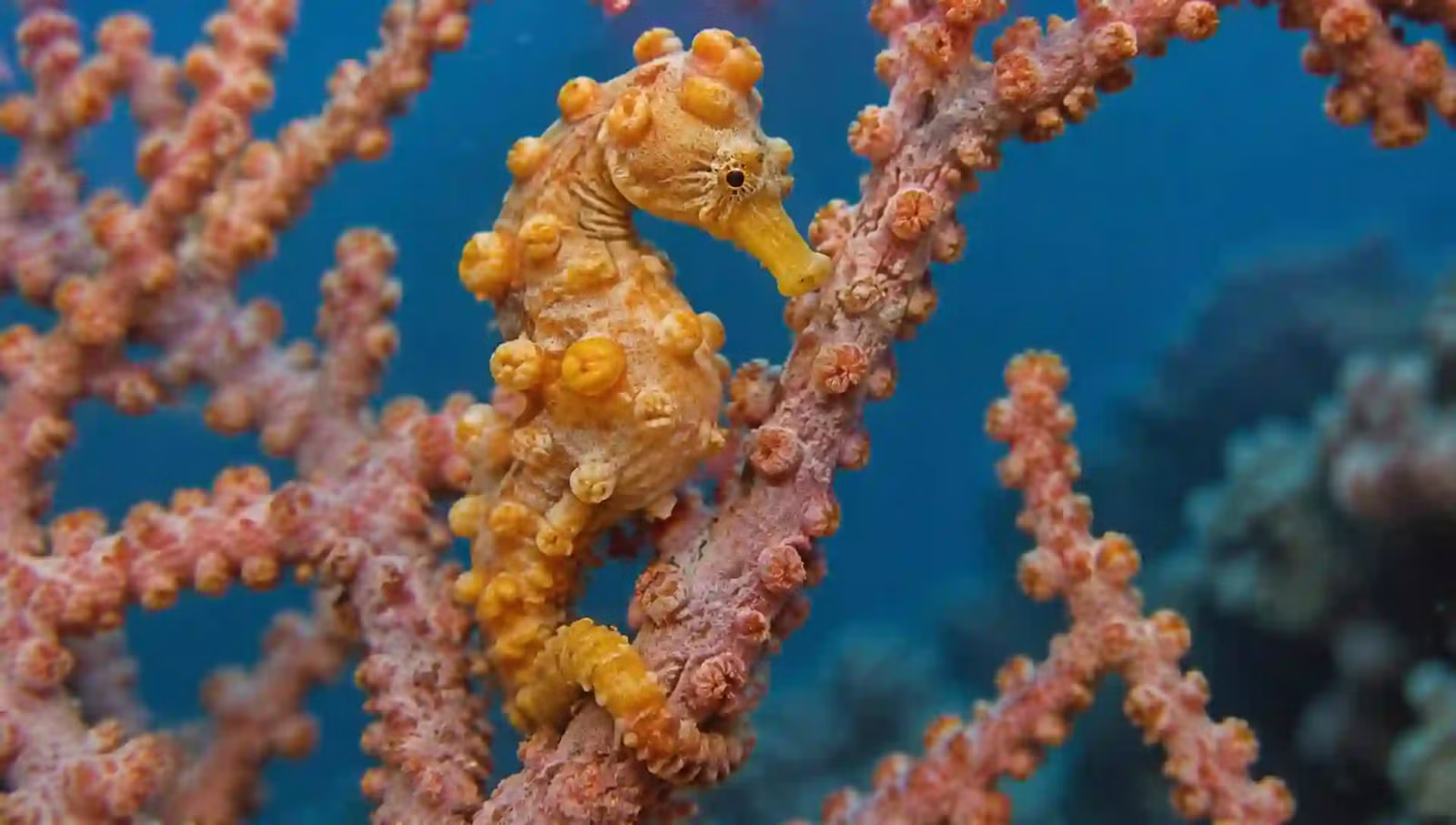
Denise's pygmy seahorse is one of the smallest seahorses in the world, rarely exceeding 2.4 centimetres from crown to curled tail. Described only in 2003, it lives exclusively on gorgonian sea fans of the genera Annella, Muricella and Echinogorgia, usually between 15 and 45 metres on current-swept reef walls and slopes in the Coral Triangle, from Indonesia and the Philippines to Papua New Guinea, the Solomon Islands and Palau. Unlike the bulkier Bargibanti pygmy seahorse, which is covered in wart-like tubercles matching the knobbly polyps of its host fan, Denise's pygmy seahorse has a smooth, slender body and a longer snout, and its colour ranges from pale orange to yellow depending on the fan it settles on. Each animal usually spends its whole adult life on a single colony, gripping a branch with its prehensile tail and swaying with the surge so that it reads as just another polyp. Pairs are faithful to one another and to their fan, and the male carries the eggs in a trunk pouch before releasing fully formed young. Because they are so small and so well camouflaged, sightings almost always come from experienced local guides who know individual fans, and they are one of the headline macro subjects of Raja Ampat, Lembeh, Anilao and Milne Bay.
Denise's Pygmy SeahorseWhere and when to see them
Want to dive with this animal?
Only destinations where this animal occurs.
Want to dive with this animal?
Only destinations where this animal occurs.
The Denise's Pygmy Seahorse at a glance
Behaviour & reproduction
- Size
- Unknown
- Weight
- Under 1 gram
- Lifespan
- Around 1–5 years
- Status
- Not Evaluated
Diving Tips
Ask the guide to point the animal out rather than searching the fan yourself, and never touch or move the coral. Keep your distance, use a single focus light on low power, and limit strobe flashes — repeated bright light stresses the animal. A 60–105 mm macro lens with a diopter works better than pushing the port into the fan, and good buoyancy matters more than any camera setting.
Fun facts about the Denise's Pygmy Seahorse
- It was only formally described in 2003 and is named after underwater photographer Denise Tackett.
- Adults are usually smaller than a human fingernail, often under 16 mm.
- It takes its colour from the sea fan it lives on, so the same species looks orange on one fan and yellow on another.
- The male, not the female, carries the developing eggs in a pouch and gives birth to miniature seahorses.
Best time to see the Denise's Pygmy Seahorse
Sightings are possible year-round because the host fans are permanent. In Indonesia (Raja Ampat, Lembeh) the calmer, clearer months from October to April suit Raja Ampat, while Lembeh and Anilao are reliable most of the year; Papua New Guinea and the Solomons are best from April to November.
Where the Denise's Pygmy Seahorse lives
Gorgonian sea fans (Annella, Muricella, Echinogorgia) on current-exposed reef walls and slopes, typically 15–45 m, across the Coral Triangle and the western Pacific.
What the Denise's Pygmy Seahorse eats
Tiny crustaceans — mainly copepods, amphipods and other zooplankton — sucked in one at a time through the tubular snout.
Denise's Pygmy Seahorse: frequently asked questions
When is the best time to see Denise's Pygmy Seahorse?
How big does Denise's Pygmy Seahorse get?
Is Denise's Pygmy Seahorse dangerous for divers?
What is the conservation status of Denise's Pygmy Seahorse?

Ready to dive with these animals?
Choose a destination or search every available vessel to find the liveaboard that matches the marine life you want to see.