Glossary · Gas

Nitrox (EAN/EANx)

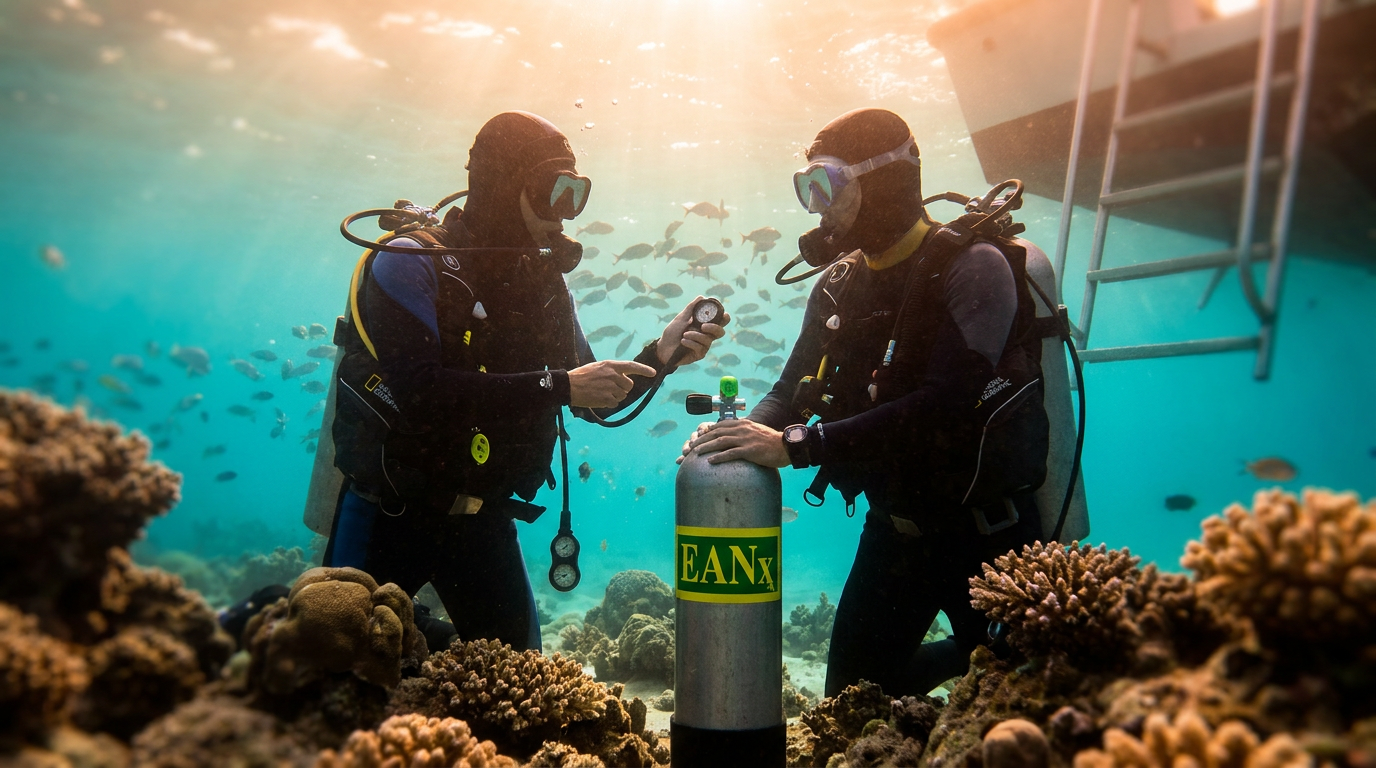
<p><strong>Enriched Air Nitrox (EAN or EANx) is any breathing gas mixture composed of oxygen and nitrogen where the oxygen proportion is higher than the 21% found in standard atmospheric air.</strong> Most recreational nitrox mixes contain either 32% or 36% oxygen (EAN32 and EAN36), specifically formulated to reduce nitrogen absorption in body tissues during a dive.</p> <p>By replacing a portion of inert nitrogen with oxygen, nitrox slows the rate at which nitrogen dissolves into body tissues under hydrostatic pressure. For example, at a depth of 18 m (60 ft), air provides a No-Decompression Limit (NDL) of approximately 56 minutes according to standard tables, whereas EAN32 extends that limit to 95 minutes. However, higher oxygen levels increase the risk of Central Nervous System (CNS) oxygen toxicity, requiring strict maximum operating depth (MOD) limits based on a maximum partial pressure of oxygen (PPO2) usually capped at 1.4 bar for bottom gas.</p> <p>On a liveaboard itinerary featuring 3 to 5 dives a day over consecutive days, nitrox becomes an essential operational tool. By significantly reducing residual nitrogen loading across multi-dive days, it allows longer bottom times, shorter surface intervals, and reduced post-dive off-gassing fatigue. On Blue Rides liveaboards worldwide, nitrox certification is often strongly recommended or mandatory, with many modern vessels supplying continuous-blend or membrane nitrox fills onboard.</p>

At a glance

How enriched air nitrox extends allowable bottom time

Dalton's Law of Partial Pressures states that the total pressure exerted by a gas mixture equals the sum of the partial pressures of its component gases. When a diver breathes compressed air (21% O2, 79% N2) at a depth of 20 m (3 bar ambient pressure), the partial pressure of nitrogen (PN2) is 2.37 bar. When using EAN32 (32% O2, 68% N2) at the same depth, the PN2 drops to 2.04 bar, effectively exposing the diver's tissues to the nitrogen equivalent of a much shallower dive.

Because tissue compartments absorb nitrogen based on its partial pressure rather than overall depth, reducing PN2 slows tissue loading. Dive computers calculate tissue saturation using decompression algorithms such as Bühlmann ZH-L16 or RGBM; when set to nitrox, the computer reflects this reduced uptake by granting significantly longer No-Decompression Limits (NDLs) before deco obligations are incurred.

The operational tradeoff for reduced nitrogen loading is elevated oxygen exposure. High partial pressures of oxygen (PPO2) can lead to acute Central Nervous System (CNS) toxicity, which can cause sudden underwater convulsions. To manage this safety hazard, recreational diving agencies enforce a strict maximum PPO2 cap of 1.4 bar during the working phase of a dive, establishing clear depth ceilings for every specific blend.

Breathing gas comparison for recreational profiles

What nitrox means for liveaboard dive operations

Liveaboard diving involves repetitive profiles over six or seven straight days. On air, residual nitrogen accumulates progressively in slow tissue compartments across consecutive days, causing NDLs to shrink significantly by the third or fourth dive of the day. Nitrox minimizes this compound buildup, maintaining wide safety windows and allowing divers to explore deep reefs or wrecks without premature ceiling penalties.

Divers use nitrox on liveaboards under two distinct strategies. The first maximizes bottom time by programming dive computers to the exact nitrox blend analysed. The second strategy, known as diving nitrox on air tables or air computer settings, maintains standard air bottom times while breathing nitrox—creating a substantial physiological safety buffer against decompression sickness on strenuous or cold multi-dive days.

Because gas blending takes place continuously on busy vessels, rigorous personal verification is mandatory. Liveaboard divers must analyse their own cylinders using a digital oxygen analyser, log the exact mixture, mark the cylinder's MOD, and program their personal dive computers before entering the water on every single dive.

Analysis and tagging procedures aboard liveaboards

The gas analysis procedure on a dive vessel follows a precise safety protocol. After the fill crew finishes pumping cylinders via a membrane system or partial-pressure panel, tanks are placed in the staging area. Each diver retrieves a digital oxygen analyser, verifies its calibration against ambient air (20.9% or 21.0%), and opens the cylinder valve to deliver a slow, continuous flow across the sensor until the reading stabilizes.

Once the FO2 (Fraction of Oxygen) is determined, the diver calculates or cross-checks the Maximum Operating Depth for a maximum PPO2 of 1.4 bar. For example, a 34% oxygen reading yields an MOD of 31 m (102 ft). The diver writes the FO2, the MOD, the date, tank pressure, and their signature on electrical tape or an attached tank tag affixed to the cylinder neck.

Finally, the diver inputs the measured oxygen fraction directly into their primary and backup dive computers. Dive computers use this percentage to recalculate real-time NDLs and track CNS clock accumulation (the percentage of total allowable daily oxygen toxicity exposure). This complete procedure ensures that no diver enters the water with an unverified blend or incorrect computer settings.

Common misconceptions

Myth: Nitrox allows you to dive deeper than standard air. Fact: Nitrox decreases your maximum achievable depth due to the risk of central nervous system oxygen toxicity. Air has an MOD of 56 m (at 1.4 bar PPO2), whereas EAN32 limits you to 33 m.

Myth: Breathing nitrox reduces your gas consumption rate. Fact: Nitrox does not reduce surface air consumption. Gas usage is governed by lung volume, depth, physical effort, and buoyancy control, regardless of the percentage of oxygen in the tank.

Myth: Nitrox completely eliminates the risk of decompression sickness. Fact: Nitrox reduces nitrogen loading, which significantly lowers DCS risk compared to air profiles, but it does not remove the risk entirely. Decompression sickness can still occur if ascent rates or computer limits are breached.

Myth: Nitrox prevents all post-dive fatigue. Fact: While many divers report feeling less fatigued after multi-dive days on nitrox due to reduced nitrogen off-gassing stress, post-dive fatigue is also heavily driven by thermal exertion, dehydration, sun exposure, and lack of sleep.

Frequently Asked Questions

Do I need a special certification to dive with nitrox?

Yes, you must hold an Enriched Air / Nitrox certification from a recognized training agency such as PADI, SSI, TDI, or RAID. The course is typically completed in a single day and covers oxygen exposure management, gas analysis, and setting your dive computer.

Does breathing nitrox reduce my air consumption rate?

No, nitrox does not change your lung volume or respiratory rate. Your Surface Air Consumption (SAC) rate is determined by buoyancy control, physical fitness, depth, and relaxation, not the oxygen percentage in your tank.

How deep can I dive using standard EAN32?

At a standard partial pressure of oxygen (PPO2) limit of 1.4 bar, the maximum operating depth (MOD) for EAN32 is 33 m (108 ft). Exceeding this depth significantly increases the risk of central nervous system oxygen toxicity.

Why is nitrox so heavily recommended on liveaboard trips?

Liveaboards routinely schedule 3 to 5 dives per day across several consecutive days. Nitrox dramatically reduces the residual nitrogen accumulation from repetitive diving, offering longer allowable bottom times and higher safety margins.

Do I need dedicated equipment to dive with recreational nitrox?

In most dive destinations, standard scuba regulators and cylinders are compatible with recreational nitrox mixes containing up to 40% oxygen, provided they are clean and serviced according to manufacturer instructions. Local regulations in regions like Europe may require dedicated M26 valve connections.

How is nitrox analysed and logged onboard a dive vessel?

Divers are required to personally test every tank using a calibrated digital oxygen analyser before putting it on their rig. You must confirm the oxygen percentage, compute your maximum operating depth, label the tank, and sign the boat's gas log.

Continue reading

Ready to dive nitrox (ean/eanx)?

Find liveaboards that take you to the world's best dive sites.

Browse liveaboards

Related Searches

Popular searches related to this guide