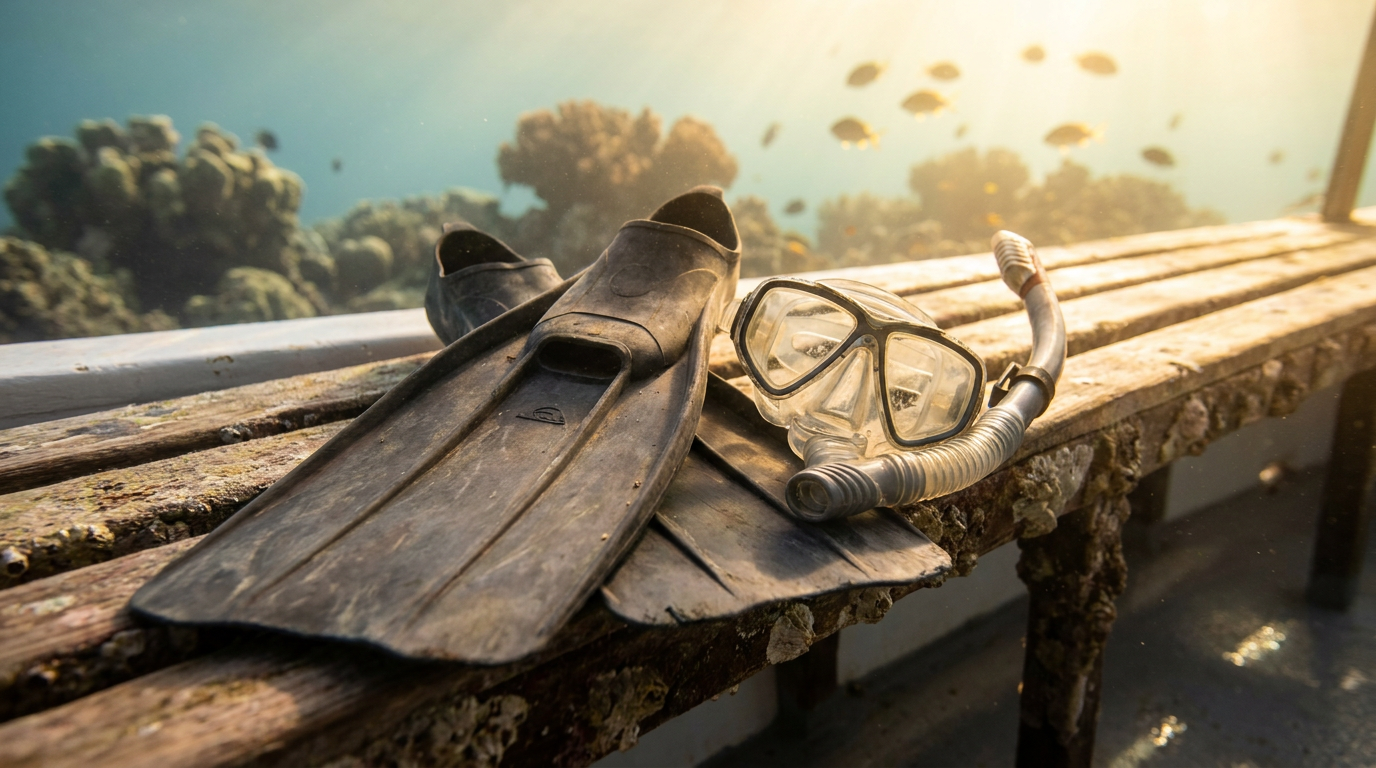
Mask: fit is everything
Brand and price barely matter. A $40 mask that seals to your face will outperform a $150 mask that doesn't. The fit test:
• Place the mask on your face without the strap
• Inhale gently through your nose
• If it stays in place for 5+ seconds, the silicone skirt seals to your face shape
• Look down — heavier masks reveal weak seals here
Avoid one-window masks if you wear contact lenses. Two-window or four-window designs sit closer to the face and reduce internal volume — easier to clear and equalise.
Mask features that actually matter
• Black silicone skirt — eliminates internal reflections for photographers
• Low internal volume — less air to clear and equalise
• Frameless or low-profile frame — smaller pack size for travel
• Prescription-ready — many models accept off-the-shelf corrective lenses ($60–$120 a pair)
Fins: paddle, split or jet
• Paddle fins (Mares Avanti, Scubapro Seawing Nova) — efficient power, work well in current. The all-rounder.
• Split fins (Atomic Split, Apollo Bio-Fin) — easier on knees, less leg fatigue. Weaker in strong current.
• Jet fins (Scubapro Jet Fin, Hollis F1) — short heavy rubber. Tech divers' choice. Excellent for back-kick and frog kick.
• Open-heel + bootie — required for cold water and shore entries
• Full-foot — warm water only, lighter for travel, no booties needed
For liveaboard travel, open-heel travel fins (Mares Volo Race, Aqualung Stratos) at 1.0–1.4 kg per pair save serious luggage weight.
Snorkel: necessary or not?
Once mandatory in dive training, the snorkel is now optional on most dives. Useful for surface swims back to a boat in choppy water; clutters your mask strap and snags lines on wreck or cave dives. The compromise: a foldable pocket snorkel that lives in your BCD pocket.
Travel weight target
A complete mask + open-heel travel fins + booties + snorkel set should weigh under 2.5 kg. Anything over 3.0 kg means you've over-bought.