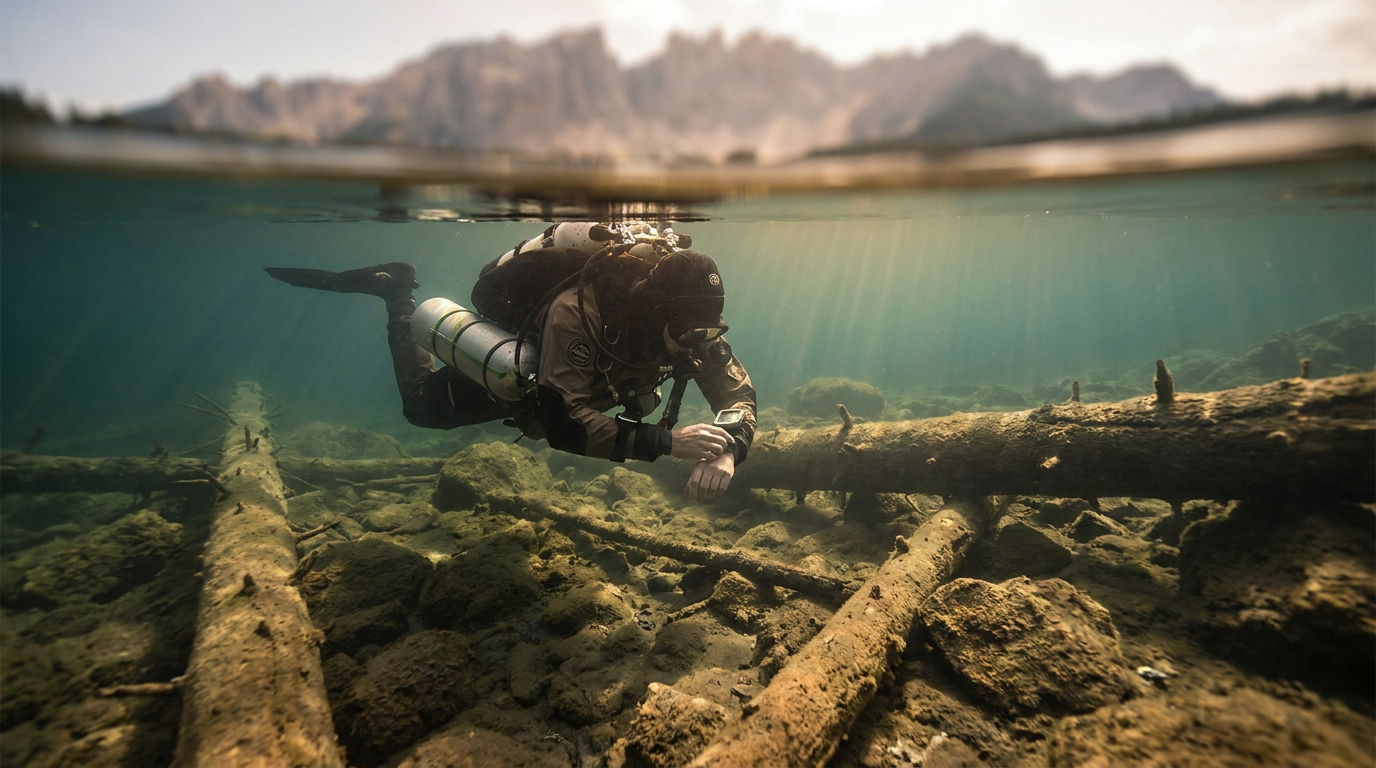
At a glance
- Definition: Diving at elevations above 300 metres (1,000 feet) where atmospheric pressure is reduced.
- Key Challenge: Increased risk of decompression sickness due to lower ambient pressure.
- Required Adjustment: Modified dive tables or dive computer settings for altitude.
- Minimum Altitude for Adjustment: 300 metres (1,000 feet)
- Physiological Impact: Increased nitrogen absorption, slower off-gassing.
- Special Training: Recommended or required (e.g., PADI Altitude Diver Specialty).
- Example Location: High-altitude lakes like Lake Titicaca (Bolivia/Peru).
How Altitude Diving Works
When a diver is at sea level, the atmospheric pressure pushing down on the water's surface is approximately 1 bar (1 atmosphere absolute or ATA). This pressure determines the partial pressure of nitrogen in the air we breathe. As a diver descends, the ambient pressure increases by 1 bar for approximately every 10 metres (33 feet) of depth. This pressure gradient dictates how quickly nitrogen dissolves into the body's tissues.
At higher altitudes, the atmospheric pressure is lower. For example, at 3,000 metres (10,000 feet) above sea level, the atmospheric pressure is closer to 0.7 bar. This means that a diver starts with less ambient pressure. When diving, the total pressure at any given depth will be less than at sea level, but the *relative* pressure change during descent and ascent is what matters for nitrogen loading and off-gassing. The lower surface pressure effectively makes the pressure gradient larger for a given depth, causing tissues to absorb nitrogen more quickly and off-gas more slowly during ascent.
To compensate for this, divers must adjust their dive planning. This typically involves using specialised altitude dive tables or setting a dive computer to an 'altitude' mode. These adjustments either treat the dive as if it were deeper than its actual depth or shorten bottom times and extend decompression stops, effectively reducing the nitrogen load or extending the off-gassing period to mitigate the increased risk of decompression sickness.
Diving at Altitude vs. Sea Level
| Feature | Sea Level Diving | Altitude Diving (e.g., 2,000m / 6,500ft) | Flying After Diving |
|---|---|---|---|
| Surface Pressure | Approx. 1.0 bar (14.7 psi) | Approx. 0.8 bar (11.6 psi) | Reduced cabin pressure (e.g., 0.7-0.8 bar) |
| Nitrogen Loading | Standard rates based on 1.0 bar surface pressure | Increased relative loading due to lower starting pressure | Rapid pressure reduction after diving |
| Decompression Risk | Standard risk, managed by tables/computers | Significantly increased if no adjustments are made | High risk of DCS if protocols not followed |
| Dive Planning | Standard dive tables/computers | Specialised altitude tables/computer settings | Strict no-fly times (e.g., 12-18+ hours) |
| Relative Safety | High with proper training and planning | High with specialised training and adjustments | High with adherence to no-fly intervals |
Surface Pressure
Sea Level Diving: Approx. 1.0 bar (14.7 psi)
Altitude Diving (e.g., 2,000m / 6,500ft): Approx. 0.8 bar (11.6 psi)
Flying After Diving: Reduced cabin pressure (e.g., 0.7-0.8 bar)
Nitrogen Loading
Sea Level Diving: Standard rates based on 1.0 bar surface pressure
Altitude Diving (e.g., 2,000m / 6,500ft): Increased relative loading due to lower starting pressure
Flying After Diving: Rapid pressure reduction after diving
Decompression Risk
Sea Level Diving: Standard risk, managed by tables/computers
Altitude Diving (e.g., 2,000m / 6,500ft): Significantly increased if no adjustments are made
Flying After Diving: High risk of DCS if protocols not followed
Dive Planning
Sea Level Diving: Standard dive tables/computers
Altitude Diving (e.g., 2,000m / 6,500ft): Specialised altitude tables/computer settings
Flying After Diving: Strict no-fly times (e.g., 12-18+ hours)
Relative Safety
Sea Level Diving: High with proper training and planning
Altitude Diving (e.g., 2,000m / 6,500ft): High with specialised training and adjustments
Flying After Diving: High with adherence to no-fly intervals
What Altitude Diving means for your liveaboard trip
For the vast majority of divers, altitude diving is unlikely to be a direct concern during a liveaboard trip, as these vessels operate exclusively at sea level. However, understanding the principles of altitude diving is still relevant for two key reasons: pre- and post-liveaboard travel and the concept of relative pressure changes.
Firstly, if you are planning a liveaboard trip to a destination that requires you to fly into a high-altitude airport (e.g., Quito, Ecuador, before a Galápagos liveaboard, or Mexico City before a Baja California liveaboard) and you plan to dive immediately upon arrival, or if you plan to visit high-altitude attractions after your liveaboard, you must be aware of the implications. Just as flying after diving poses a risk due to reduced cabin pressure, diving at altitude requires careful consideration of nitrogen off-gassing. Ascending to a high-altitude city after a sea-level dive trip has similar physiological effects to a fast ascent or flying too soon.
Secondly, the principles of altitude diving highlight the critical importance of understanding pressure changes in relation to nitrogen management. It reinforces why ascent rates are crucial, why safety stops are recommended, and why no-fly times are strictly enforced after diving. All these measures are designed to manage the body's nitrogen load and prevent decompression sickness by controlling pressure changes. Therefore, while altitude diving itself might not be part of your liveaboard itinerary, its underlying concepts are fundamental to safe diving practices at any depth or elevation.
Global High-Altitude Dive Locations & Notable Lakes
| Location | Approx. Altitude (m / ft) | Body of Water | Typical Dive Environment |
|---|---|---|---|
| Bolivia/Peru | 3,812 m / 12,507 ft | Lake Titicaca | Cold, clear, archaeological sites, unique fauna |
| Chile/Argentina | 3,000-4,000 m / 10,000-13,000 ft | Andean Lakes (various) | Cold, pristine, high-mountain flora/fauna |
| USA (Colorado) | 3,186 m / 10,453 ft | Blue Mesa Reservoir | Freshwater, cold, submerged structures, ice diving |
| USA (Nevada) | 2,255 m / 7,400 ft | Lake Tahoe (CA/NV) | Deep, cold, clear, rock formations, shipwrecks |
| Europe (Switzerland) | 1,797 m / 5,896 ft | Lake Neuchâtel | Freshwater, moderate cold, limited visibility |
Bolivia/Peru
Approx. Altitude (m / ft): 3,812 m / 12,507 ft
Body of Water: Lake Titicaca
Typical Dive Environment: Cold, clear, archaeological sites, unique fauna
Chile/Argentina
Approx. Altitude (m / ft): 3,000-4,000 m / 10,000-13,000 ft
Body of Water: Andean Lakes (various)
Typical Dive Environment: Cold, pristine, high-mountain flora/fauna
USA (Colorado)
Approx. Altitude (m / ft): 3,186 m / 10,453 ft
Body of Water: Blue Mesa Reservoir
Typical Dive Environment: Freshwater, cold, submerged structures, ice diving
USA (Nevada)
Approx. Altitude (m / ft): 2,255 m / 7,400 ft
Body of Water: Lake Tahoe (CA/NV)
Typical Dive Environment: Deep, cold, clear, rock formations, shipwrecks
Europe (Switzerland)
Approx. Altitude (m / ft): 1,797 m / 5,896 ft
Body of Water: Lake Neuchâtel
Typical Dive Environment: Freshwater, moderate cold, limited visibility
Common misconceptions
Myth: Altitude diving is only for extreme adventurers. Fact: While some high-altitude dives are challenging, the core definition applies to any dive above 300 metres (1,000 feet). Many popular recreational lakes and reservoirs worldwide are at elevations requiring altitude adjustments, making it relevant for a broader range of divers.
Myth: My dive computer automatically adjusts for altitude. Fact: While many modern dive computers have an 'altitude mode' or automatically detect altitude, it is crucial to verify that your specific computer has this feature and that it is correctly activated before diving at elevation. Always check your manual and consider redundancy.
Myth: You just need to dive shallower at altitude. Fact: Diving shallower helps reduce nitrogen absorption, but it's not the only factor. The lower ambient pressure at the surface still alters the pressure gradient and off-gassing dynamics. Proper altitude adjustments, which may include shorter bottom times, longer safety stops, or specific dive table modifications, are essential for safety regardless of depth.
Myth: The risks of altitude diving are the same as sea level diving. Fact: The primary risk of decompression sickness is significantly amplified during altitude diving if no adjustments are made. The reduced surface pressure means that the body off-gasses nitrogen more slowly on ascent to the surface, and the relative pressure changes are greater for a given depth, increasing the likelihood of bubble formation.
