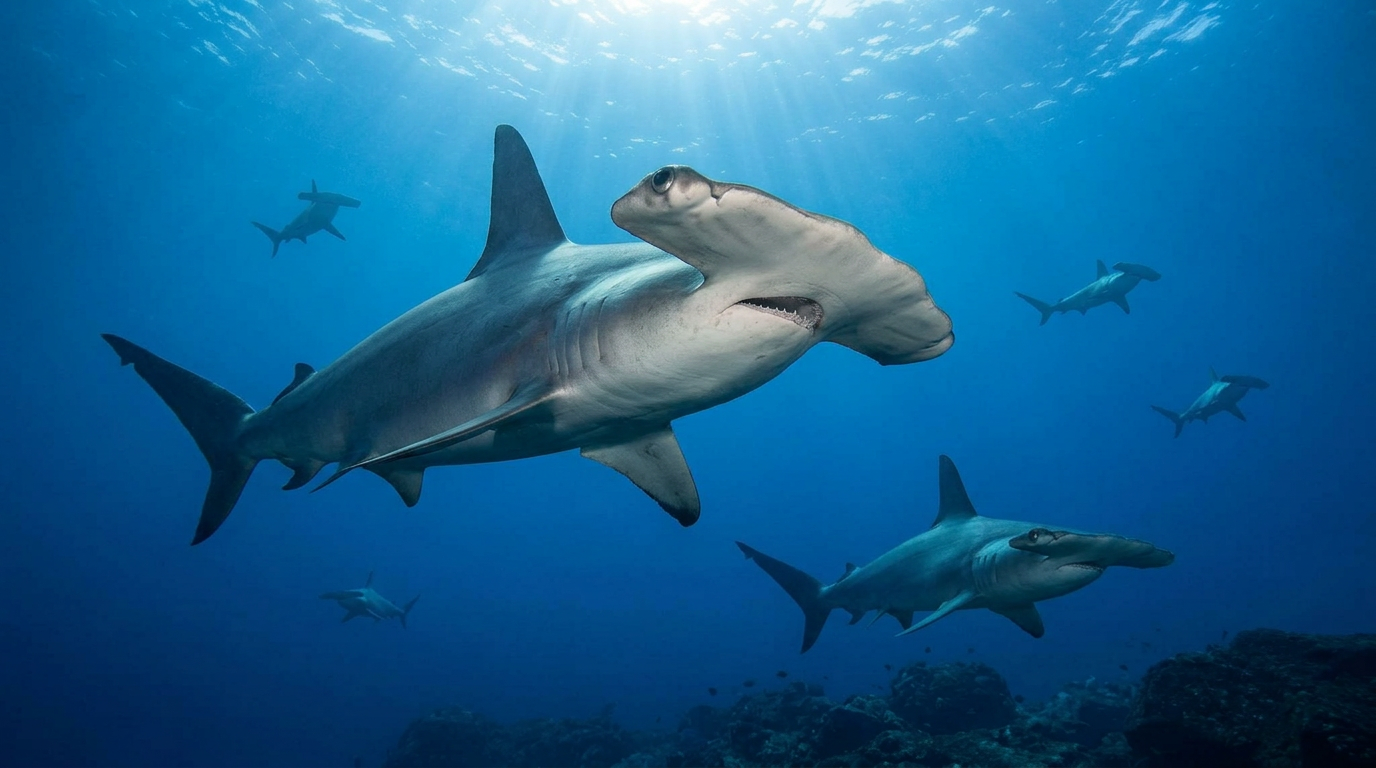
Imagine a living, breathing tapestry of sheer power, ancient instinct, and breathtaking numbers. Picture yourself suspended in an azure expanse, and from the blue, a shadow emerges, then another, then dozens, hundreds even, their distinctive T-shaped heads swaying rhythmically. This isn’t a dream; it’s the Galápagos, specifically the legendary northern outposts of Darwin and Wolf, and the utterly surreal spectacle of schooling hammerhead sharks.
Why Hammerhead Shark Schools Belongs on Your Bucket List
To witness a school of scalloped hammerhead sharks numbering in the hundreds, possibly even thousands, is to experience one of nature’s grandest congregations. These aren't fleeting glimpses; these are prolonged, immersive encounters that redefine your understanding of marine life. What makes this particular experience globally unique is the sheer density and predictability of these gatherings. While hammerheads are found in various oceans, the confluence of nutrient-rich currents, deep volcanic seamounts, and untouched marine reserves around Darwin and Wolf creates a phenomenon unparalleled anywhere else on Earth. It's an ecological marvel, a ballet of apex predators moving with remarkable synchronicity, often around specific underwater structures known as cleaning stations.
This isn’t just a dive; it’s a pilgrimage for serious divers and marine life enthusiasts. It’s for those who have seen a lot and now crave the truly extraordinary, the moment that will forever sit atop their diving memories. The Galápagos, famed for its unique terrestrial and marine biodiversity, amplifies this experience by presenting it within an ecosystem that time seems to have forgotten. You’re not just seeing sharks; you’re witnessing an ancient ritual in a pristine environment. It’s an adventure that requires commitment, takes you to the far reaches of the Pacific, and promises a reward that far outweighs the journey.
The "hammerhead wall" at sites like Darwin's Arch (before its natural collapse, and now the surrounding plateau) and El Bajo at Wolf Island offers a spectacle that transcends typical shark encounters. It's the sheer biomass, the humbling sensation of being completely surrounded by these magnificent creatures, that makes it profoundly impactful. It’s a testament to the power of the ocean and the critical need for its conservation. This experience isn't merely about ticking a box; it's about humbling yourself before nature's majesty, an encounter that will resonate long after you've surfaced.
What You'll See and Do
Diving "Hammerhead Shark Schools" primarily involves drifting along volcanic walls and seamounts, often at depths ranging from 18 to 30 metres (60 to 100 feet). The core of the experience revolves around observing scalloped hammerheads (Sphyrna lewini) as they gather in large schools, often circling specific cleaning stations. Here, smaller reef fish, such as king angelfish and barberfish, meticulously remove parasites from the sharks’ skin, gills, and mouths. You'll witness this fascinating symbiotic relationship up close, often with hundreds of hammerheads patiently queuing for their turn. These are not aggressive encounters; the sharks are generally indifferent to divers, focused on their cleaning ritual or navigating the currents.
Beyond the hammerheads, the sheer abundance of marine life in Darwin and Wolf is astounding. You’ll frequently encounter Galápagos sharks (Carcharhinus galapagensis), silky sharks (Carcharhinus falciformis), and oceanic whitetip sharks (Carcharhinus longimanus) patrolling the blue. Giant manta rays (Mobula birostris) with wingspans of several metres often glide gracefully past, alongside mobula rays and majestic eagle rays. Large schools of jacks, barracudas, and tuna are common, forming swirling tornadoes of silver. Occasionally, lucky divers might even spot whale sharks (Rhincodon typus), especially during the warmer months, though the prime time for hammerheads is the colder season.
The dive style is predominantly drift diving, utilising the strong currents that bring in the nutrient-rich waters and marine life. This means you’ll often descend at one point and be carried along the wall or seamount, absorbing the panoramic marine spectacle. Divers typically descend quickly to the preferred depth and then maintain position by holding onto rocks (only if absolutely necessary and without damaging anything) or hovering neutrally buoyant, allowing the current to showcase the passing parade of marine life. Safety is paramount, with boat tenders always following the divers’ bubbles for swift pick-up. Surface intervals are often filled with sightings of boobies, frigatebirds, and the rugged, untouched beauty of the remote islands themselves.
Best Time to Go
The optimal season for witnessing the immense hammerhead shark schools in the Galápagos, particularly around Darwin and Wolf, is during the cooler, dry season, which runs from June to November. During these months, the Humboldt Current brings cold, nutrient-rich waters from the south, triggering a massive upwelling of plankton. This abundance of food attracts a plethora of marine life, including the vast aggregations of scalloped hammerheads.
While the abundant marine life is a major draw, divers should be prepared for cooler water temperatures and potentially stronger currents. Water temperatures around Darwin and Wolf during this period typically range from 20°C to 24°C (68°F to 75°F). Visibility, while generally excellent, can be variable depending on plankton blooms, but often ranges from 15 to 30 metres (50 to 100 feet). Stronger currents are expected and are, in fact, desirable, as they are the very reason for the marine traffic. Surface conditions tend to be choppier, with a greater likelihood of swells due to the cooler, windier weather. Despite these conditions, the sheer number of sharks and other pelagic species makes this a truly unforgettable time to visit.
How to Dive Hammerhead Shark Schools
Accessing the remote northern islands of Darwin and Wolf is exclusively via liveaboard. Day trips are simply not feasible given their distance from the main Galápagos islands. This makes a liveaboard a non-negotiable part of the experience, offering dedicated diving days at these premier sites, allowing for multiple dives and sufficient surface intervals. Liveaboards typically spend several days at Darwin and Wolf, providing ample opportunity for multiple hammerhead encounters, moving between sites like Darwin's Arch (now the plateau and surrounding areas) and Wolf Island's famous "The Cave" and "El Bajo".
A dive experience of this magnitude demands a certain level of proficiency and preparedness. While technically certified Open Water Divers can participate, it is highly recommended to be at least Advanced Open Water certified, with a minimum of 50-100 logged dives. Experience in current diving is crucial, as the currents can be strong and unpredictable. Therefore, a Drift Diver specialty certification is highly beneficial. Nitrox certification is also strongly recommended, as it allows for longer bottom times, maximising your opportunities to absorb the spectacle of the schools. For gear, a 5mm or even 7mm wetsuit or a semi-dry suit is advisable given the cooler water temperatures. Depending on individual cold tolerance, a hood and gloves (where permitted by local regulations) are also recommended. Ensure your regulators are well-serviced and that you carry essential spares, as there are no dive shops nearby.
Conservation and Responsible Diving
Diving with hammerhead shark schools in the Galápagos comes with a significant responsibility to protect these magnificent, often endangered species and their fragile ecosystem. The scalloped hammerhead is listed as Critically Endangered by the IUCN, making respectful and ethical diving practices paramount. Always maintain a respectful distance from the marine life; never attempt to touch, feed, or harass any creature. This includes avoiding the use of dive lights directly into their eyes. Stay close to your dive guide and adhere strictly to their instructions, as they are intimately familiar with local conditions and conservation protocols. Buoyancy control is critical to avoid accidental contact with the delicate coral structures and volcanic rock formations. When taking photos or videos, do so from a distance, refraining from aggressive pursuit. Remember, we are guests in their home, and our presence should be as minimally impactful as possible, ensuring these spectacular aggregations can thrive for future generations.
Plan Your Trip
The Galápagos hammerhead shark schools represent the pinnacle of dive travel, a truly humbling and unforgettable experience. If you’re ready to witness one of the ocean's greatest spectacles, explore Blue Rides' curated selection of premium liveaboards departing for this extraordinary adventure. Our expert team is ready to help you plan your journey to these remote, shark-filled waters.
