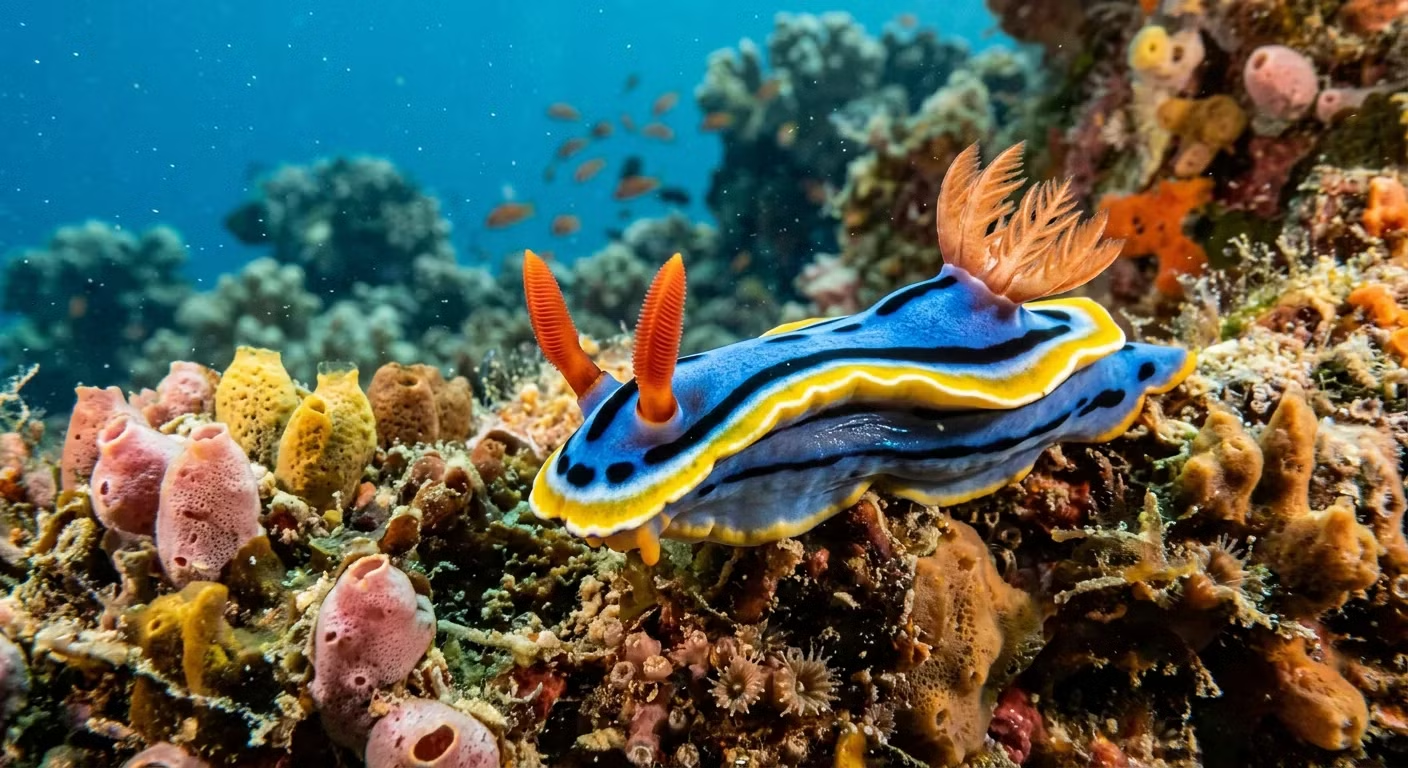
Sea slugs, encompassing a vast array of marine gastropods predominantly within the clade Heterobranchia and the famed order Nudibranchia, are celebrated among the most vibrant and visually mesmerising invertebrates in the ocean. Having evolutionary shed or internalised their heavy ancestral shells, these soft-bodied molluscs exhibit an astonishing spectrum of morphological adaptations. Their forms range from elongated, ribbon-like bodies to stout, papillate shapes adorned with intricate appendages. Prominent upon their heads are sensory organs known as rhinophores, which detect chemical cues and water currents, often resembling delicate antennae, feathers, or clubbed stalks. Many species, notably the nudibranchs, bear external gill plumes positioned in rosettes on their backs or maintain finger-like projections called cerata that double as respiratory organs and digestive conduits. Their colouration spans an electric kaleidoscope of neon blues, vibrant purples, fiery oranges, and intricate geometric patterns that warn potential predators of chemical unpalatability.
Behaviour & reproduction
- Size
- Unknown
- Weight
- Under 1 kg
- Lifespan
- Several months to 1 year
- Status
- Not Evaluated
Sea slugs, belonging to the diverse Heterobranchia clade, exhibit a range of behaviours, but are generally solitary and not known for complex social interactions. Their activity patterns often depend on species, with many being nocturnal or crepuscular, though some are active during daylight hours, typically foraging for food. Reproduction in sea slugs is predominantly hermaphroditic, with individuals possessing both male and female reproductive organs. Mating involves two individuals exchanging sperm, after which both can lay eggs. Most species are oviparous, depositing their eggs in characteristic gelatinous masses or ribbons, often attached to substrates such as algae or rocks. The number of eggs laid per clutch varies immensely between species, ranging from a few dozen to several million microscopic eggs. Incubation periods are generally short, lasting days to weeks. Juvenile development commonly involves a planktonic larval stage before settling and metamorphosing into the benthic adult form. Maturity can be reached rapidly, often within weeks to months, allowing for multiple reproductive cycles within their typically short lifespans.


