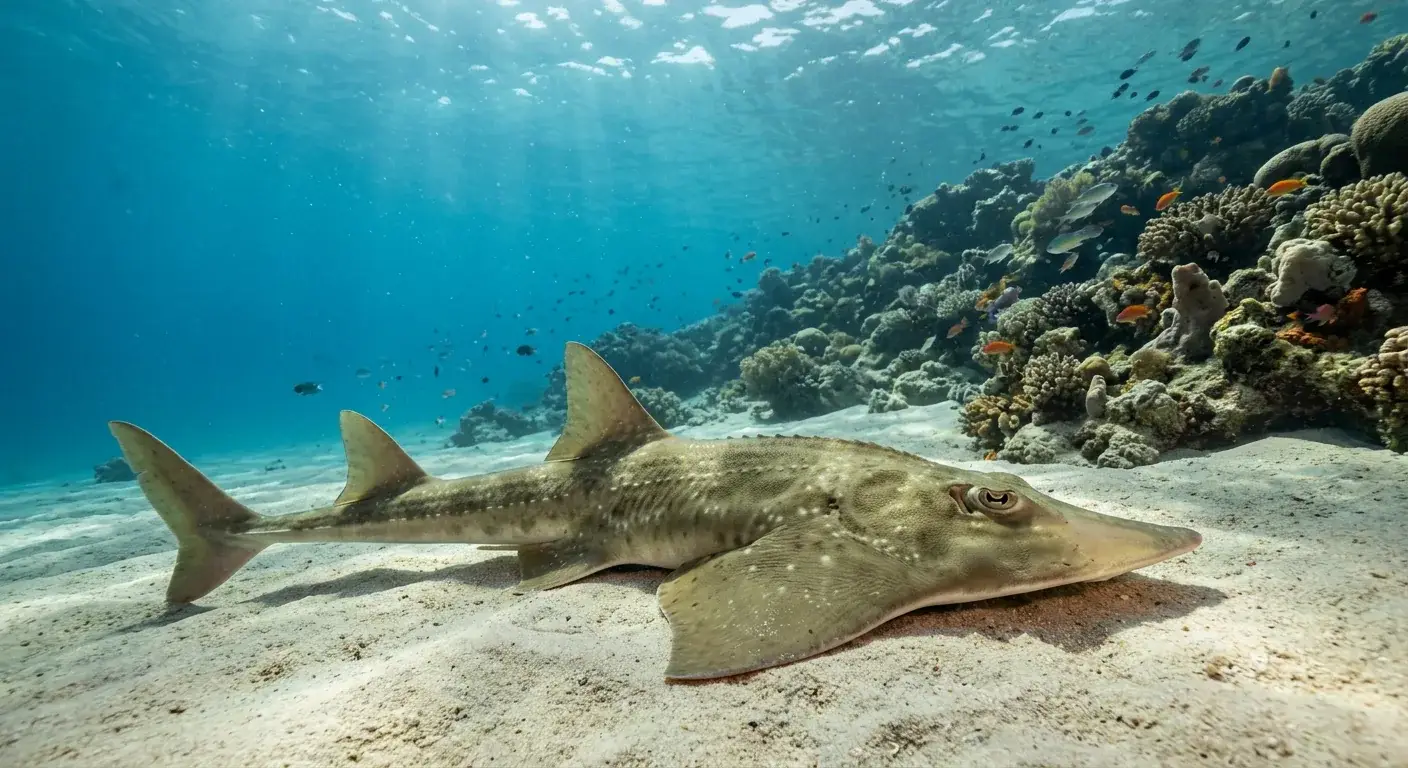
Guitarfishes, belonging to the order Rhinopristiformes (chiefly the families Rhinobatidae and Glaucostegidae), occupy a fascinating evolutionary transition between sharks and true rays. Characterised by a flattened, wedge-shaped or spade-like head that merges seamlessly with wide pectoral fins, their anterior body resembles an acoustic guitar or violin, which gives them their evocative common name. Behind the pectoral disc, their form transitions into a stout, muscular, shark-like tail equipped with two distinct dorsal fins and a well-developed caudal fin. Their coloration is an exquisite study in camouflage: the dorsal surface presents mottled shades of sandy beige, olive, slate-grey, or warm ochre, frequently adorned with subtle spots, bands, or symmetrical ocelli that mimic sun-dappled substrate. The ventral side is stark white or pale cream, housing the mouth, nostrils, and five pairs of gill slits. Rather than propelling themselves through the water via flapping pectoral disc motions like eagle rays or stingrays, guitarfishes drive themselves forward with powerful lateral sweeps of their muscular tail, much like a typical shark.
Behaviour & reproduction
- Size
- Unknown
- Weight
- Up to 220 kg
- Lifespan
- 12–20 years
- Status
- Not Evaluated
Guitarfish, belonging to the genera Rhinobatos and Glaucostegus, are typically solitary benthic rays, often found partially buried in sand or mud on continental shelves and slopes, exhibiting a largely nocturnal or crepuscular activity pattern, though some activity may occur during daylight hours. Social interactions beyond mating are generally limited, with individuals usually observed singly. Their reproduction strategy is ovoviviparous, meaning internal fertilisation occurs and eggs hatch inside the mother's body, with live young subsequently born. While specific mating seasons can vary by species and region, many demonstrate an annual reproductive cycle. Litter sizes are moderate, typically ranging from a few to over a dozen pups, depending on the species and maternal size. Gestation periods are generally lengthy, extending several months. Pups are born as miniature versions of the adults, fully developed and independent, with no parental care post-birth. Age or size at sexual maturity also varies across species but is usually reached after several years.


