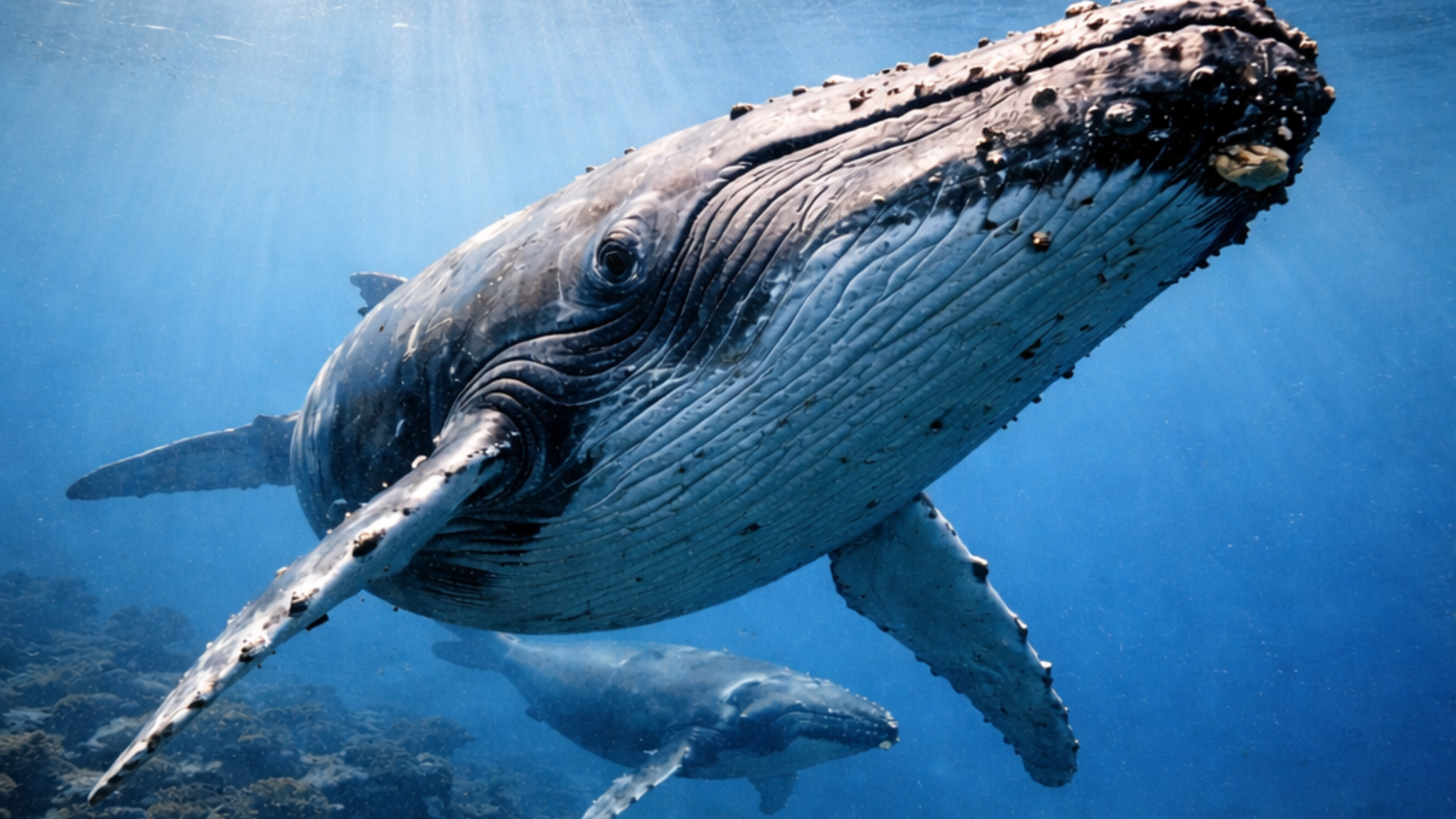
Humpback Whale
Megaptera novaeangliae
About Humpback Whale
These magnificent giants migrate thousands of kilometres annually, offering breathtaking encounters in tropical breeding grounds.
Quick Facts
- Habitat: Humpback whales, *Megaptera novaeangliae*, are **highly migratory cetaceans** found in oceans worldwide, undertaking some of the longest migrations of any mammal. They typically inhabit **cold, productive feeding grounds** during summer months, moving to **warm, tropical breeding and calving grounds** in winter. During their feeding phase, they can be found in high-latitude areas such as **Alaska's Inside Passage**, the **waters off Iceland**, and the **Gulf of Maine**. For breeding, they migrate to regions like the **Caribbean Sea** (e.g., **Dominican Republic's Silver Bank**, **St. Vincent and the Grenadines**), the **South Pacific** (e.g., **Tonga**, **French Polynesia**, **Niue**), and the **coast of Western Australia** (e.g., **Exmouth**). These migrations often follow coastlines or oceanic ridges, making certain areas **predictable migratory corridors** for divers. Juveniles and non-breeding adults may occasionally be sighted in intermediate waters, but the **seasonal patterns** are largely driven by reproductive cycles.
- Diet: Humpback whales are **opportunistic feeders** with a diet primarily consisting of **krill** and small schooling fish, such as **herring, mackerel, and capelin**. They employ diverse and **highly cooperative hunting techniques**. Perhaps the most iconic is **bubble-net feeding**, where a group of whales works together to blow bubbles in a circular pattern around a school of prey. This creates a 'net' of bubbles that corrals the fish into a dense bait ball near the surface, allowing the whales to **lunge through the concentrated prey** with their massive mouths open. Their baleen plates, numbering between 270 and 400 on each side of the upper jaw, then filter out the water, trapping the food. They are also known to **lunge feed individually** or in smaller groups, often breaching the surface with their mouths agape to capture prey. This **active and intelligent feeding behavior** is central to their survival during their summer feeding periods.
- Best season: Diving with or observing humpback whales is a **highly seasonal activity**, dictated by their annual migration patterns. In the **South Pacific**, such as in Tonga, French Polynesia, and Niue, the **breeding and calving season** typically runs from **July to October**, with **August and September** often being peak months for encounters. For the **Caribbean breeding grounds**, particularly the **Silver Bank** off the Dominican Republic, the season is from **January to April**, with **February and March** being ideal. In Australia, the western population can be encountered migrating and breeding off the coast of places like **Exmouth** from **July to October**. For viewing their **feeding behaviors** in colder waters, the **Alaskan summer** (June to September) offers opportunities, though direct diving encounters are less common due to colder waters and regulations. Always check with local operators for **precise seasonal variations** as they can shift slightly year to year.
Fun Facts
Male humpback songs can last for hours and carry for hundreds of kilometres,They blow 'bubble nets' to corral schools of fish for group feeding,Their flippers (up to 5m long) are the longest appendage of any animal,Each whale's tail pattern is unique—used for individual identification worldwide
Diving Tips
Encountering humpback whales underwater is an **unforgettable privilege** but requires **strict adherence to regulations and ethical guidelines**. Most regions prohibit direct diving with whales, instead offering **snorkeling or in-water observation** from a distance, or 'soft in-water encounters' where whales approach on their own terms. Always maintain a **respectful and safe distance**, typically **100 meters** for boats and often minimum approaching distances for swimmers as well, depending on local laws (e.g., 30-50m for swimmers in Tonga, but they must approach you). **Never pursue, touch, or harass** these animals; their behavior should be entirely natural and undisturbed. Look for **surface activity** such as breaches, tail slaps, and blows (the exhalation of water vapor), which indicate their presence. Listen for their **complex songs** through specialized hydrophones or even just by listening carefully underwater, especially in breeding grounds. Be aware of their **immense size and power**; a sudden movement could be accidental but dangerous. Choose **reputable operators** who prioritize whale welfare and adhere to all local and international guidelines, such as those from the **International Whaling Commission (IWC)**. Remember, these are **protected species**, and illegal or unethical interactions can result in **severe penalties**. The goal is a **passive and non-intrusive observation** to minimize impact on these magnificent creatures.