Stingray
Hypanus americanus
About Stingray
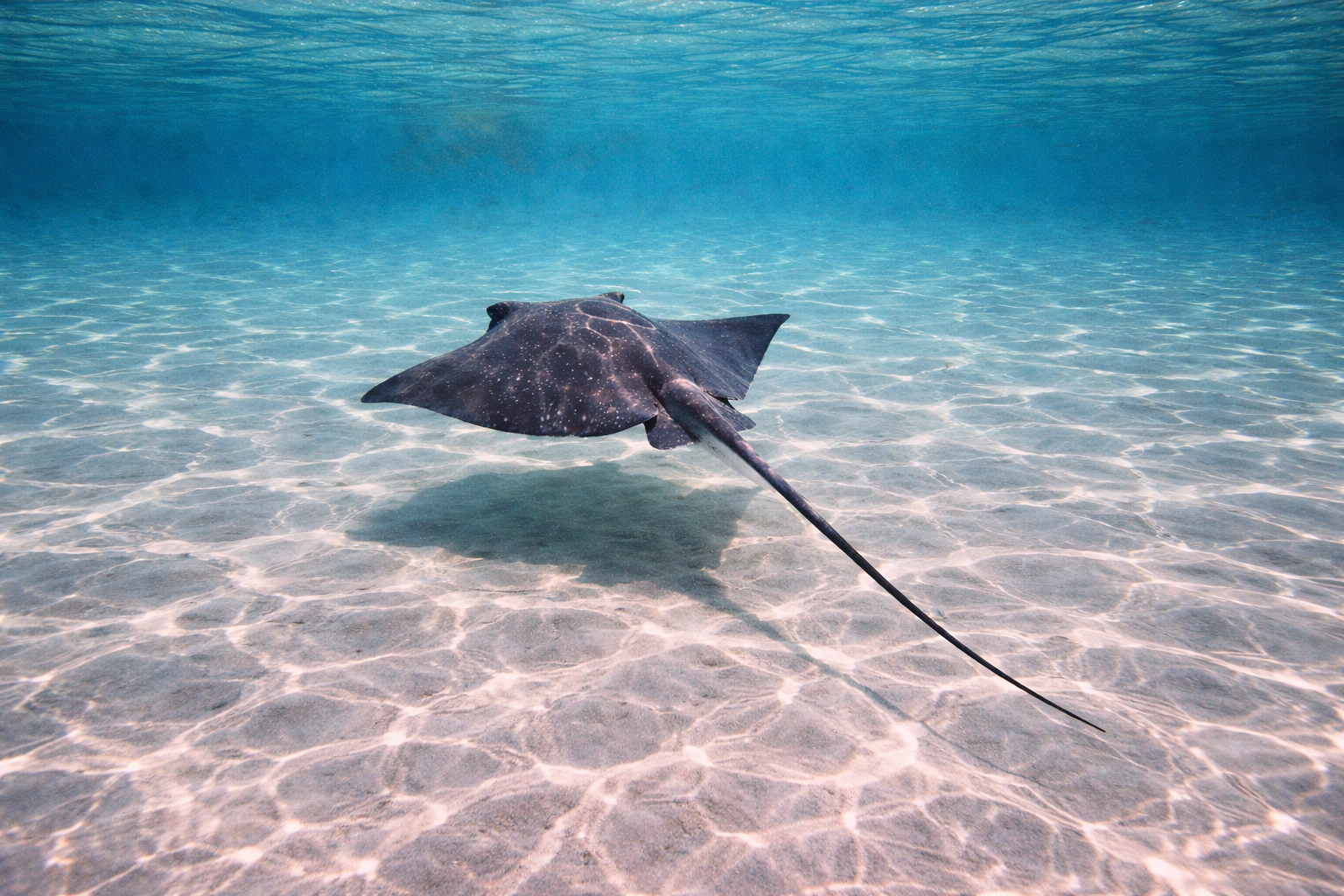
Sandy shallows
Quick Facts
- Habitat: The Southern Stingray, *Hypanus americanus*, is a **common inhabitant** of tropical and subtropical waters across the **Western Atlantic Ocean**, ranging from the Mid-Atlantic United States (North Carolina to Florida) down through the **Caribbean Sea**, including the Gulf of Mexico, Bermuda, and along the northern coast of South America to Brazil. These rays prefer **sandy flats, seagrass beds, and muddy bottoms** in shallow coastal waters, often at depths of less than 30 meters, though they can be found deeper. They are frequently observed close to shore in bays, estuaries, and even mangroves, particularly during their **breeding season**. Divers commonly encounter them resting partially buried in the sand near coral reefs in destinations like the **Florida Keys**, **Cayman Islands**, **Cozumel, Mexico**, and the **Bahamas**. While generally coastal, individuals have been sighted offshore, suggesting some migratory patterns linked to water temperature and food availability. Their reliance on soft substrates for camouflage and foraging makes these areas their preferred domain year-round.
- Diet: Southern Stingrays are **opportunistic bottom feeders**, primarily preying on **small invertebrates** and bony fishes buried in the sand or hidden in seagrass. Their diet typically consists of **clams, worms, crabs, shrimp, and small fishes**. They use their **highly developed sense of smell** and electroreceptors (ampullae of Lorenzini) to detect prey buried beneath the sediment. Once prey is detected, they employ a unique feeding strategy: they rapidly flap their pectoral fins to create a vacuum, **sucking the prey out of the substrate**. This often leaves characteristic **depressions or 'feeding pits'** in the sandy bottom, indicating their recent presence. Their powerful plate-like teeth are well-suited for crushing the shells of crustaceans and mollusks. They typically forage during both day and night, demonstrating a **flexible feeding schedule** that adapts to prey availability.
- Best season: Encounters with Southern Stingrays are **possible year-round** in much of their tropical range, but specific seasons offer **peak visibility and activity**. In the **Florida Keys and Caribbean**, the **late spring through early autumn** (May to October) generally provides warmer, calmer waters and more consistent sightings. During these months, water temperatures are optimal for their activity, and they are more frequently observed in shallower, accessible areas. For instance, in the **Cayman Islands**, particularly in the famous **Stingray City**, interactions are popular **all year**, but the calmer seas of summer can enhance the experience. In the northern parts of their range, such as off **North Carolina**, they are more prevalent during the **warmer summer months** (June to September) when water temperatures are suitable, and they may migrate to deeper, warmer waters during winter. Conversely, their presence in places like **Belize** is **consistent throughout the dry season** (November to May), benefiting from clearer water conditions. Generally, periods of **less wave action** and good visibility contribute to the best diving encounters.
Fun Facts
Stingrays bury themselves in sand for camouflage,Their venom is only used defensively, never for hunting,They can detect prey using electroreception,Female stingrays give birth to live young called pups
Diving Tips
When diving with Southern Stingrays, **maintain a respectful distance** and avoid sudden movements to prevent startling them. For observing, look for their **distinctive diamond or disc shape** partially buried in sandy patches or gliding gracefully over seagrass beds. Their **eyes are on top of their head**, so approach slowly and from the side if you wish to see their full face. **Never attempt to touch or feed** wild stingrays, as this can alter their natural behaviors and potentially lead to accidental injury. While generally docile, they possess a **venomous barb on their tail** for defense. If threatened or stepped on (a risk in shallow areas), they may whip their tail. Therefore, when wading or exploring shallow, sandy areas where stingrays might be present, divers should practice the **'stingray shuffle'** – sliding their feet along the bottom to alert any buried rays to their presence, allowing them to swim away. Observe them from a safe distance, ideally several meters away, to witness their natural behaviors without causing stress. Remember that touching marine life can also be **illegal in many protected areas**, so always check local regulations. Enjoy these magnificent creatures from a distance, appreciating their beauty and role within the marine ecosystem.