Mediterranean Monk Seal
Monachus monachus
About Mediterranean Monk Seal
One of the world's most endangered marine mammals, occasionally spotted in remote Turkish coastal caves and islands.
Quick Facts
- Habitat: The Mediterranean Monk Seal, *Monachus monachus*, is one of the most endangered marine mammals globally, with a fragmented distribution primarily across the **Mediterranean Sea** and parts of the **North Atlantic Ocean**. Historically, these seals utilized open beaches and shallow coastal areas, but due to human disturbance and habitat loss, they have largely retreated to more secluded and **inaccessible caves and grottoes**, often with underwater entrances. Key populations can be found around the **Greek islands**, particularly in the **Cyclades** and **Dodecanese**, and along the coasts of **Turkey**, especially in the **Aegean Sea**. Smaller, isolated groups persist off the coast of **Mauritania** and in the **Madeira Archipelago**, including the **Desertas Islands**. They prefer areas with **rocky shorelines**, abundant fish, and minimal human activity. While they don't migrate extensively, their presence can be seasonal in certain areas, depending on prey availability and breeding cycles. Divers in regions like the **National Marine Park of Alonissos Northern Sporades** in Greece might spot them near these cave systems, especially in areas with limited boat traffic and protected status. Their reliance on specific cave habitats makes them particularly vulnerable to disturbance.
- Diet: Mediterranean Monk Seals are opportunistic feeders, with their diet consisting primarily of **fish, cephalopods, and crustaceans**. They are **generalist predators**, adapting their diet based on the availability of prey in their local environment. Common prey items include various species of **octopus, squid, cuttlefish**, and a wide range of bottom-dwelling and schooling fish such as **sardines, mackerel, hake, mullet**, and **eels**. They typically hunt in **shallow coastal waters**, often near reef systems or rocky seabeds, but have been observed foraging at depths exceeding 100 meters. Monk seals employ a **solitary foraging strategy**, using their keen eyesight and highly sensitive whiskers (vibrissae) to detect prey in often murky or low-light conditions, especially when hunting within their preferred cave systems or at dawn and dusk. Their powerful jaws and teeth are well-suited for crushing shells and firmly gripping slippery prey. They are **efficient hunters**, capable of pursuing and capturing fast-moving fish and cephalopods, contributing to the health of coastal marine ecosystems.
- Best season: Spotting Mediterranean Monk Seals is a rare and special event due to their critically endangered status and shy nature. While there isn't a guaranteed 'best' season, **late spring through early autumn (May to October)** generally offers the best diving conditions across much of their remaining Mediterranean range, coinciding with warmer water temperatures and calmer seas which facilitate access to their secluded habitats. In the **Greek islands**, particularly around the protected areas of the **National Marine Park of Alonissos Northern Sporades**, this period is prime for general diving and offers the highest chance, albeit slim, of an encounter. For populations off the coast of **Mauritania** and the **Madeira Archipelago**, including the **Desertas Islands**, the seals are resident year-round. However, **summer and early autumn (June to September/October)** in Madeira often provide the most stable weather and sea conditions for reaching the more remote dive sites where these seals may be present. During **autumn and winter (October to March)**, monk seals may be more focused on breeding and pupping within their caves, potentially making them even more elusive or sensitive to disturbance outside their haul-out sites. Always prioritize minimal impact and respect their critical need for undisturbed habitat.
Fun Facts
Turkey's Foça district is named a Special Environmental Protection Area specifically for monk seals,They can hold their breath for up to 15 minutes,Monk seals give birth in sea caves,Ancient Greeks and Romans frequently depicted monk seals in their art
Diving Tips
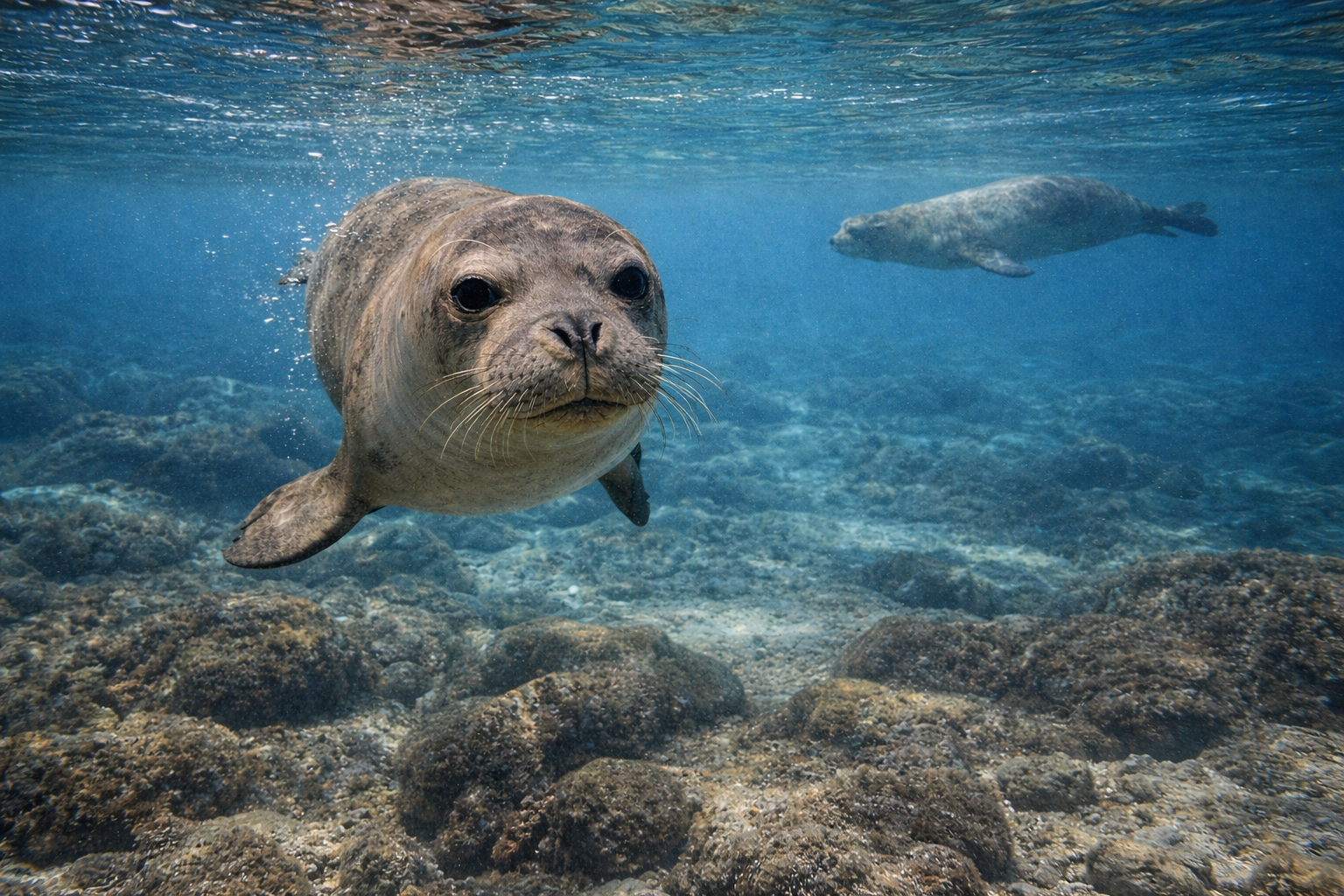
Encountering a Mediterranean Monk Seal while diving is an extraordinarily rare privilege. If you are fortunate enough to spot one, **maintain extreme distance** and observe very passively. **Do not approach, pursue, or attempt to interact** with the animal in any way. Keep a minimum distance of **50 meters (165 feet)**, or more if possible. Monk seals are critically endangered, highly sensitive to disturbance, and their conservation relies on us **minimizing our impact**. Any perceived threat can lead them to abandon critical resting or breeding sites. It is **illegal to disturb them** in many protected areas, such as the **National Marine Park of Alonissos Northern Sporades**. Watch for their sleek, dark grey or brown bodies, often with a lighter belly patch. They might be seen swimming gracefully, either alone or occasionally in small groups, or resting near the entrance of a secluded cave. **Avoid entering caves or grottoes** unless specifically guided and permitted for other purposes, as these are vital sanctuary sites for the seals. If a seal approaches you, which is highly unlikely, **remain still and allow it to pass**, then slowly and calmly move away. **Never feed wild animals**, as this habituates them to humans and can lead to dangerous situations for both seals and divers. **Report any sightings** to local conservation authorities or park rangers, providing details like location, time, and behavior, as such information is crucial for monitoring these vulnerable populations. Always dive with a reputable, eco-conscious operator who understands **local marine protection laws and best practices**.