
Sperm Whale
Physeter macrocephalus
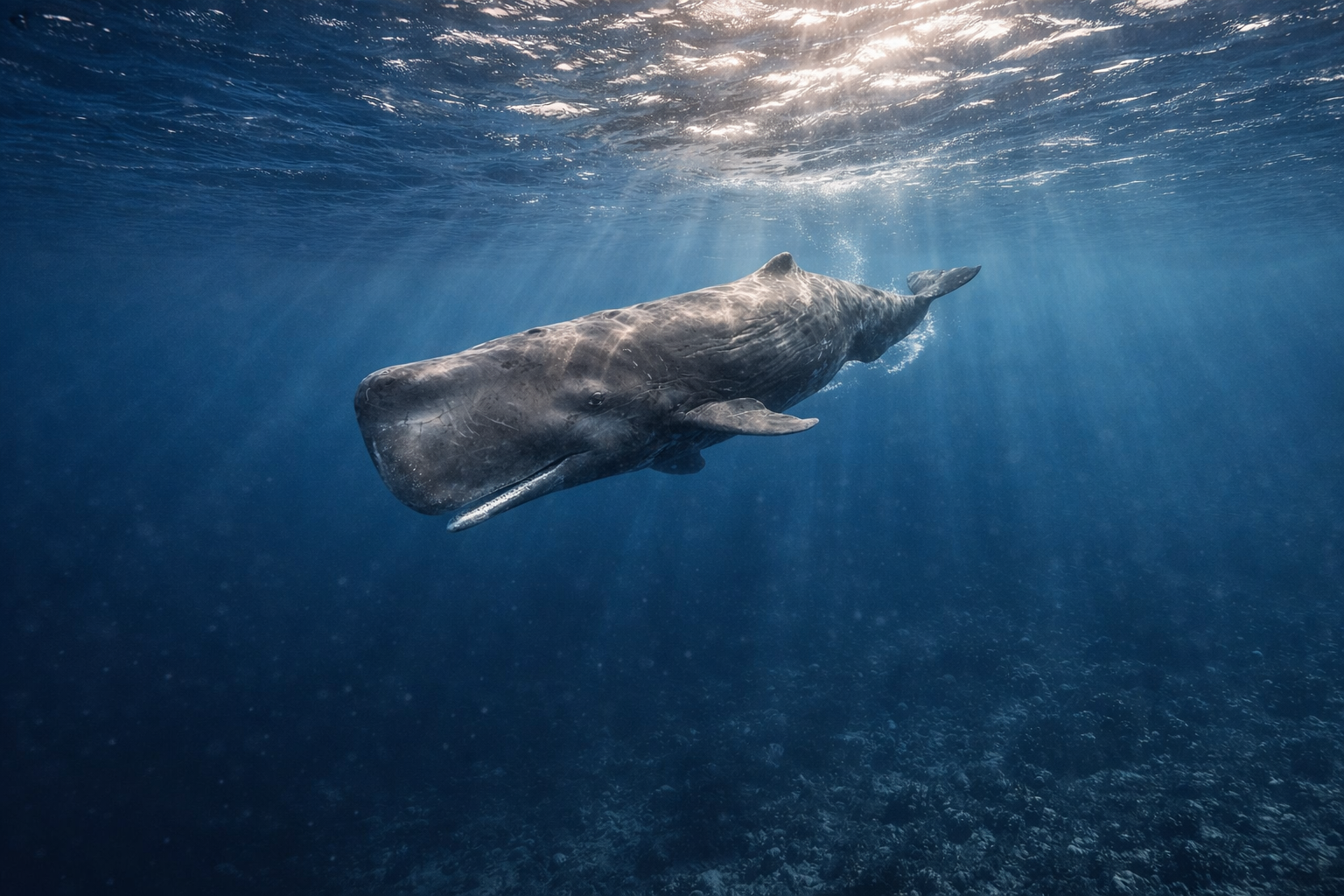
About Sperm Whale
The largest toothed predator on Earth, famous for deep dives exceeding 2,000 meters. Resident populations thrive in the deep waters around the Azores.
Quick Facts
- Habitat: The sperm whale, *Physeter macrocephalus*, is a truly **cosmopolitan species**, inhabiting all deep oceans from the equator to the polar regions. They are primarily found in **deep offshore waters**, typically beyond the continental shelf, where they can dive to impressive depths in pursuit of prey. While they are pelagic, certain areas are known for more consistent sightings due to favorable oceanographic conditions or prey availability. Notable locations include the waters around the **Azores**, where the deep Mid-Atlantic Ridge provides ideal habitat, and the **Dominica** region of the Caribbean Sea, characterized by deep trenches close to shore. Other significant areas include the **Canary Islands**, the **Galapagos Islands**, various parts of the **Pacific Ocean** near oceanic islands or seamounts, and even parts of the Mediterranean Sea. They are generally less common in coastal areas or shallow shelves. Sperm whales often aggregate in areas with strong upwellings or submarine canyons that concentrate their prey. While they are not known for extensive seasonal migrations like some baleen whales, their presence in particular areas can be influenced by the **seasonal availability of cephalopod prey** and reproductive cycles, with females and juveniles often found in warmer, lower latitudes, and males undertaking longer migrations to higher latitudes.
- Diet: Sperm whales are **apex predators** with a highly specialized diet, primarily consisting of **cephalopods**, particularly large and deep-dwelling squid. Their favored prey includes **giant and colossal squid**, although they also consume a variety of other squid species, octopuses, and occasionally deep-sea fish. Their hunting strategy involves **deep dives** to depths often exceeding 1,000 meters, where they locate prey using **powerful echolocation**. The unique structure of their head, containing the spermaceti organ, plays a crucial role in amplifying and focusing sound waves for effective sonar capabilities in the dark abyssal depths. When a prey item is located, the whale uses its large, conical teeth, primarily in the lower jaw, to **grasp and secure** the slippery creatures. Evidence suggests that sperm whales may also employ a **"carousel feeding" technique**, circling schools of squid to disorient them. Their impressive diving physiology allows them to hold their breath for extended periods, sometimes over an hour, enabling them to pursue prey in the deep ocean, far beyond a diver's reach. The sheer size and strength of a sperm whale are essential for subduing large and often formidable prey like the giant squid.
- Best season: Encountering sperm whales as a diver is an **extraordinary and rare privilege**, usually requiring specific permits for **in-water encounters**. The **Azores** is one of the most reliable locations, with the **summer months** from **June to September** being peak season for sightings, as females and calves are often present, and deep-sea conditions are calmer for boat excursions. **Dominica** offers opportunities year-round, but the **calmer seas** outside of hurricane season, typically from **November to May**, are more conducive to seeking them out. During these months, the chances of encountering groups of foraging whales are higher due to favorable ocean currents and abundant prey. In the **Canary Islands**, sightings are possible throughout the year, but the **spring and summer** months, particularly **April to October**, often provide the best conditions for boat-based observation. While males may travel to higher latitudes during summer, females and calves tend to remain in warmer waters year-round. These periods generally align with warmer water temperatures and **more stable weather conditions**, making boat-based expeditions and potential in-water observations (where permitted) safer and more rewarding. However, due to their deep-diving nature and vast range, **predicting encounters remains challenging**, making it a truly special event whenever it occurs.
Fun Facts
Sperm whales can dive to over 2,000 metres and hold their breath for 90 minutes,Their clicks at 230 decibels are the loudest sound produced by any animal,The spermaceti organ was once harvested for lamp oil,They sleep vertically, bobbing at the surface in groups
Diving Tips
Encountering a sperm whale while diving is an **extremely rare and unique experience**, as these animals are predominantly found in **deep, offshore waters** well beyond typical recreational diving depths. Most encounters occur during **boat-based expeditions**, often with specific permits for **in-water observation**, such as those in the Azores or Dominica. If you are fortunate enough to participate in a permitted in-water experience, always adhere strictly to the **guidelines of your experienced guide and permit restrictions**. Maintain **calm, slow movements** and avoid sudden actions that could startle the animal. Keep a **respectful distance**, typically mandated by regulations, and **never attempt to touch or chase** a whale. Approaching too closely or aggressively can be considered harassment and can lead to immediate termination of the encounter and legal repercussions. Listen for their **distinctive clicking sounds** underwater, which are used for echolocation; these can sometimes be heard at the surface or from a distance, indicating their presence. Spotting cues during boat trips often involve looking for their **characteristic bushy, forward-facing blow**, which is angled due to the position of their blowhole. Always prioritize the **welfare of the whale** and the **safety of all participants**. Remember that encounters are on the whale's terms, and if it chooses to leave, allow it to do so undisturbed. **Responsible whale watching operators** will emphasize minimal disturbance and contribute to research and conservation efforts. Follow all **local regulations and international guidelines** regarding marine mammel interaction. Respect for these magnificent creatures is paramount, ensuring these precious encounters remain a positive experience for both divers and whales.